A courtier who became king
Ay, Kheperkheperure in his throne titulary, succeeded Tutankhamun around 1323 BC. UCL Digital Egypt places his reign until about 1319. He belongs to the last rulers of the 18th Dynasty, but his career before his accession unfolded in the circle of the Amarna court. The titles and monuments attributed to him show an elite rise rather than a simple succession from father to son. His precise family ties with the other figures of the period are debated. The brevity of his reign and the later treatment of his memory make his record fragmentary. He nevertheless remains an essential actor for understanding the transition between Tutankhamun’s restoration and the seizure of power by Horemheb. In the chronology of Ian Shaw (Oxford, 2000), his reign falls c. 1327–1323 BC.
From the Amarna Period to the return of Amun
Monuments at Amarna show Ay among the leading figures of the reign of Akhenaten. He was linked to a circle that had carried the cult of the Aten, then to the court of Tutankhamun, which returned to the traditional sanctuaries. This continuity of personnel is a key to understanding the period: the religious changes did not replace all the officials overnight. Ay’s titles indicate a high position, but they do not allow every decision taken in the young king’s name to be attributed to him. The stories that make him a lone manipulator go beyond the evidence. His tombs and inscriptions, and those of his contemporaries, must be compared to follow a career that spanned several orientations of the monarchy.
The funeral of Tutankhamun
A famous scene in tomb KV62 shows Ay performing a rite before the mummy of Tutankhamun. It associates the successor with the funerary cult of the dead king and contributes to the legitimation of the new reign. The image is a ritual act represented in a funerary context, not a photograph of a ceremony that we could recount minute by minute. Its location in the tomb and Ay’s titulary are nevertheless direct evidence of his role in the succession. The objects and the excavation archives of the Griffith Institute allow the scene to be studied as a whole, with the other walls and the contents of KV62. The transition thus appears through contemporary evidence of rare visual force.
A kingship of limited duration
Ay’s reign was short. The inscriptions bearing his name are fewer than those of Horemheb or of the following Ramesside kings. A relief in the Petrie Museum and other objects nevertheless show that his power was asserted in the usual forms of the titulary. Some monuments were taken over from predecessors, and others were in turn appropriated by his successors. This chain of reuse calls for careful reading: a name carved today does not guarantee that the whole monument was conceived under the same king. Political brevity is not an absence of history. On the contrary, it concentrates questions of legitimacy, burial and the transmission of institutions.
The mortuary temple and the tomb
Ay began a mortuary temple at Thebes, which Horemheb later appropriated. His burial is associated with tomb WV23 in the West Valley, an annexe of the Valley of the Kings. These places show that the ruler placed himself in the continuity of Theban funerary practice, despite a short reign. Destruction and alterations to the decoration explain the complex state of the evidence. The original architectural project, the inscriptions altered under Horemheb and the modern discoveries must be distinguished. A temple appropriated by a successor does not mean that Ay’s memory was entirely erased; his tomb and some reliefs preserve part of his titulary. Archaeology recovers these successive layers.
Horemheb and the rewriting of the succession
Horemheb, a general under Tutankhamun, succeeded Ay. His reign developed a policy of restoration and a new way of telling the end of the 18th Dynasty. Later lists omitted several rulers associated with Amarna. In this context, Ay became less visible than he had been in his lifetime. Each omission is not, however, proof of a specific personal condemnation. Royal memory served to construct a legitimate continuity for the new holders of power. The reinscribed monuments show the operation in stone; they do not fully explain individual intentions. Comparing contemporary inscriptions with later lists is therefore fundamental.
A transition that deserves attention
Ay links two courts often described as opposites: that of Akhenaten and that of the restoration. His career shows the survival of the elites, his scene in KV62 documents the transmission of power, and his monuments reveal the competition over memory with Horemheb. The reign remains short and the reasons for his accession are not fully known. This uncertainty should not be filled with intrigues. By starting from the objects, the titles and the history of the buildings, a real ruler and a decisive sequence can be described. The end of the 18th Dynasty then appears as a process of reorganisation, rather than a series of absolute breaks.
Main sources
- UCL Digital Egypt, Ay and his attestations
- UCL Digital Egypt, Horemheb and the succession
- Griffith Institute, archives of the tomb of Tutankhamun
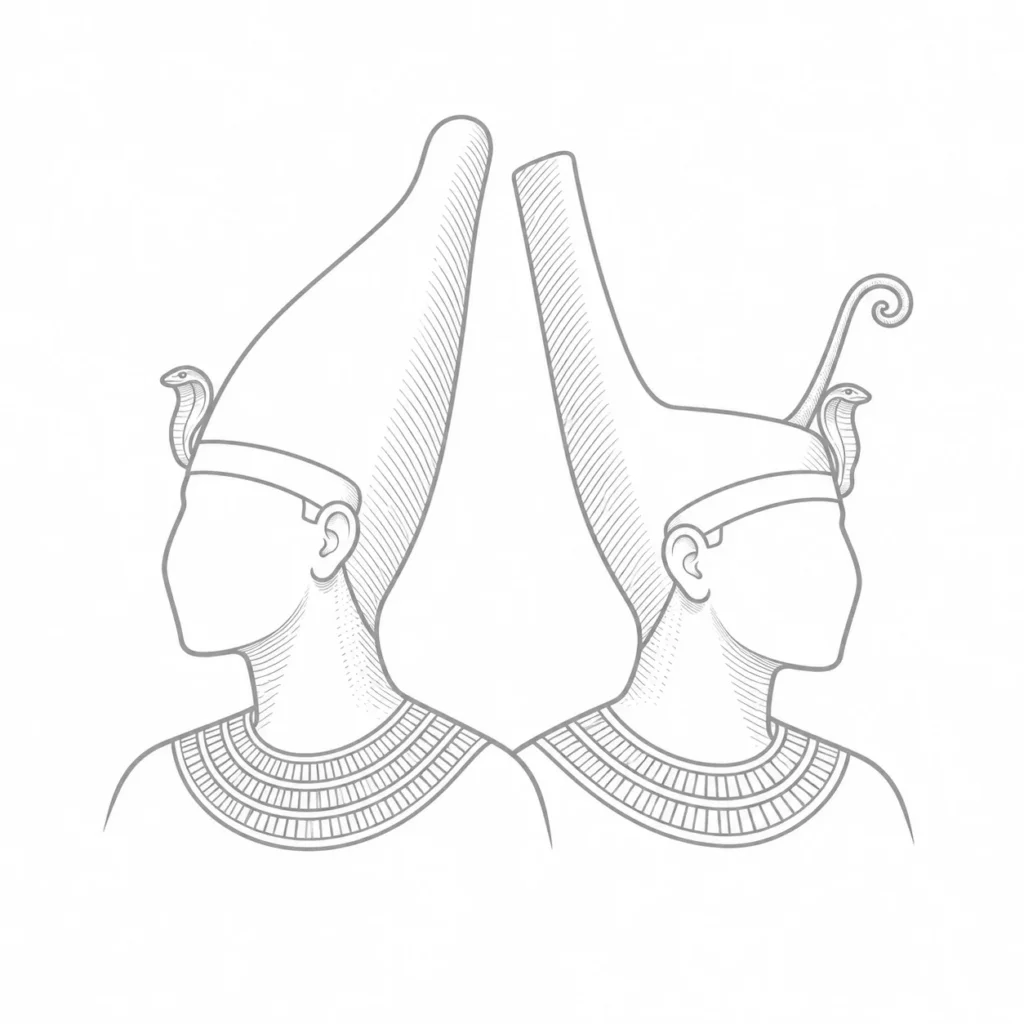
- Crowns drawn from the statue of Senusret I and the relief of Ahmose, Metropolitan Museum of Art.
Reference works
- Ian Shaw (ed.), The Oxford History of Ancient Egypt, Oxford, Oxford University Press, 2000, chronology pp. 479–483
- Aidan Dodson and Dyan Hilton, The Complete Royal Families of Ancient Egypt, London, Thames & Hudson, 2004