A ruler of Avaris
Apophis (Egyptian Apep) is a Hyksos king of the 15th Dynasty. His throne name, Aauserre, appears on seals and objects. The Metropolitan Museum of Art places his reign approximately between 1581 and 1541 BC, but these limits depend on the chronology adopted. Apophis ruled from Avaris, in the eastern Delta, while the Theban rulers controlled the south. His history is known both from objects bearing his name and from the texts produced during the conflict with Thebes. These two families of sources must be distinguished: the former confirm the exercise of kingship, the latter construct the narrative of a political and military rivalry.
The royal name on everyday objects
Scarabs and a scarab ring bearing the name of Apophis are kept in the Metropolitan Museum. Their cartouches show that the ruler presented himself in the pharaonic vocabulary. These small objects could circulate and serve purposes of authentication, ornament or prestige. Each one does not indicate a seat of government. Their documentary strength lies in proving the repeated use of the royal names and in showing their material variants. Reading them alongside the impressions discovered in the Delta helps to place the court of Avaris within an administrative culture. They are also a reminder that the Hyksos period produced its own evidence, and not only adversaries to be fought.
Avaris and the society of the Delta
The excavations at Tell el-Dab’a, ancient Avaris, reveal a complex town, with residential, palatial and cult spaces. Not all the archaeological levels correspond to the reign of Apophis; they nevertheless shed light on the setting in which Hyksos kingship had developed. The material traditions of the eastern Delta combine Egyptian practices with links to the Levant. Speaking of a simple foreign occupation would flatten this long urban history. The monuments and objects of Apophis must be integrated into this context. The court ruled over diverse populations, used Egyptian signs of sovereignty and took part in networks that extended beyond the borders of the valley.
The stelae of Kamose
The main narrative of the confrontation with Apophis comes from the stelae of Kamose, ruler of Thebes. They present the Theban military initiative and denounce the presence of a Hyksos power in the north. The second stela mentions a message from Apophis to the ruler of Kush, intercepted by Kamose. This account is essential for understanding the geopolitics of the end of the period, but it also serves to celebrate the Theban king’s victory. The triumphal phrasing should not be taken as an exhaustive record of the operations. It shows what Thebes wished to make known about its adversary. The voice of Apophis himself is accessible to us mainly through his titulary and his objects.
A reign long enough to leave traces
The dates attributed to Apophis suggest a long reign by the standards of many rulers of the Second Intermediate Period. The inscribed objects and certain dated documents support the idea of a lasting court, even if the exact number of years varies between readings. A long reign allows diplomatic contacts, changes of entourage and developments in the capital, but each of these aspects requires separate evidence. Archaeologists date objects by their inscriptions, context and style; historians compare these data with the king lists and the Theban accounts. This approach avoids projecting onto the whole 15th Dynasty the events of its last years.
From Kamose to Ahmose
The war waged by Kamose foreshadows the campaigns of Ahmose I, which finally put an end to Hyksos power at Avaris. Not all the episodes of the reconquest can be attributed to Apophis, however. The handover between the Hyksos rulers is poorly documented, and later Egyptian accounts simplify the sequence to highlight the reunification. The name of Apophis remains central because Kamose designates him as his adversary and because several objects confirm his historical reality. Following him to the end of his reign requires separating attested facts, relative chronology and reconstruction. This caution is particularly important when recounting a war seen almost exclusively from the victor’s side.
A history with several voices
Apophis is a major figure because he embodies the power of Avaris at the moment when Thebes undertook to confront it. The scarabs, the ring, the remains in the Delta and the Theban stelae offer different viewpoints on his time. The balance of power can be explained without repeating Kamose’s propaganda word for word or erasing Hyksos political culture. The dates proposed by museums also have their value and their limits. The king’s history links the exchanges of the Delta, the competition between courts and the formation of the New Kingdom. Its complexity comes precisely from the confrontation between the objects he had inscribed and the texts that fought against him.
Main sources
- Metropolitan Museum of Art, scarab bearing the name of Apophis
- Metropolitan Museum of Art, ring bearing the name of Aauserre
- Austrian Academy of Sciences, Tell el-Dab’a and the temples of Avaris
- University of Chicago, presentation of the Kamose sources
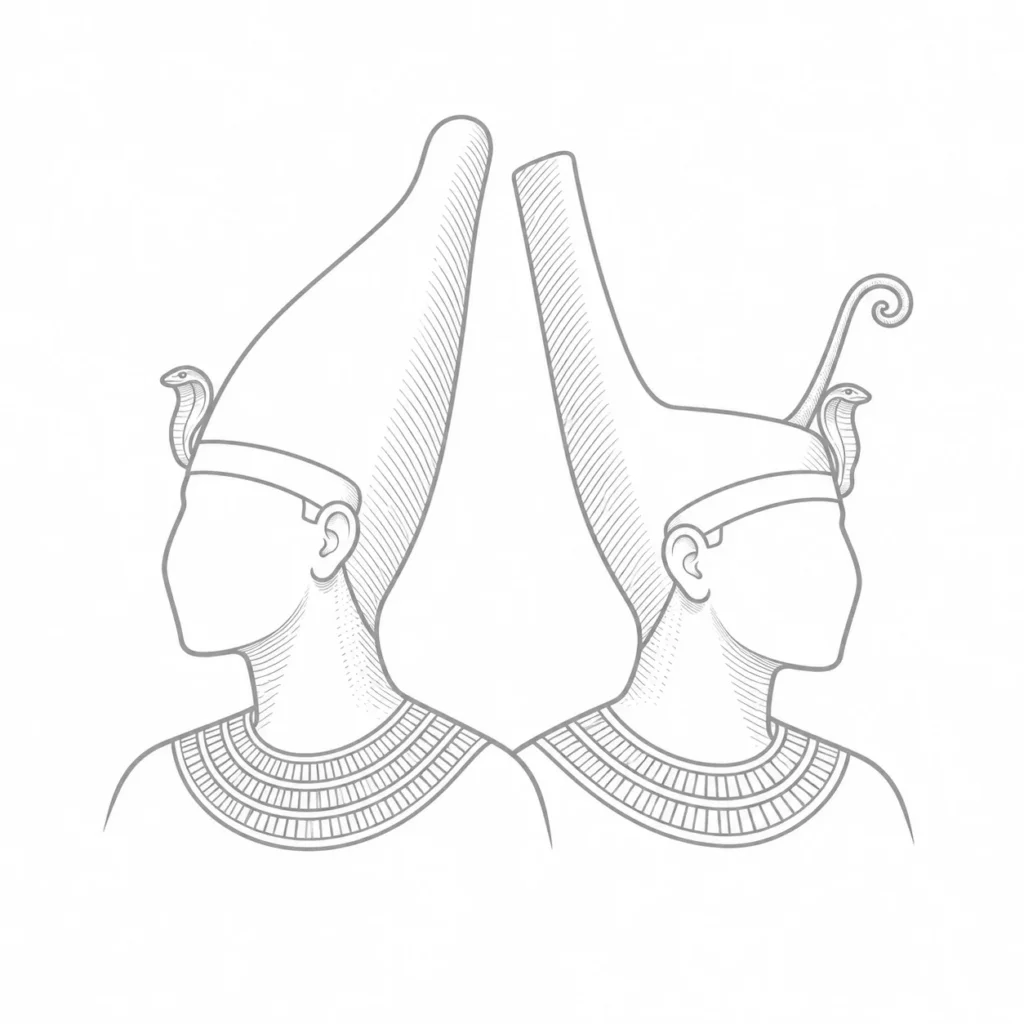
- Crowns drawn from the statue of Senusret I and the relief of Ahmose, Metropolitan Museum of Art.
Reference works
- Ian Shaw (ed.), The Oxford History of Ancient Egypt, Oxford, Oxford University Press, 2000, chronology pp. 479–483
- Aidan Dodson and Dyan Hilton, The Complete Royal Families of Ancient Egypt, London, Thames & Hudson, 2004