In brief
Dendera, Egyptian Iunet, Tentyris to the Greeks, lies in Upper Egypt, in the Qena region. Its great temple of Hathor was begun in July 54 BC, under Ptolemy XII, and is among the last great sanctuaries built in the pharaonic tradition. The work continued under Cleopatra VII and then under the Roman emperors: from Octavian to Marcus Aurelius, almost all of them left their cartouche on its walls. The town, capital of the 6th nome of Upper Egypt in the Ptolemaic period, also bore the name ‘Heliopolis of the Goddess’.
What you discover
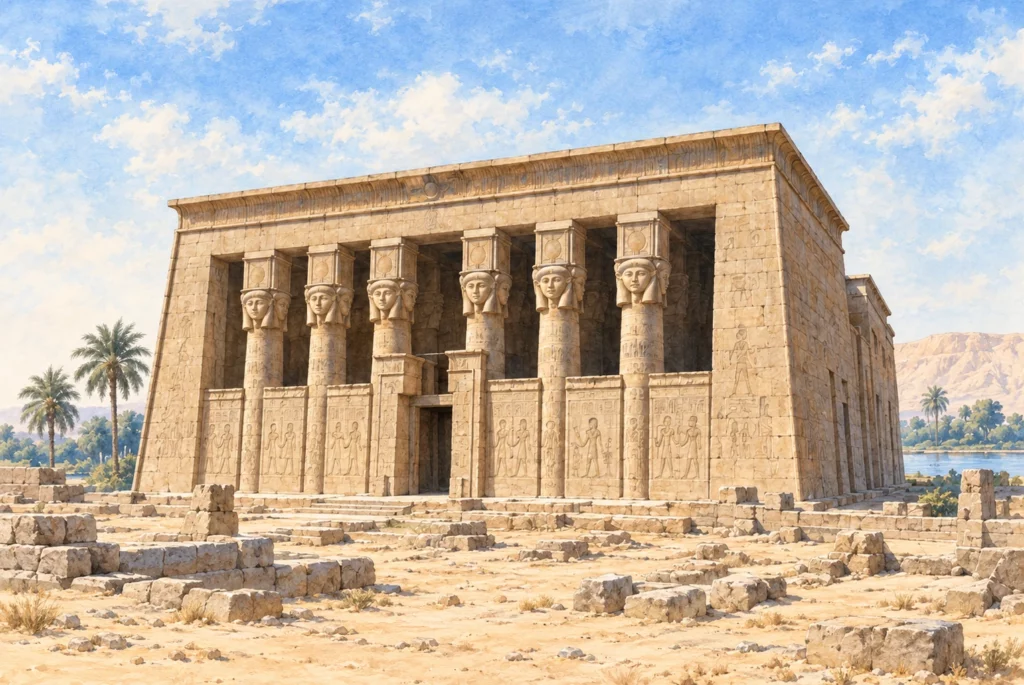
The sacred domain is entered through a monumental gateway of the Roman period, set in a mudbrick enclosure wall attributed to Domitian. In the centre stands the temple, whose naos and pronaos are almost intact, roof included. The columns of the pronaos, twenty-four in all, bear Hathor capitals: the face of a young woman with cow’s ears, crowned by a façade in the shape of a sistrum, the musical instrument associated with the goddess. This hall was decorated under Tiberius, around AD 34. Beyond it follow more than fifty rooms spread over several levels: dark rooms devoted to the cult and to festivals, crypts, staircases built into the masonry and chapels on the roof.
Around the temple, the enclosure brings together a sacred lake, two mammisi, one Ptolemaic and the other Roman, and the remains of a basilican church, dated on first analysis to the 6th century.
What to look at
The ceiling of the pronaos is worth looking up at: the sky goddess Nut swallows the sun in the evening and gives birth to it again in the morning. On the staircases, the walls show the procession that carried the statue of Hathor up to the roof for the New Year festival, the most important of the year, when a rite of ‘union with the disc’ of the sun took place in a kiosk on the terrace.
On this terrace, two groups of chapels are dedicated to Osiris. The ceiling of the eastern chapel bore the famous zodiac, a sandstone relief about 2.5 metres square in which the vault of heaven, with its constellations and decans, is held up by four female figures with raised arms. Removed in 1821 and bought by Louis XVIII in 1822, the original is in the Louvre; a copy has taken its place. At the back of the temple, on the outer wall, a large relief shows Cleopatra VII with Caesarion, her son by Julius Caesar. Finally, in the chapel of the goddess, at the rear of the sanctuary, appears the cartouche of Pepi I: the temple’s texts thus claim a link with the Old Kingdom.
Its history
The visible temple is only the last of a long series. Test pits have revealed occupation from the time of Naqada II (3400–3200 BC), and the town was already a regional capital under Cheops (Khufu), in the 4th Dynasty. The limestone walls of a chapel of Mentuhotep II, reworked by Merenptah, are displayed in the Egyptian Museum in Cairo. Each year, during the festival of the ‘Beautiful Reunion’, the statue of Hathor travelled to Edfu to join Horus there.
The programme was never completed: the pylon and the court that were to precede the pronaos remained at foundation level. For a long time, excavation was confined to the necropolis, with William Flinders Petrie in 1898 and then Clarence Stanley Fisher from 1915 to 1918, while the Institut français d’archéologie orientale (IFAO, French Institute of Oriental Archaeology) published the inscriptions, from Émile Chassinat to Sylvie Cauville. Many questions remain open: a second sacred domain, more than 400 metres to the west and probably dedicated to Horus of Edfu, has never been excavated, and the study of the residential quarters began only recently.
Sources
Consulted on 30 September 2026: Dendara, architecture et archéologie d’un sanctuaire de Haute-Égypte, Institut français d’archéologie orientale (in French); Temples pharaoniques de Haute-Égypte des périodes ptolémaïque et romaine, Tentative List, UNESCO (in French); Zodiac of Dendera (E 13482), Musée du Louvre.