In brief
The tomb of Mehu, what the Egyptians called a ‘house of eternity’, belongs to Saqqara and to the 6th Dynasty, but not to the excavations of Vassil Dobrev. Discovered in 1940 by the Egyptian archaeologist Zaki Saad, it lies near the complex of Djoser. Mehu was chief justice, vizier, overseer of royal scribes and governor of Upper Egypt under Pepi I. His burial belongs to a different sector of Saqqara from the necropolis of Tabbet al-Guesh.
What you discover
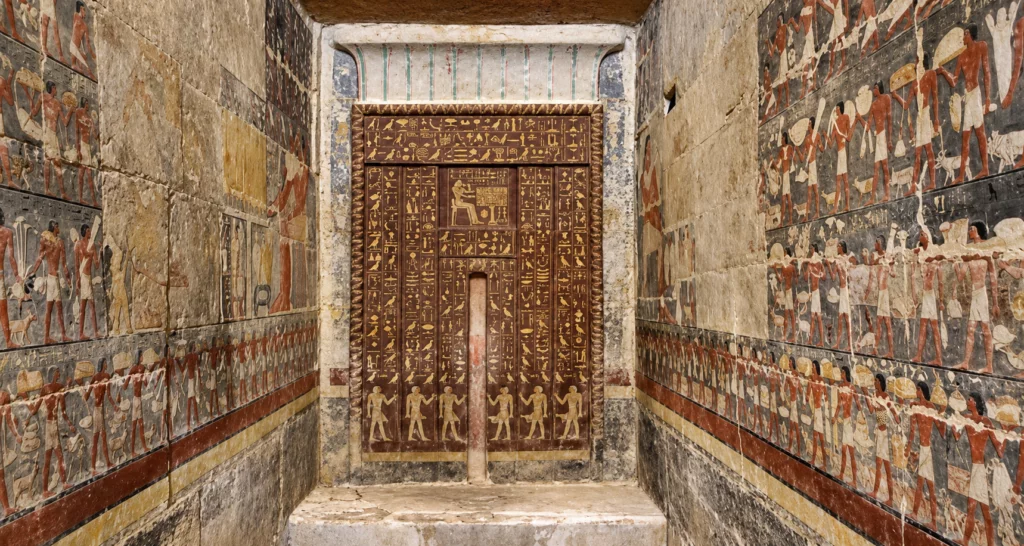
The walls preserve an exceptional repertoire of life and of the funerary cult: harvests, fishing with nets, boating, metalworking, gardens, the making of bread and beer, birds prepared for meals, offering bearers, musicians and dancers. These scenes are not a neutral report on daily life. They compose for Mehu an ordered, prosperous and eternal world, placed at the service of his survival.
A man at the top of the state
The vizier was one of the highest officials in the kingdom. The titles preserved for Mehu place him at the heart of justice, administrative writing and territorial government. This accumulation is not mere honorific decoration: it sets the deceased within the institutions that made the monarchy work. The tomb shows how political prestige could be translated into space, images and ritual abundance.
From discovery to opening to the public
Long closed to visitors, the tomb was officially inaugurated by the Egyptian Ministry of Antiquities on 8 September 2018. This opening, nearly eight decades after the discovery, made accessible decoration that until then had been known mainly to specialists. It is nevertheless a reminder that a visitable tomb remains a fragile environment: lighting, visitor flow and conservation must preserve the pigments and reliefs that give it its value.
To go further
The in-depth article examines the function of the scenes, Mehu’s titles, the place of his descendants in the monument and the status of the tomb on the Saqqara route. Mehu can be compared with the priests of Tabbet al-Guesh in terms of period and general site, but his monument belongs to a different history of excavation.