In brief
South of the complex of Djoser, on the Saqqara plateau, lies the interrupted building site of another pyramid of the 3rd Dynasty. It is attributed to King Sekhemkhet, whose royal name appears in the archaeological record. The monument was probably meant to take up the idea of a step pyramid, but its upper parts were never completed. Long hidden by sand, it was found in the 20th century by the Egyptian archaeologist Zakaria Goneim.
What you discover
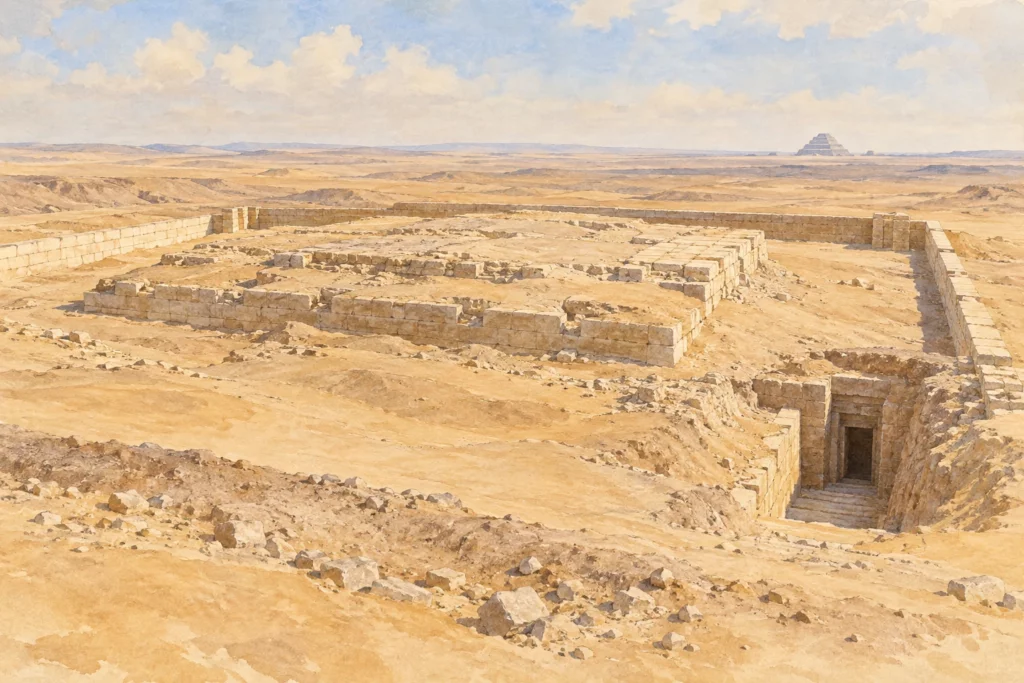
On the surface, you see mainly a low base, traces of the enclosure wall and the results of the excavations. A descending passage leads to underground spaces cut into the rock. In the main chamber, Goneim discovered a calcite sarcophagus whose closure appeared intact; when it was opened, however, it proved to be empty. This fact is famous, but on its own it does not answer the question of the king’s burial. The site also preserves other galleries and elements of the funerary project, which must be studied separately from the neighbouring pyramid of Djoser.
Its history
An unfinished building tells of construction choices: the foundations and the underground parts may be well advanced while the upper mass remains low. Sekhemkhet’s short reign is often put forward to explain the halt in the work, without providing on its own any proof of the exact circumstances. The discovery of an empty sarcophagus has prompted several hypotheses: a tomb never used, a modified deposit or an ancient intervention. None should be presented as demonstrated by the state of the lid alone.
Why this place matters
The pyramid of Sekhemkhet sheds light on the experiments in royal architecture that immediately followed Djoser’s innovation. It also shows how far a pyramid is a project that includes an enclosure, a stone building site and underground spaces. The work of Goneim, then of Jean-Philippe Lauer, made visible elements that had long been buried. The two images supplied separately are an evocation and a non-metric interpretive plate: neither shows a completed pyramid or exactly reproduces the excavated ground.