In brief
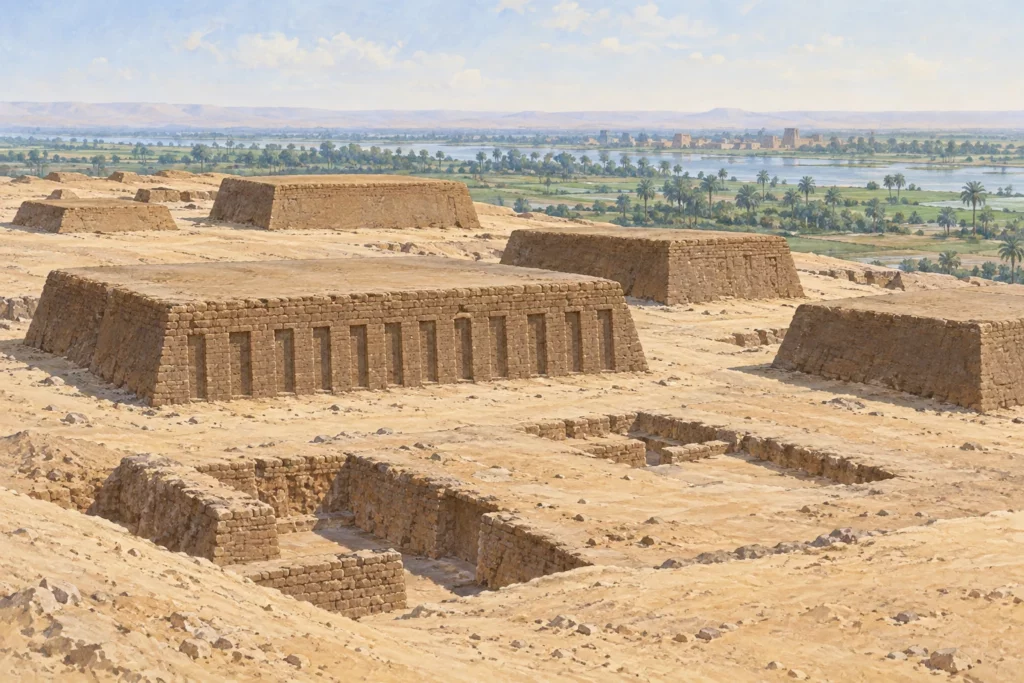
In the north of the Saqqara plateau, near ancient Memphis, large mudbrick tombs were built for the elites of the first dynasties, c. 3100–2700 BC. Their visible part took the form of a low rectangular mass: the mastaba, an Arabic word meaning ‘bench’. The burial lay beneath this structure. The cemetery opens up a period earlier than the Step Pyramid of Djoser, when funerary architecture was changing rapidly.
What you discover
Some mastabas had façades with repeated niches that evoked palace architecture. Others had simpler forms. Funerary deposits, seals, pottery and the remains of structures help to date the groups. The monuments were not all of the same size or from the same moment. Excavations and archives have documented many structures, including more modest tombs often overshadowed by the largest. The present landscape, marked by erosion and archaeological work, shows only part of their original height and decoration.
Its history
In the 20th century, the size of the great mastabas led some researchers to look in them for the tombs of the kings of the 1st Dynasty. This attribution remains debated: the royal burials of these rulers are known at Abydos, while North Saqqara appears above all as a cemetery of high-ranking figures linked to Memphis. The occupant of a mastaba cannot be identified from its size alone. The differences in plan and façade between the 1st and 2nd Dynasties also show that the ‘mastaba’ is not a fixed form.
Why this place matters
North Saqqara sheds light on the rise of an elite close to the political centre of Memphis and on its investment in monumental burials. The niched façades, the underground chambers and the goods deposited speak of status, memory and funerary practice. Recent research is revisiting the old archives to place each tomb within a dense and evolving cemetery. The images accompanying the articles are evocations: they distinguish the visible mass from the buried chamber, without reproducing a specific mastaba.