Identification and date
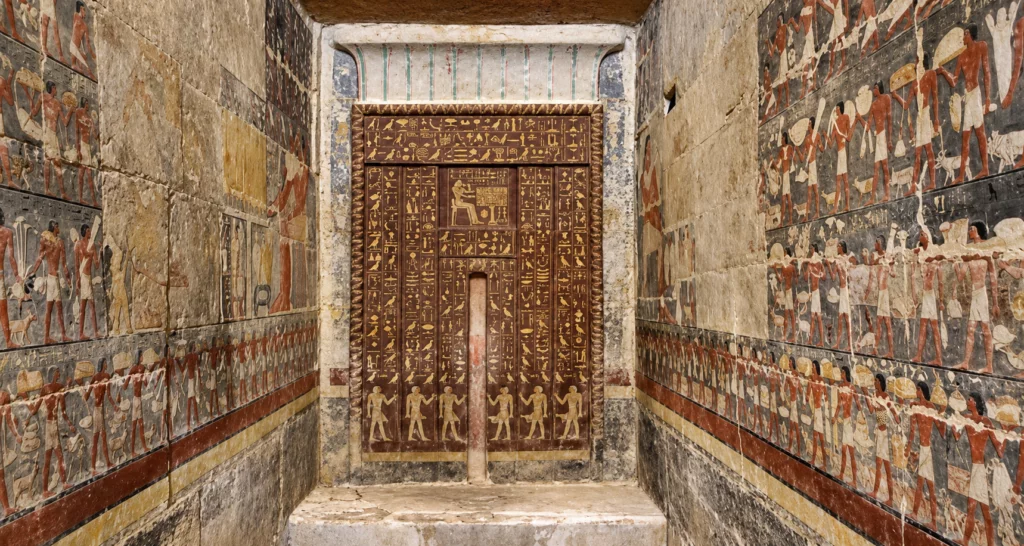
The tomb of Mehu, what the Egyptians called a ‘house of eternity’, was discovered in 1940 by Zaki Saad and belongs to a different sector of Saqqara. The Egyptian ministry dates it to the 6th Dynasty; its newsletter of September 2018 places it in the reign of Pepi I. Mehu’s titles include those of judge, vizier, overseer of royal scribes and governor of Upper Egypt. These offices place him among the principal dignitaries of the kingdom.
A family tomb
The monument was not conceived as a simple individual burial vault. The spaces and inscriptions associate Mehu with members of his line, which sets family memory in stone. In the Old Kingdom, a large tomb could thus bring together several generations while maintaining the pre-eminence of its founder. The names, titles and distribution of the scenes allow this hierarchy to be followed. Where identifications vary between modern publications, this article favours the ministry’s data and refers to the specialist studies.
The decoration as a lasting world
The scenes of harvesting, gardening, fishing, boating and craftwork do not seek to tell the story of a particular day. They select the activities that guarantee abundance and order. The bearers bring goods, the workshops produce, the musicians and dancers accompany the ceremony. By fixing these actions on the wall, the funerary programme removes them from time. The image becomes a ritual reserve, available even if the real offerings cease.
The Nile, animals and disorder mastered
The marsh scenes are among the most famous in the tomb. Fish, birds, reptiles and vegetation form a dense space in which the deceased asserts his ability to master a living and potentially dangerous environment. Picturesque interpretations, notably around the crocodiles and turtles, should remain cautious: the decoration combines observation, artistic convention and symbolic meaning. It does not offer an explicit fable for which we possess the ancient commentary.
The vizier and the state
Under Pepi I, the vizier coordinated essential areas of administration and justice. The title of overseer of royal scribes underlines the place of writing in this authority: censuses, orders, accounts and decisions circulated through trained staff. The title of governor of Upper Egypt also places Mehu within the relationship between the court and the provinces. His tomb transforms this career into an eternal identity, without giving us a continuous biography.
Conserving and opening
The tomb remained inaccessible to the public from its discovery until its inauguration in September 2018. Before the opening, the authorities had to prepare the circulation and presentation of a painted monument. The visit today offers a spatial understanding that isolated photographs cannot convey, but it calls for careful management: dust, contact, humidity and light can damage surfaces more than four millennia old.
Mehu in the Saqqara section
The tomb of Mehu combines political history, funerary art and the experience of a visit. Its comparison with Tabbet al-Guesh must nevertheless remain comparative. It shows what the burial of a very senior official of the 6th Dynasty could be, while Pepior, Sabi and Ankhti document other levels of the cult staff. The comparison enriches the portrait of Saqqara; merging them would erase the distinct histories of the excavations and their discoverers.