In brief
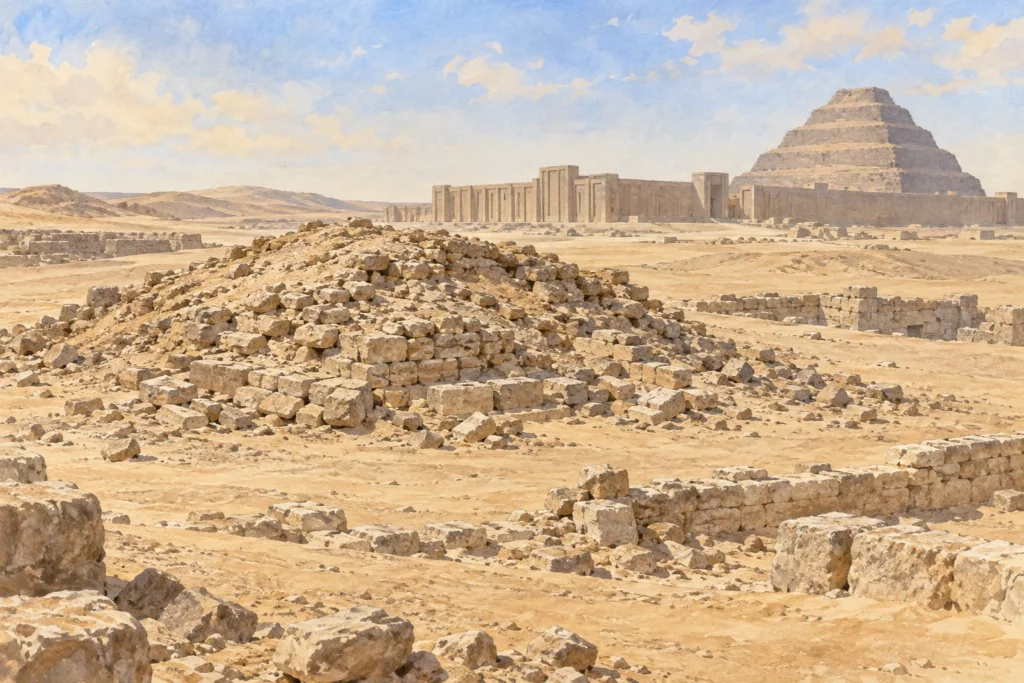
In the north of Saqqara, near the north-east corner of Djoser’s enclosure, lie the remains of the pyramid of Userkaf. This king opened the 5th Dynasty, after the great building works of the 4th Dynasty at Giza. His monument is now very ruined: it looks more like a heap of stones than the smooth silhouette of a finished pyramid. It should be looked at together with the temples and the small neighbouring pyramids.
What you discover
Visitors can make out the collapsed core of the pyramid and the traces of the funerary complex that surrounded it. The temple for the king’s cult occupied the south side, an unusual arrangement for this type of complex. A small satellite pyramid was part of the programme. Nearby stands the pyramid attributed to Queen Neferhetepes. The immense recessed enclosure and the Step Pyramid of Djoser provide an essential landmark: Userkaf placed his monument close to a very ancient royal complex. The visible walls and the volumes reconstructed in drawings must not be confused.
Its history
Userkaf had his tomb built at Saqqara, while his sun temple lay elsewhere, at Abu Ghurab. These two sites do not form a single monument. After centuries of erosion and stone robbing, the casing and much of the buildings have disappeared. In the 20th century, the work of Cecil Firth and Jean-Philippe Lauer, followed by the research of Aly El-Khouli and other Egyptologists, clarified the layout of the remains. The excavations also showed that the sector was reused in much later periods.
Why this place matters
This pyramid marks a change of place and scale after Giza, without signalling the abandonment of great royal ambitions. Its position beside Djoser raises the question of the references made to earlier kings; its temple on the south side is a reminder that pyramid plans were not immutable. The present ruin invites us to distinguish what is visible, what the excavations have established and what the reconstructions propose.