Identification and location
The tomb of Userefre, also transcribed Waser-If-Re, was announced in April 2025 at Saqqara by an Egyptian mission bringing together the Supreme Council of Antiquities and the Zahi Hawass Foundation. The Egyptian ministry presents its owner as a son of Userkaf, the first king of the 5th Dynasty. The inscriptions on the great false door and the eastern entrance bear his name, his titles and a cartouche of Neferirkare. The tomb therefore belongs to the funerary landscape of the 5th Dynasty, even if some objects found inside belong to later phases.
General presentation
The interest of this case is twofold. The pink granite false door, exceptionally tall according to the press release, gives material form to the owner’s position and to the offering arrangement. The inscriptions give political, judicial, scribal and religious titles. At the same time, the presence of displaced or later objects means that the history of the monument after its construction must be studied. This distinction is essential: an object found in the tomb was not necessarily made for Userefre or placed there at his burial.
Monuments and remains
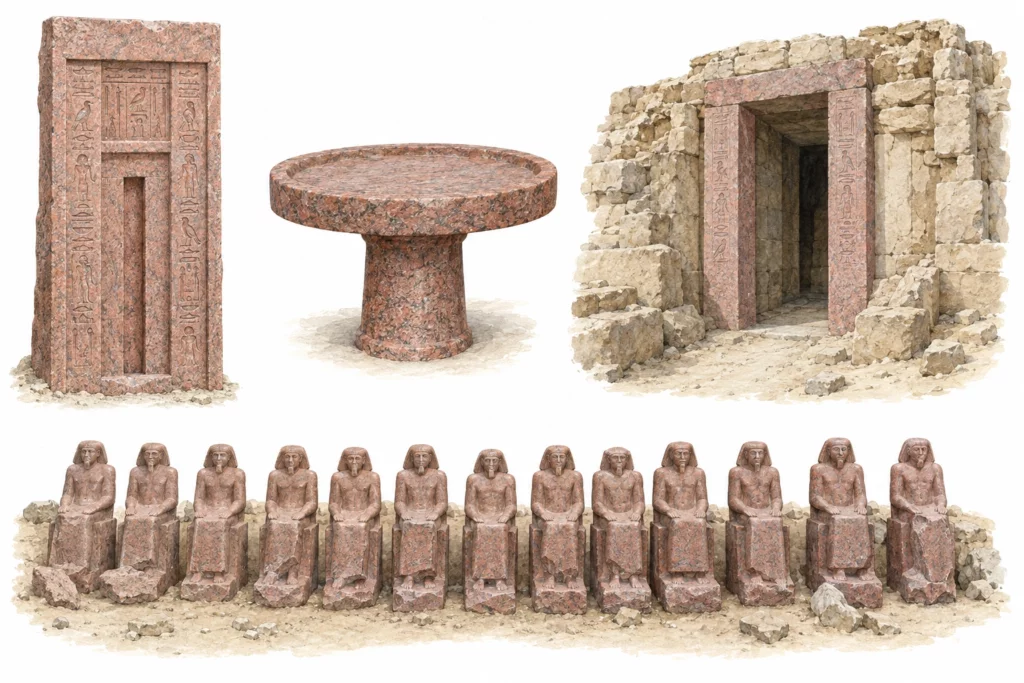
The false door measures, according to the ministry, about 4.5 by 1.15 metres. Its inscriptions identify in particular a hereditary prince, a governor of Buto and Nekheb, a royal scribe, a vizier, a judge and a lector priest. A circular red granite offering table about 92.5 centimetres in diameter bears a text relating to offerings. The eastern façade has another entrance with pink granite jambs, bearing inscriptions of the owner and a cartouche of Neferirkare. Nearby, a group of thirteen seated statues in pink granite was reported, together with other statues. The first announcements do not yet give a complete, stratigraphically detailed record of each sector and each object.
Chronology and building phases
The initial phase is attributed to the beginning of the 5th Dynasty, in the circle of Userkaf and Neferirkare. The evidence of reuse belongs to another story. The ministry reports that a statue group of Djoser, his wife and his daughters is thought to have been moved from a room near the Step Pyramid to the tomb at a late date; it presents this as the result of preliminary studies and is still looking for the reason for the move. A black granite statue may date from the 26th Dynasty, which suggests reuse. It would therefore be misleading to assign a single date to all the contents or to include the statues of Djoser without reservation in the tomb’s original programme.
History and functions
The false door and the offering table belong to the Egyptian funerary language: the deceased was to receive food and other ritual provisions through the cult maintained by the living. The carved titles place Userefre within the self-presentation of an elite close to royal power. They tell us about the offices claimed in the monument, but they do not on their own describe the day-to-day exercise of each office. The cartouche of Neferirkare helps to place some of the inscriptions in time; it does not allow every construction, sculpture or reuse to be attributed mechanically to that king.
Excavations and the history of research
The discovery was made public by the Egyptian ministry in 2025, while the mission was continuing its research. At this stage, the main accessible documentation is the institutional press release and its report in Ahram Online, dated 18 April 2025. The information on the original provenance of the statues of Djoser and on the late reuse is explicitly provisional. A future excavation publication will be valuable for presenting the plans, photographs, inscriptions, find contexts and dating criteria needed to test these first conclusions. The present documents justify an article, but not a precise architectural reconstruction of the whole tomb.
State of preservation and research questions
The monument is newly under study, and its detailed state of preservation is not described room by room in the available source. The dimensions of the false door and the presence of the table, the eastern entrance and the statue groups have been announced; the order of the deposits and the supposed displacements need confirmation.
Sources
Main sources: Egyptian Ministry of Tourism and Antiquities, ‘Discovery of the tomb of Prince Userefre, son of King Userkaf’, https://egymonuments.gov.eg/news/discovery-of-the-tomb-of-prince-userefre-son-of-king-userkaf/; Egyptian ministry, Arabic version of the same press release, https://egymonuments.gov.eg/ar/news/discovery-of-the-tomb-of-prince-userefre-son-of-king-userkaf; Nevine El-Aref, ‘Tomb of prince Waser-If-Re unearthed in Saqqara’, Ahram Online, 18 April 2025, https://english.ahram.org.eg/NewsContent/9/40/544833/Antiquities/Ancient-Egypt/Tomb-of-prince-WaserIfRe-unearthed-in-Saqqara.aspx (online sources consulted on 27 September 2026).