Identification and location
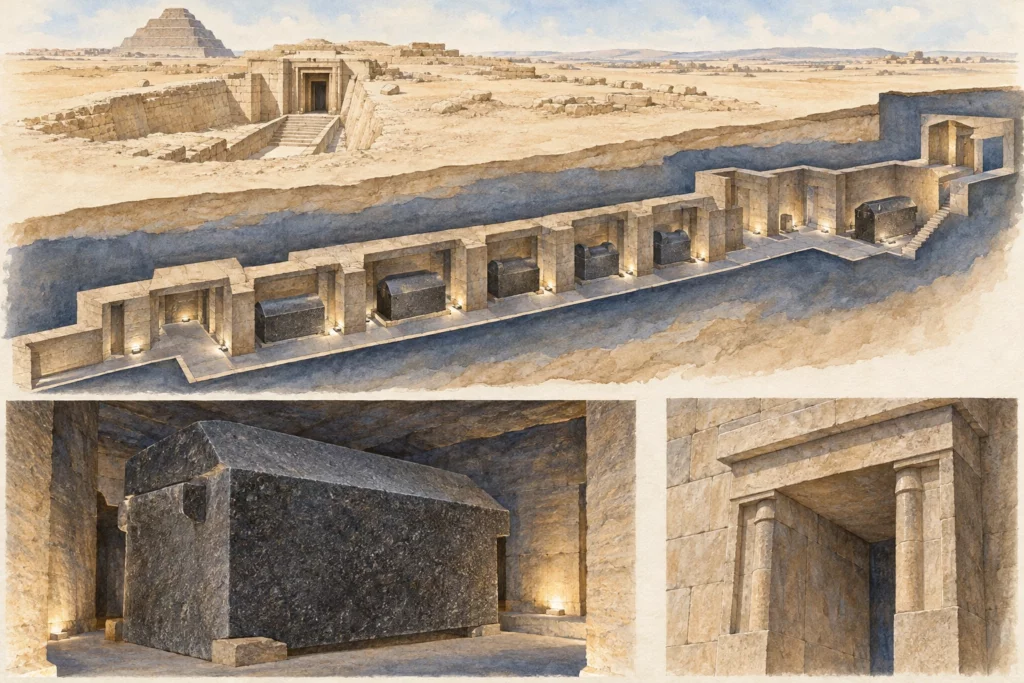
The Serapeum of Memphis is the funerary complex of the Apis bulls, located in North Saqqara, in the necropolis of the ancient capital. The Apis was recognised by characteristic black and white markings; when the animal died, the priests looked for a young bull whose coat recalled that of its predecessor. The link between the Apis and kingship is ancient: the Palermo Stone already mentions a ‘running of the Apis’ under Kings Den and Ninetjer. The Egyptian Ministry of Tourism and Antiquities presents the bull as an incarnation of Ptah, whose cult centre was Memphis.
From isolated tombs to catacombs
The earliest evidence of posthumous rites goes back to the end of the 18th Dynasty; the ministry dates the beginning of the site’s use to Amenhotep III. At that time, each bull received its own burial, made up of a chapel on the surface and an underground chamber. Under Ramses II, these tombs were replaced by a series of catacombs in the same sector, collectively known as the Serapeum. Two of the king’s sons, Khaemwaset and Merenptah, princes and high priests of Ptah, made offerings of jewellery and shabtis there. The galleries called the ‘Lesser Vaults’ were still in use at the beginning of the 26th Dynasty: a stele in the Louvre (N 403), found on 22 February 1852, records there the death of an Apis in year 20 of Psamtik I and its burial in year 21. The ‘Greater Vaults’ were in use in the Ptolemaic period, and the burials ceased under Augustus.
The treatment of the bull and the grave goods
The remains of the bulls of the 18th and 19th Dynasties take the form of broken bones, bound together with resin and linen; the later animals were embalmed in the conventional way. A papyrus of the late Ptolemaic period describes the sequence of the funeral: ritual washing, embalming, bandaging, placing in the coffin and ceremonies. In the Roman period, the animal’s lifespan may have been limited to twenty-five years, with no evidence of such a rule earlier. The site has yielded abundant material: dated votive stelae and statues. Among them is a painted limestone Apis of the reign of Nectanebo I (Louvre, N 390), discovered in a chapel beside the avenue that linked two temples. The jambs of the door of the Greater Vaults were covered, under Ptolemy VI, with Demotic graffiti naming the staff of Apis-Osiris.
Mariette and the discovery of 1850
Auguste Mariette, an employee of the Louvre, had obtained, thanks to Charles Lenormant and the Académie des inscriptions et belles-lettres, a mission to collect Coptic, Ethiopic and Syriac manuscripts. Landing at Alexandria on 2 October 1850, he went to Saqqara on 27 October and saw there a limestone sphinx head emerging from the sand. Clearing the avenue led him to the Serapeum, which he excavated until 1854. Part of the finds entered the Louvre through the division of finds, from 1852. The votive stelae have been studied notably by Jean Vercoutter, in his Textes biographiques du Sérapéum de Memphis (1962).
A chronology still under discussion
The end of the site’s use is placed in the Ptolemaic period by the ministry and under Augustus by Aidan Dodson. The correspondence between each stele, each bull and each chamber remains difficult to establish, because a large part of the monuments has been moved since the 19th century and dispersed between Cairo and Paris.
Sources
Sources (consulted on 30 September 2026): Aidan Dodson, ‘Rituals Related to Animal Cults’, UCLA Encyclopedia of Egyptology, 2009; Jacques Vandier, ‘La découverte du Sérapéum et les funérailles de l’Apis d’après certaines stèles du Sérapéum’, Journal des savants, 1964 (in French); Door of the Greater Vaults of the Serapeum of Memphis (N 420), Musée du Louvre.