Identification and location
The pyramid of Teti, the first ruler of the 6th Dynasty, lies near the complex of Djoser at Saqqara. The Egyptian ministry places his reign c. 2345–2323 BC and gives an original height of 52.5 metres. The building belonged to a funerary complex with an upper temple; the valley temple has not been found. An important necropolis of officials extends nearby, including the mastabas of Mereruka and Kagemni. The name of the pyramid, Djed-sut, is attested in the documentation cited by UCL.
General presentation
The monument sets an exterior distorted by the loss of its casing against much better preserved internal chambers. Its interest lies in the continuation of the Pyramid Texts after Unas, in the organisation of the underground rooms and in the relationship with the necropolis of senior officials. The inscriptions are not the first occurrence of the corpus: they continue a practice inaugurated, among the surviving pyramids, under the last king of the 5th Dynasty. The funerary spaces must not be separated from their architectural and social context.
Monuments and remains
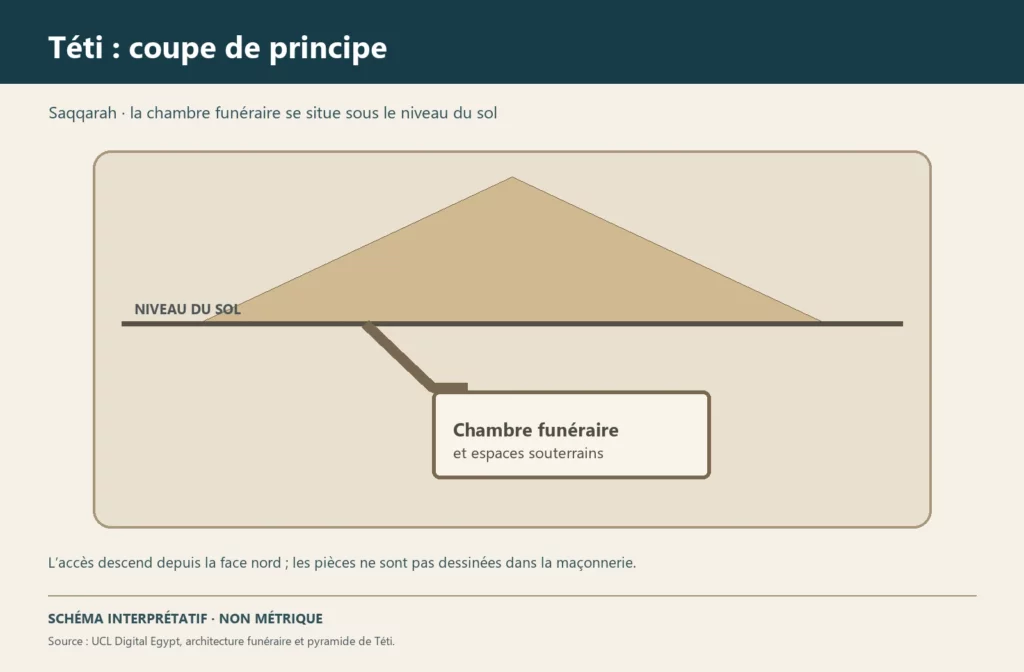
The core of the pyramid combines small blocks of local limestone with rubble fill. When the casing blocks were removed, this core settled, giving the appearance of a hill. The entrance leads by a descending passage to a horizontal corridor and then to an antechamber. Three storerooms for the funerary equipment lie on one side; they were found empty after ancient robberies. To the west, the burial chamber preserves a ceiling painted in gold on a dark blue ground, depicting a starry sky. The end of the corridor, the antechamber and the chamber bear Pyramid Texts. Fragments of the mortuary temple survive, but most of its blocks have been removed. The valley temple remains unknown on the ground: showing it on a complete plan would be a hypothesis.
Chronology and building phases
The construction belongs to the reign of Teti, at the beginning of the 6th Dynasty. The programme of texts and internal decoration does not seem to have been entirely completed, according to the Egyptian ministry’s entry. An end of the reign before completion is plausible, but this observation does not prove how the king died. The ancient removal of the casing and the robbery of the substructure are other phases in the material history of the site. The development of the officials’ mastabas in front of the pyramid belongs to the organisation of the royal necropolis and to the memory of power under and after Teti.
History and functions
The pyramid was the king’s tomb, while the temple received the offerings linked to his cult. In the chambers, the carved spells were meant to ease his passage to a transformed existence and to secure eternal provisions. The starry ceiling set the burial within a cosmic picture. The storerooms indicate that equipment accompanied the deceased, although they were found empty. The large mastabas of neighbouring officials show the pull of the royal tomb on the elite. Their function should not, however, be deduced from mere proximity: each tomb has its own programme and its own inscriptions.
Excavations and the history of research
The substructure and its texts were recorded by Egyptologists after the first modern explorations of Saqqara. A fragment of Pyramid Text from the pyramid of Teti is kept in University College London’s Petrie Museum, which makes it necessary to distinguish the original monument from the displaced object. The Egyptian ministry summarises the state of the internal parts, the temple and the officials’ necropolis. Research on the neighbouring mastabas has enriched the study of the reign, but it does not replace the evidence specific to the pyramid. Manetho’s account that Teti was murdered by guards comes from a much later tradition and has no solid archaeological confirmation.
State of preservation and research questions
The outer envelope is badly degraded, while the substructure is described by the ministry as largely intact. The texts and the ceiling require conservation measures suited to enclosed spaces. The unfinished decoration may tell us about the timetable of the building work, but it does not prove the murder related by Manetho. The fact that no valley temple has been found limits the reconstruction of the complete funerary route.
Sources
Main sources: Egyptian Ministry of Tourism and Antiquities, ‘Pyramid Complex of Teti’, https://egymonuments.gov.eg/monuments/pyramid-complex-of-teti/; University College London, Digital Egypt, ‘King Teti’, https://www.ucl.ac.uk/museums-static/digitalegypt/chronology/kingteti.html; UCL Petrie Museum, ‘A pyramid text’, https://www.ucl.ac.uk/engage/museums-collections/petrie-museum-egyptian-and-sudanese-archaeology/top-objects-petrie-museum/pyramid-text; UCL, ‘Pyramids in Egypt’, https://www.ucl.ac.uk/museums-static/digitalegypt/pyramids/owners.html (online sources consulted on 27 September 2026).