In brief
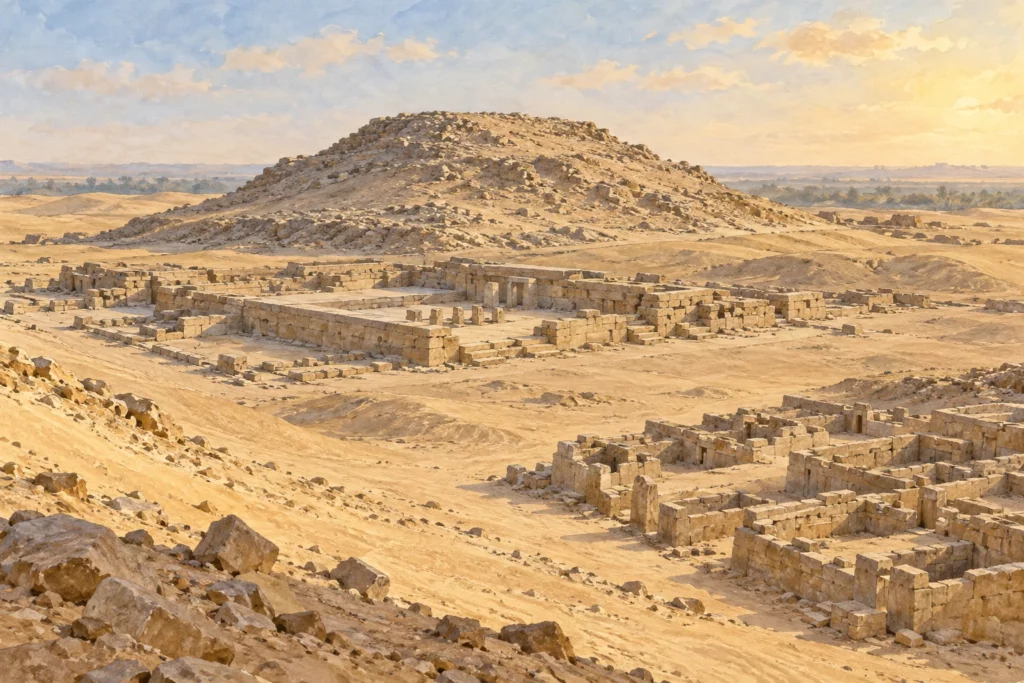
Teti, the first king of the 6th Dynasty, had his pyramid built at Saqqara c. 2345–2323 BC. From the outside it now looks like a hill of stone. Yet its underground chambers preserve Pyramid Texts and a blue ceiling scattered with golden stars. The monument shows how far the present appearance of a pyramid can differ from its internal organisation.
What you discover
The pyramid was originally about 52.5 metres high. Its facing of fine limestone was removed in antiquity; the core, made of small blocks and fill, has slumped. A descending passage leads to a horizontal corridor, then to an antechamber. Three small rooms served for depositing funerary objects. The king’s chamber lies to the west, beneath a painted sky of stars. The walls at the end of the corridor and in the chambers bear spells intended for the king’s journey after death. The remains of the mortuary temple are limited, and the valley temple has not yet been located.
Its history
The programme of inscriptions takes up the practice that appeared in the pyramid of Unas at the end of the 5th Dynasty. According to the Egyptian ministry, the planned decoration was not completed, a possible sign of a death that came before the work was finished. The priest-historian Manetho, writing much later, claimed that Teti was killed by his guards, but this story lacks independent proof. Around the pyramid, dignitaries had large mastabas built, including those of Mereruka and Kagemni. They bear witness to the place of the royal court in this necropolis.
Why this place matters
Teti helps us to read the gap between a monument stripped on the outside and a ritual space still documented inside. The texts, the starry ceiling and the storerooms speak of a conception of the tomb as a place of transformation. The necropolis of the neighbouring officials shows that the pyramid belonged to a wider social and religious whole. Archaeological observations must be distinguished from the late account of the king’s death.