Identification and location
The mastaba of Mereruka lies north of the pyramid of Teti, in the necropolis of Saqqara. Mereruka was vizier under Teti, the first ruler of the 6th Dynasty, and had married a daughter of the king. The Egyptian ministry describes a tomb of more than thirty chambers, with six chambers for his wife and five for his son Meryteti. The dating rests on the reign of Teti and the history of his court, rather than on a single secure year for all parts of the tomb.
General presentation
The importance of the site lies in the combination of a vast family programme, abundant decoration and a direct relationship with the royal necropolis. The reliefs are a source on the representation of work, animals and landscape, but they serve a funerary purpose. They are not a neutral inventory of observed activities. The office of vizier and the royal marriage explain the owner’s place in this prestigious space, without allowing an episode of his biography to be deduced from each scene.
Monuments and remains
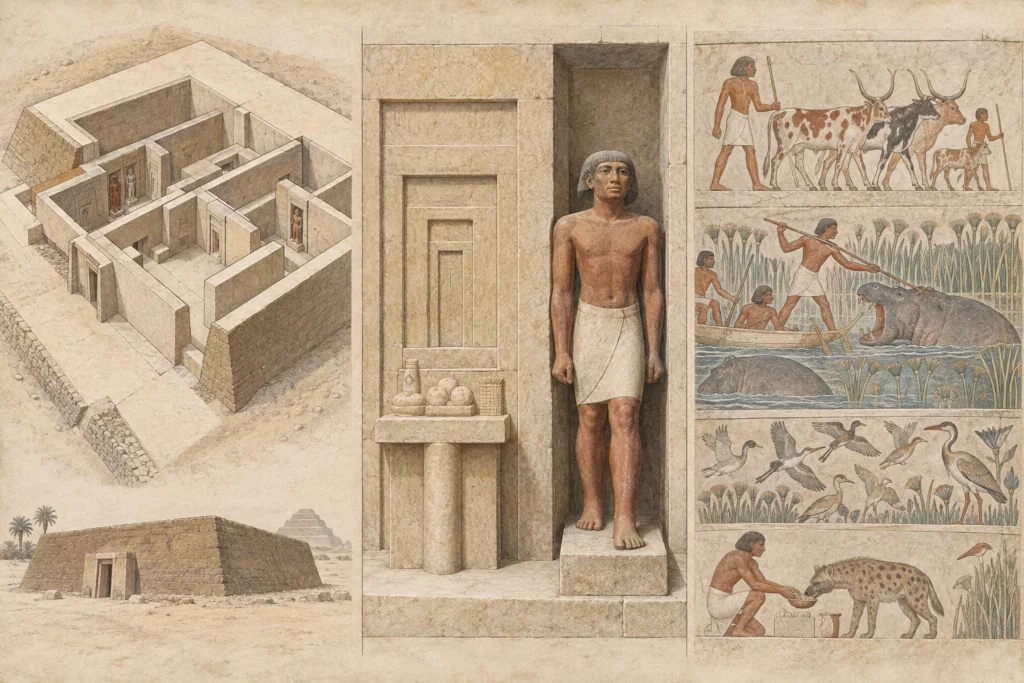
The low superstructure of the mastaba covers an arrangement of interconnected chapels and rooms. The number of chambers is exceptional for the period. The sections for the wife and son, explicitly mentioned by the ministry, must be distinguished from Mereruka’s own. The decorated spaces show herds, birds, hippopotamus-hunting scenes and the feeding of hyenas. A rare image personifies the three seasons of the Egyptian calendar. The false door is a focus of the offering arrangement; near it, a life-size statue of the deceased is shown walking. The accompanying visuals simplify this layout and do not claim to fix the exact arrangement of the chambers.
Chronology and building phases
The monument belongs to the development of the dignitaries’ necropolis around the pyramid of Teti. Its construction may have involved several campaigns of building and decoration linked to members of the family, but the summary entries consulted do not make it possible to date each room separately. The surviving reliefs show the programme planned for the chapels. Later interventions, surface losses and present conditions of access belong to another material history, not to be confused with the Old Kingdom design.
History and functions
The false door provided a ritual point of passage and of receipt of offerings; the statue gave material form to the lasting presence of the owner in the chapel. Scenes of cattle, marshes or food contributed to the idea of the abundance the deceased needed. The variety of animals, down to the hyenas being fed, enriched this visual programme. The same image may tell us about gestures known to craftsmen and express a religious ideal: these two levels of reading must be kept distinct. The family spaces suggest associated cults and memories, each with its own owner.
Excavations and the history of research
The tomb is known from field observation, its reliefs and major illustrated publications. Prentice Duell’s survey, The Mastaba of Mereruka, published in two volumes and listed by the library of the American Research Center in Egypt, is a historical record to be compared with the present state of the rooms. The Egyptian ministry’s entry provides an accessible overview of Mereruka’s identity, the members of his family and the notable motifs. The neighbouring pyramid of Teti is an archaeological context, not part of the mastaba.
State of preservation and research questions
The number of rooms and the richness of the decoration make any single plate necessarily selective. The accompanying composition juxtaposes schematic architecture, false door, statue and relief themes. It is interpretive and non-metric; it does not give the exact position of each scene and does not reproduce an excavation survey. The passages, volumes and colours of the reliefs must be checked room by room before any scientific reconstruction. The available entries do not justify a precise date for each phase of the monument.
Sources
Main sources: Egyptian Ministry of Tourism and Antiquities, ‘Tomb of Mereruka’, https://egymonuments.gov.eg/monuments/tomb-of-mereruka/; ‘Pyramid Complex of Teti’, https://egymonuments.gov.eg/monuments/pyramid-complex-of-teti/; American Research Center in Egypt, bibliographical record of Prentice Duell, The Mastaba of Mereruka, https://library.arce.org/portal/Record/4751 (online sources consulted on 27 September 2026).