Clémence Rossignol – 2014-05-30 – History, Egypt
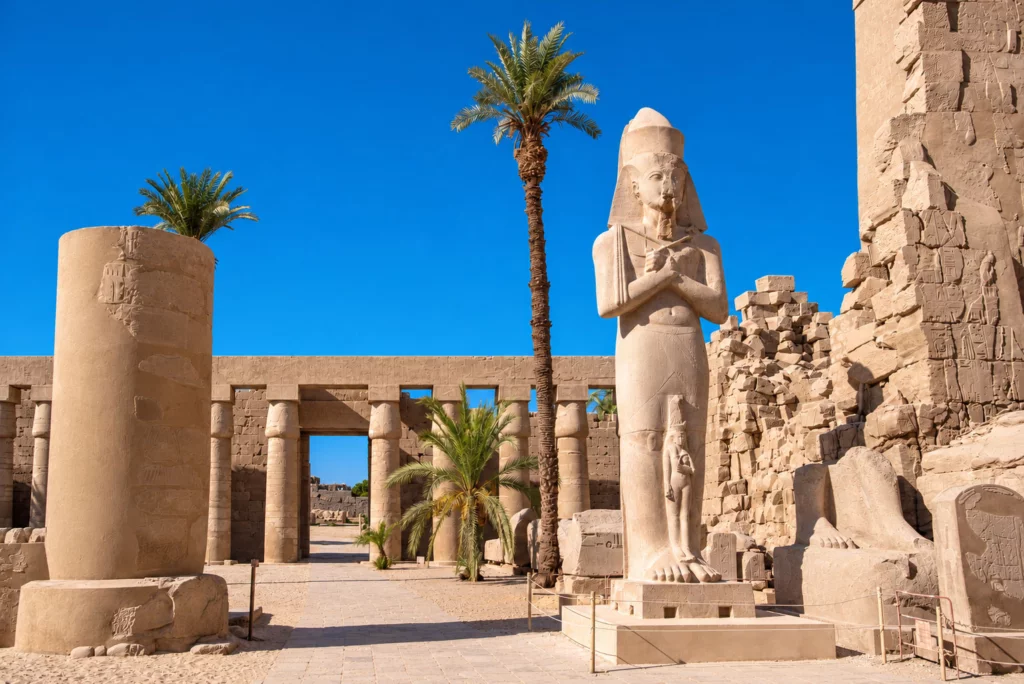
The temple of Karnak was enlarged again and again from its original sanctuary throughout the two thousand years of its history. The pharaohs did not hesitate to destroy the buildings of their predecessors in order to recover the materials they needed for their own creations.
Anecdotes and changes
The temple was enlarged again and again from its original sanctuary throughout the two thousand years of its history. The pharaohs did not hesitate to destroy the buildings of their predecessors in order to recover the materials they needed for their own creations. It was also a way of wiping out all traces of their predecessors. Ramses II, for example, did not hesitate to hammer out the cartouches of other pharaohs and have his own name carved in their place.
The temple was not built by slaves but by Egyptian citizens who were obliged, for a few weeks a year, to serve the pharaoh. The period of service was always outside the harvest seasons.
The temple of Amun at Karnak is so big that you could fit Notre-Dame de Paris and its whole neighbourhood inside it. It covers 30 hectares.
Monumental dromoi, preceded by a majestic avenue of 40 ram-headed (criosphinxes) and human-headed sphinxes, protect the entrances of the temple and link them to the banks of the river. In the past, a landing stage linked the temple to the Nile by a canal, now filled in; it was used during the Opet festival.
The walls and columns of the temple work like posters or billboards on which you can carve and show your adoration of God to the rest of the world. These drawings in the form of hieroglyphs were above all meant to be understood by all Egyptians. Indeed, only 1 or 2 % of the elite could read and write. At the time, all these drawings and carvings were painted in wonderful colours.
Only a few priests were allowed into the room where the statue of Amun stood. Every morning one of them took the statue, gave it its morning bath, then rubbed it with precious oil (perfume), and after that dressed it in the most beautiful delicate clothes; offerings, flowers and perfumed oils were left for it. Then, on a large stone table, food was set out in front of the God so that he could eat. Of course, he did not really eat, but fed on the smells, and after a while it was the priests who ate the food. Then incense was burnt, and the God was left to enjoy his day.
The site would reach its true golden age in the New Kingdom. The pharaohs would express their devotion to the main god by bringing large quantities of riches from the territories over which Egypt extended its influence. They would contribute to the embellishment of Karnak, which would become the grandest religious complex of Antiquity.
Karnak would be rediscovered by Captain Norden and the Reverend Pococke at the beginning of the 18th century, before Bonaparte’s expedition made an inventory of it.
Indeed, to make people forget the failure of the military campaign against the British, Napoleon, who had become emperor, commissioned the most illustrious scholars of his time to produce an encyclopaedia on Egypt in order to make people forget his defeat.