In brief
Karnak, called Ipet-Sut, ‘the most select of places’, by the Egyptians, is not a building constructed in a single campaign. Around the sanctuary of Amun-Ra, already important in the Middle Kingdom, the kings of the New Kingdom added pylons, courts, obelisks and halls. The Egyptian Ministry of Tourism and Antiquities points out that almost all the rulers of this period contributed to its development. What can be seen today therefore layers decisions taken over several centuries, on the east bank of Thebes, in present-day Luxor.
What you discover
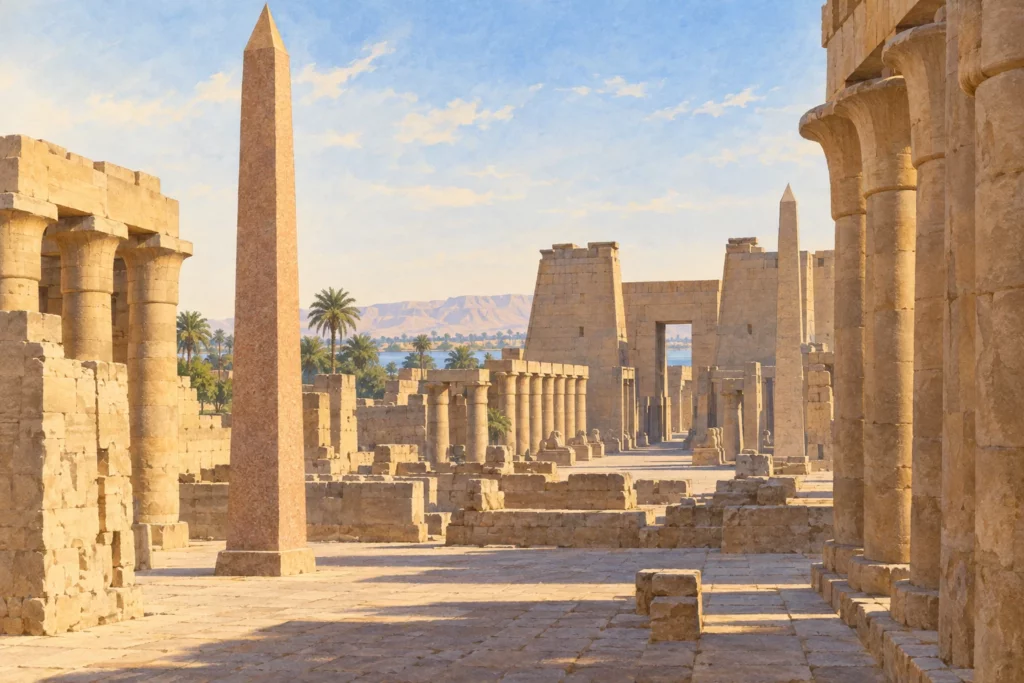
Hatshepsut had obelisks erected and took part in the extension of the temple; one of her obelisks is almost 30 metres high and weighs more than 300 tonnes. Thutmose III marked the southern axis, notably with the Seventh Pylon, whose inscriptions refer to his campaigns. These works are distinct from the great hypostyle hall, undertaken much later under Seti I and completed under Ramses II: a forest of 134 columns, about 15 metres high, except for twelve central columns that reach 21 metres. The temple was devoted to the cult of Amun-Ra and served for the processions of the Theban triad. A modern aerial view shows all the phases together, but it does not convey the experience of a visitor of a single period.
What to look at
The Seventh Pylon offers a precise detail. The Centre franco-égyptien d’étude des temples de Karnak (CFEETK, Franco-Egyptian Centre for the Study of the Temples of Karnak) describes a sandstone tower about 26 metres high, with a gateway of about 13 metres, once preceded by colossi and obelisks. The walls bear large scenes of the king smiting captives, accompanied by topographical lists. The team distinguishes two campaigns of carving: one linked to the battle of Megiddo, in year 23 of the reign, the other to the eighth campaign against Mitanni, in year 33. These scenes should therefore be seen as decoration added in two stages, not as the record of a single building project.
Its history
Royal inscriptions, masonry joints and reused blocks make it possible to attribute interventions. Since 2017, the CFEETK has been recording the blocks in place and some 200 scattered blocks from the gateway, in order to study their chronology and consider re-erecting it. A scene carved by one king may also have been restored or usurped later. Enlargement expressed royal power and religious investment. Not every wall of Karnak should, however, be attributed to Hatshepsut or Thutmose III. The earlier core, the Ramesside additions and the late campaigns must be read separately.
Why this place matters
The value of Karnak is recognised by UNESCO, which has included it since 1979 within ‘Ancient Thebes with its Necropolis’, under criteria (i), (iii) and (vi). The preserved and restored site gives access to the ancient parts, but modern works alter the appearance of some areas. For a precise chronology, the surveys of the CFEETK take precedence over an illustrative perspective.
Sources
Consulted on 30 September 2026: Karnak, Egyptian Ministry of Tourism and Antiquities; Étude épigraphique du VIIe pylône, CFEETK, CNRS (in French); Ancient Thebes with its Necropolis, UNESCO.