In brief
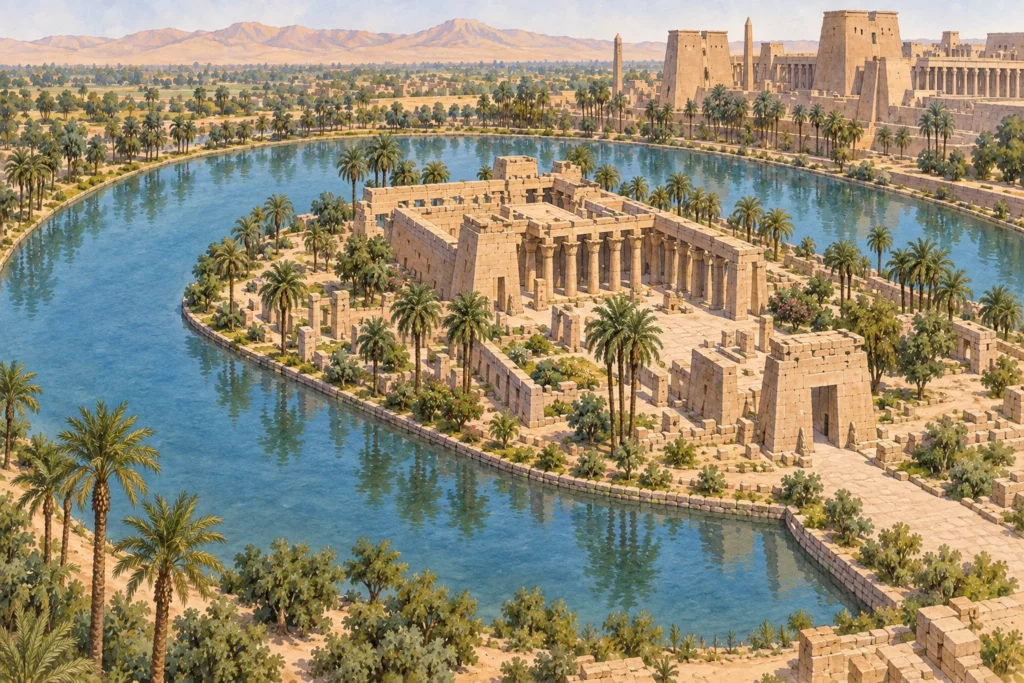
South of the great enclosure of Amun lies the domain of Mut, a major goddess of Theban theology. It is linked to the main sanctuary by a processional way. ARCE, which disseminates the work of the Brooklyn Museum mission, describes a temple of more than 20 acres (about 8 hectares) at South Karnak. The horseshoe-shaped sacred lake, the Isheru, surrounds three sides of the temple of Mut: this form is a type specific to the goddesses known as the Eye of Ra.
What you discover
The domain comprises the main temple and other buildings; its constructions and reworkings belong to various periods. Its present appearance does not correspond to a single programme of the 18th Dynasty. The oldest surviving structures go back to Hatshepsut and Thutmose III, but evidence of a Middle Kingdom building has been found beneath the later levels. In the Theban triad, Mut was particularly associated with Amun as his consort and with Khonsu as his mother. The main temple occupies the inside of the curve of the lake, and archaeologists have identified porticoes with 24 columns there.
What to look at
The first detail is the very shape of the lake: a horseshoe whose curve encloses the temple, not an ordinary rectangular basin. The second concerns the statues of Sekhmet. ARCE reports that the Brooklyn Museum expedition cleared, conserved and set on new bases many half-buried statues, to protect them from rising groundwater. Look out too for the gate of Taharqa and the gate of the Thutmosid period, two distinct landmarks discovered by the excavations, which show that the entrance to the domain was remodelled.
Its history
The Brooklyn Museum excavations, directed by Richard Fazzini, have been under way since 1976 and have revealed a complex stratigraphy. Since 2001, the Johns Hopkins University expedition has shared the site and works in particular on the temple of Ramses III and the areas south of the sacred lake; the two teams work independently but cooperate on conservation. Some monuments have been moved to the Karnak open-air museum; their modern place of storage should not be confused with their ancient position. Late phases transformed older arrangements.
Why this place matters
The relationship between water, goddess and procession sheds light on the distinctive character of the domain. It does not make it possible to reconstruct a complete calendar of ceremonies or to date the whole edge of the lake to a single period. The temple of Mut is an independent sector of Karnak, which escapes the usual image of the great temple of Amun. Excavation and consolidation work change access to the domain; a scientific plan must be consulted to assign a statue or a wall to a precise phase.
Sources
Consulted on 30 September 2026: Mut Temple, American Research Center in Egypt; Karnak, Egyptian Ministry of Tourism and Antiquities.