
Clémence Rossignol – 2014-05-30 – History, Egypt
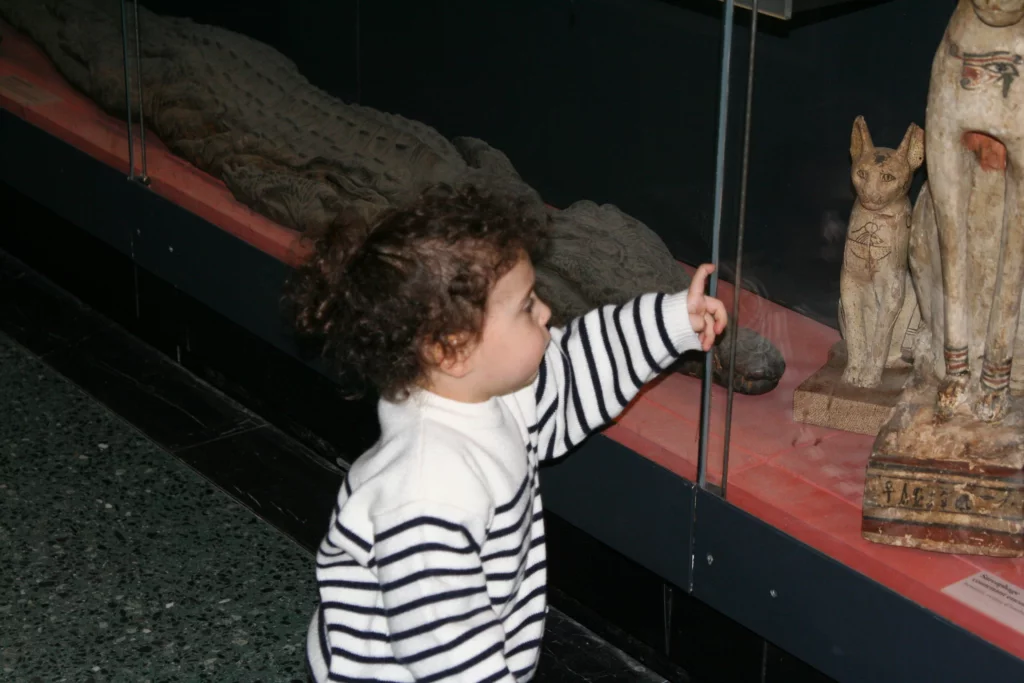
For as long as I can remember, I used to go with my father to the Musée du Louvre for his work. Every time he went, I wanted to go with him because I really liked seeing the statues of the Egyptian gods and the animal mummies (especially the cats). They were also moments I could share with him.
A presentation on the temples of Karnak
When I was asked to give this presentation, I first thought of the pyramid of Cheops (Khufu), but as I wanted to talk about the Gods and learn new things, I chose the temples of Karnak as my subject. The temple of Karnak is in fact made up of several temples joined together (including a main one). This group of temples is in Egypt, on the banks of the Nile, in the town of Karnak next to Luxor.
Temples used to be the houses of the Gods. At Karnak, the three main gods worshipped are: Montu, an ancient local war god, Amun, the main god of Thebes, and the goddess Mut, the wife of Amun.
The Karnak complex was developed for more than 2,000 years by successive pharaohs. Its construction began in the Middle Kingdom (around 2000 BC) and went on until the Roman period.
The temple of Karnak covers more than two km² and is made up of three enclosures. It is the largest religious complex of the whole of Antiquity.
The background: when, where, who, how?
The Egyptians thought that the world had begun as a primeval marsh. From this marsh the gods raised a small island. This island became Egypt.
In Egypt, the East (the rising sun) stood for the beginning of life and the West (the setting sun) stood for the end of life, so tombs were built on the West bank and temples on the East.
The first temples go back more than five thousand years BC. At first they were built of mudbrick, but the Egyptians soon realised that they had to find another way of building because the tombs of the pharaohs had to last for eternity.
When the temples of Karnak were built, Thebes was the capital of Egypt. This city is now called Luxor. It is 700 km south of the present capital, Cairo, and 300 km north of the town of Aswan.
Several pharaohs came one after another to build the temple. A serious competition went on for more than two thousand years on the site of Karnak. The greatest builder pharaohs competed here. The temples of Montu in the North, Amun in the centre and Mut in the South form a real historical and archaeological maze.
The word Karnak comes from the Arabic al-Karnak, an expression meaning ‘the fortified village’. In Antiquity, this site was called Ipet-Sut, which can be translated as ‘The Most Venerated Place’.
How many pharaohs left their mark here? More than ten, if we believe the Egyptologists who studied the number of cartouches carved on the pylons.
When the temple of Amun was first discovered and studied, nobody could read hieroglyphs, so it was called after the name of the town where it stood, ‘Karnak’. The excavations that uncovered the temples of Karnak were carried out by Bonaparte’s expedition to Egypt from 1798 to 1801, continued by the British from 1805, and they are still going on today.
It is thanks to the mission of Jean-François Champollion in 1828 that people began to read hieroglyphs, because he was the first to decipher the Rosetta Stone.