In brief
At the heart of Karnak, near Luxor, the famous New Kingdom monuments cover an older history. In the ‘Middle Kingdom court’, the researchers of Centre franco-égyptien d’étude des temples de Karnak (CFEETK, Franco-Egyptian Centre for the Study of the Temples of Karnak) are studying the foundations of a sanctuary of Amun-Ra earlier than the great pylons and the hypostyle hall. A small column bearing the name of Intef II already attests a cult in the 11th Dynasty. The original building was then rebuilt and enlarged several times.
What you discover
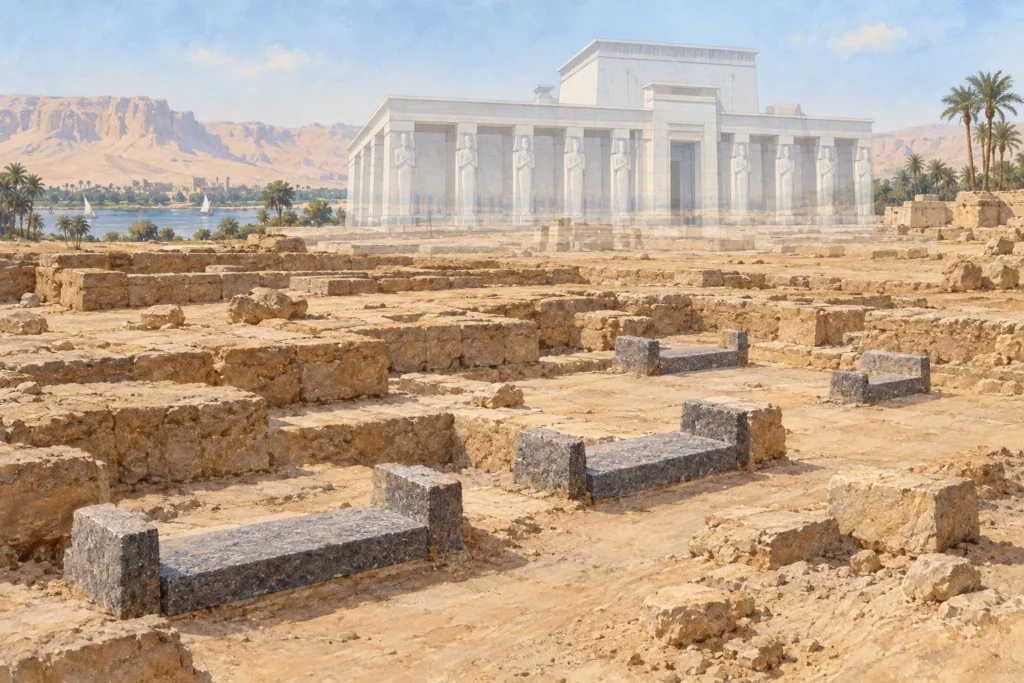
Senusret I, a king of the 12th Dynasty, had a limestone temple built on a broad foundation that enveloped the earlier platform. According to the CFEETK, his programme was about four times larger than that of the previous temple. A portico with Osiride figures of the king preceded a court and three successive rooms. Four granite thresholds bearing elements of his name are among the rare parts still in place. The rest has to be reconstructed from incomplete traces.
Its history
The sanctuary housed the statue of Amun-Ra in a naos. A surviving calcite base was long replaced on the axis, but the CFEETK’s research specifies that this position is wrong. Later, the cult centre was reworked, then much of the temple’s limestone was destroyed or salvaged. The ‘White Chapel’ of Senusret I, re-erected in the Karnak open-air museum, is another monument: its original location is unknown and it should not be placed arbitrarily in the early temple.
Why this place matters
These first phases show how a sanctuary grew through successive reworkings rather than appearing complete all at once. The foundations, thresholds and fragments of decoration are the essential evidence; the silhouette of the temple remains a reconstruction.