Clémence Rossignol, 2014-05-30, History, Egypt
The immense area called Karnak is about 3 km north of Luxor Temple, on the right of the Nile, because all the temples were built on the east bank of the Nile. The group of temples at Karnak is divided into three closed and clearly separate parts.
A description of the temples of Karnak and their use
The immense area called Karnak is about 3 km north of Luxor Temple, on the right of the Nile, because all the temples were built on the east bank of the Nile.
The group of temples at Karnak is divided into three closed and clearly separate parts.
In the middle, the largest, of about 30 hectares, is the best preserved and is dedicated to the God Amun. This area is almost rectangular in shape; it is bounded by a wall built of mudbrick and has eight entrances, three of them to the west.
On the left, almost attached to that of Amun, is the area of Montu; it is also surrounded by a mudbrick wall. It is the smallest (about 2.5 hectares) and it is square. Of the temple of Montu, only a few ruins remain, still covered by heaps of earth, and a magnificent gateway to the east.
On the right, 300 m from the area of Montu, still half unexplored and shaped like a trapezium, is the area of Mut, surrounded by a mudbrick enclosure wall and covering about 9.5 hectares.
The main temple of Karnak was built to honour a single deity:
Amun was the king of the Gods. Amun had a wife called Mut, Goddess of motherhood. It is Amun, the king of the Gods, who gives the pharaohs their powers.
The temples of Karnak were the houses of the Gods, where offerings were collected to feed the Gods. The pharaoh was in charge of collecting this food.
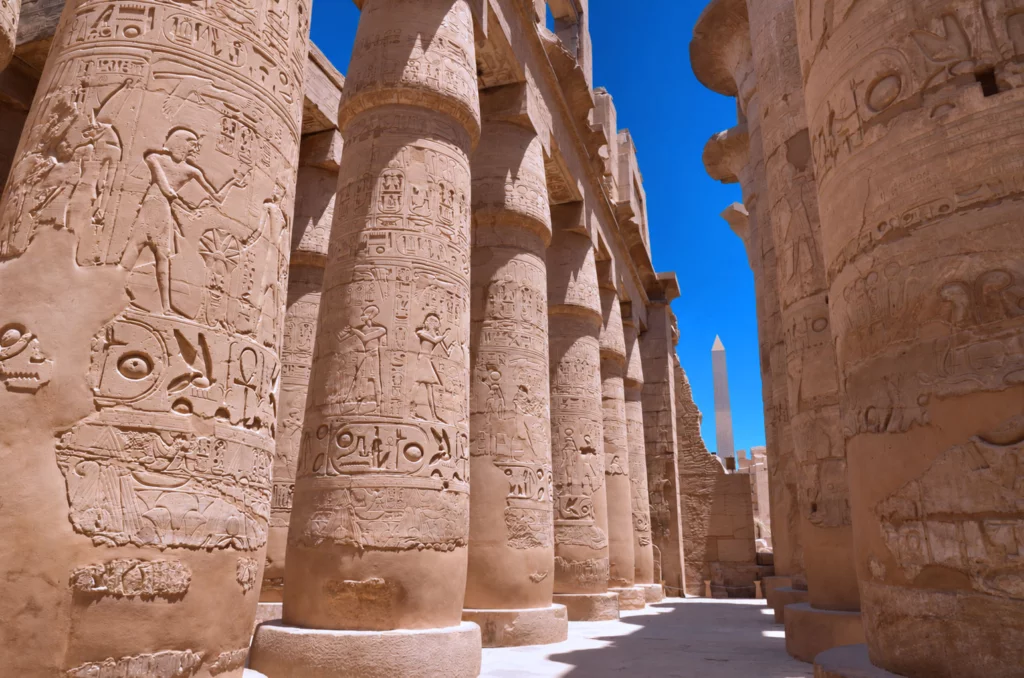
Karnak stands out for the great hypostyle hall of Ramses II, exceptional with its 134 papyriform columns that held up the roof more than twenty-four metres high. There were windows in the roof that let the sun light up the hall. The columns were all decorated with religious scenes and the pharaoh’s great feats of arms. The side aisles of the hall were in darkness. 15 obelisks were built to honour the sun God Amun-Ra. The obelisks were carved from a single block of granite. The tips of the obelisks were once covered with gold so that they would shine in the first light of the sun at dawn and in its last rays in the evening.
The temples were more than a place where people went to pray: they were also places of trade and culture. The temples indeed had their own fields and animals (cows, sheep), like a big farm.
Today, this complex site, with four courts, ten pylons, a sacred lake and many buildings, can be visited like an open-air museum. The hypostyle hall is the heart of a visit to the temples of Karnak. Karnak is one of the most visited sites in Egypt. Tourists from all over the world go to Egypt just to see it.
The temples of Karnak are certainly a tourist site, but they are also a place of archaeological excavations that have still not given up all their secrets.
And since 1979, Karnak has been a UNESCO World Heritage Site.