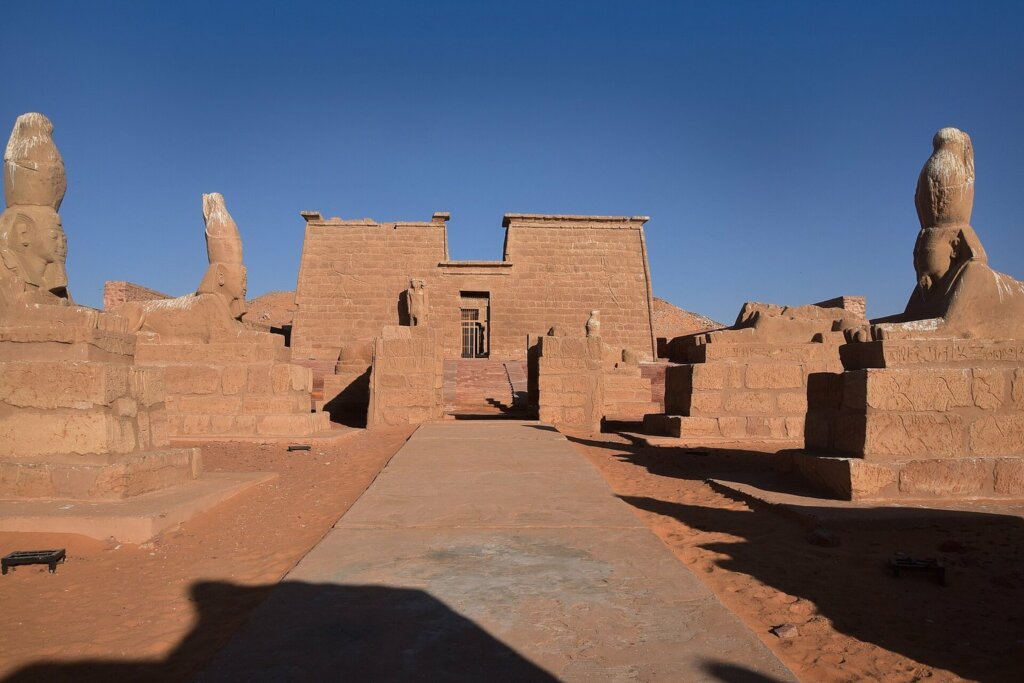
South of Aswan, Wadi es-Sebua invites us to look at a temple that has changed place without ceasing to tell its story. Ramses II (Ramesses II) had it built in Egyptian Nubia; teams dismantled and reassembled it in the 20th century to save it from the rising waters. Its avenue of sphinxes and its open courts still lead to the sanctuary, but the landscape one crosses today is also that of a rescue.
The ‘valley of the lions’
The modern name of Wadi es-Sebua, often translated as ‘valley of the lions’, recalls the sphinxes set along the approach to the temple. Their lion bodies mark a progression rather than a mere entrance. The visitor advances towards the pylons, passes from open spaces to narrower rooms, then reaches the part cut into the rock. This route gave the approach to the sanctuary a ritual dimension.
The photographs show an architecture made of successive thresholds: avenue, courts, statues and passages. In the temple, the images of Ramses II take up a considerable place. They are not just portraits of the sovereign: they assert his presence among the gods and in a region where Egyptian power was keen to be seen.
A royal sanctuary in Nubia
The Egyptian Ministry of Antiquities presents the temple of Wadi es-Sebua as a foundation of the Ramesside period dedicated to Amun-Ra and Ra-Horakhty. This double dedication associates the great Theban god with a solar form. The monument combines built parts and spaces cut into the stone; its reliefs and statues give the king a place in the religious language of the site.
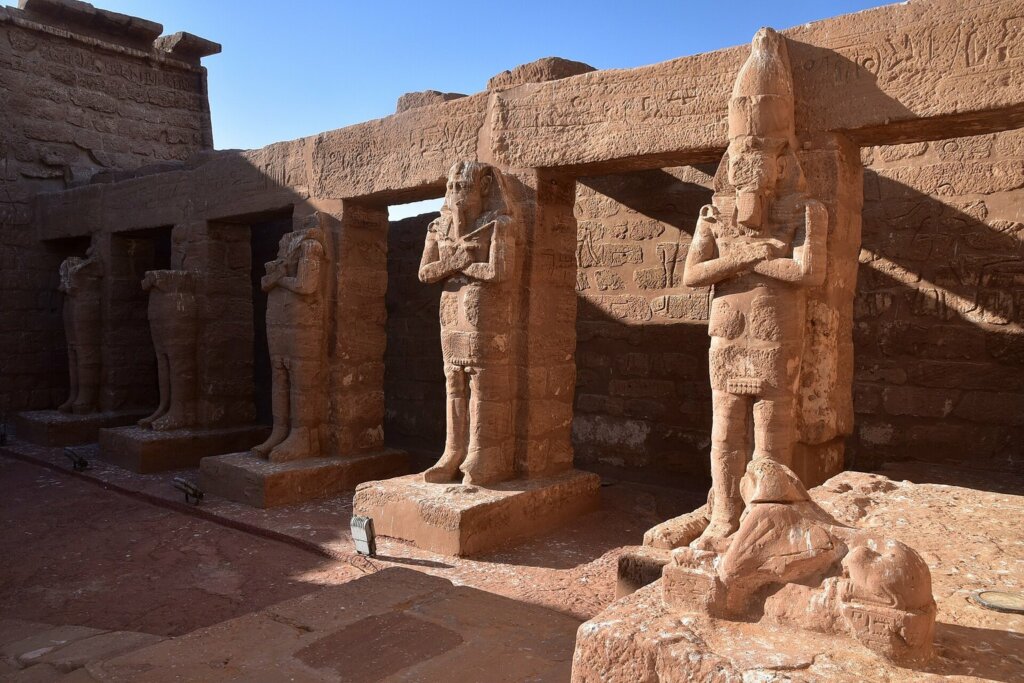
One must also imagine the temple in its former territory, on the bank of the Nile, long before Lake Nasser. Nubia was not an empty setting around the royal monuments: people lived there, moved about and kept up their own traditions. The sanctuary sheds light on the assertion of the power of Ramses II, but it does not on its own sum up the history of this region.
The move in the face of the dam
In the 20th century, the building of the Aswan High Dam transformed the valley. The water of the future lake threatened entire sites. The international rescue campaign coordinated by UNESCO led to many Nubian monuments being documented, dismantled and then moved. Wadi es-Sebua was transferred to higher ground, about four kilometres north-west of its former location, according to the Egyptian ministry.
The site now called New Wadi es-Sebua also brings together the temples of Dakka and Maharraqa, which came from other locations. These three buildings had neither the same date nor the same dedication. Their present proximity therefore results from a rescue decision, not from a group conceived in this way in Antiquity. They are among the monuments of Nubia inscribed on the World Heritage List in 1979. This inscription recalls both the value of the temples and the history of their conservation. It also invites us to distinguish the ancient stones from the contemporary setting in which they were rebuilt.
Reading the monument and its new landscape
Walking round Wadi es-Sebua thus means reading two periods at once. The sphinxes, statues and reliefs speak of Ramesside kingship; the reassembled plan and the nearby lake recall the scale of the choices made to preserve these stones. The move saved the temple from immersion, while changing its relationship with the Nile and with the places around it.
The location map (in French) helps to situate this Nubian stage. To continue the journey, the article on Aswan (in French) tells of the threshold of this region and the landscapes transformed by the dam.