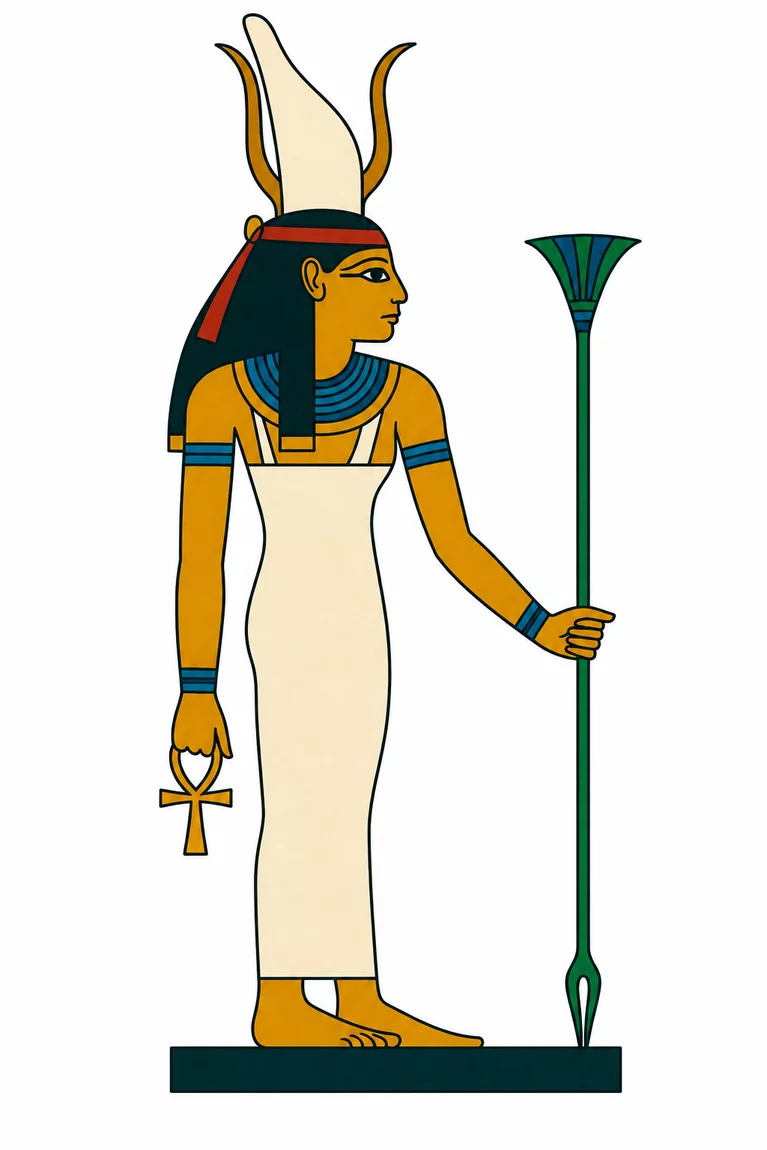
Satet, known as Satis in Greek, is one of the earliest attested deities of the Nile valley. Her cult is tied to a precise place: the island of Elephantine, opposite Aswan, where Egypt ended and Nubia began. A goddess of the frontier, she is also associated with the fresh water of the cataract and the return of the flood. Her silhouette is less familiar than those of Isis or Hathor, but her sanctuary is among the longest frequented in the country.
A name linked to the act of shooting
The name Satet is generally connected with a verb meaning ‘to throw’, ‘to shoot’ or ‘to pour out’. It can evoke the arrow loosed by an archer as well as the gushing of water. This double reading fits the two sides of the goddess well: an armed protector of the southern marches and a giver of the water that purifies and fertilises. The form Satis is the Greek transcription, fixed later by classical authors.
From the Pyramid Texts, at the end of the Old Kingdom, Satet appears in purification formulas: she washes the dead king with water from her jars brought from Elephantine. The water of the cataract, regarded as the place where the flood came forth, had a particular ritual value.
A recognisable image
Satet is shown in human form, wearing a sheath dress. Her distinctive attribute is her headdress: the White Crown of Upper Egypt, flanked by two long antelope or gazelle horns. The antelope, an animal of the southern desert, recalls her roots in the borderlands of the south. She sometimes holds a bow and arrows, more often the sceptre and the ankh, or libation vessels.
The White Crown links her to the kingship of Upper Egypt. Satet is indeed called ‘mistress of Elephantine’ and sometimes ‘lady of Nubia’, two titles that express her role as guardian of the territory.
The triad of the cataract
From the New Kingdom onwards, Satet forms with Khnum and Anuket the triad of the First Cataract. Khnum, the ram-headed god, shapes beings on his potter’s wheel and releases the flood from the supposed caverns of the cataract. Satet is presented as his consort, Anuket as an associated goddess, sometimes as their daughter. This arrangement as a divine family is late: it brings together cults that existed separately, on Elephantine and on the neighbouring island of Sehel.
In the Famine Stela, carved at Sehel in the Ptolemaic Period, the three deities appear together in connection with a failing flood under King Djoser. The text, written long after the reign it portrays, shows above all how the priests of the region promoted their gods. Some late texts also bring Satet close to Sopdet, the star Sirius whose rising announced the flood, which strengthens her link with the seasons of the Nile.
Three thousand years of sanctuary
The temple of Satet at Elephantine offers a rare example of continuity. Around 3000 BC the first place of worship was no more than a natural niche between granite boulders, furnished with small faience offerings. The sanctuary was rebuilt in the Middle Kingdom, notably under Senusret I, then entirely rebuilt under Hatshepsut and Thutmose III. The Ptolemies gave it its final form. Each rebuilding covered the previous one, which allowed the archaeologists of the German Archaeological Institute to recover the successive phases.
This sanctuary was linked to the river by a staircase and a nilometer, where the height of the water was measured. The cult of the goddess, the watch over the flood and the defence of the frontier thus came together in one place.
What Satet tells us
Satet is a reminder that Egyptian gods were not abstract figures. Each was attached to a landscape, a town and a concrete function. This one watches over the southern gate of the country and over the water that comes down from it every year. To understand her, you have to stand on the rocks of Elephantine, between the granite and the current, where her cult was born and lasted until the end of Antiquity.