Anuket, also called Anukis or, in French, Anoukhet, belongs to the religious landscape of southern Egypt. She is linked to the First Cataract of the Nile, near Aswan, where the river passes through a cluster of islands and rocks before continuing northwards. Her cult is a reminder that Egyptian deities were also attached to precise places. To understand Anuket, we need to look at Elephantine and Sehel as much as at the mythological stories: the islands, sanctuaries and inscriptions give her history a concrete depth.
A goddess of the cataract region
The First Cataract was not the real source of the Nile, but it marked a major zone of passage between Egypt and Nubia. There the waters changed rhythm on meeting the granite and the islands. The Egyptians set up places of worship there and carved on the rock the names of rulers, officials and expeditions. Anuket belongs to this world of river and frontier. Museum entries describe her as a goddess of the cataract region and of the south.
On the island of Elephantine she forms a triad with Khnum and Satet, also called Satis. It would be reductive, however, to see her only as a third figure added to a couple. Local traditions evolved, and the sanctuaries of the region show that each of these deities had its own ties to the place. The Global Egyptian Museum entry even places the probable origin of her cult on the neighbouring island of Sehel.
Sehel, Elephantine and the memory of the river
The Egyptian Ministry of Tourism and Antiquities notes numerous inscriptions within the bounds of the temple of Anuket at Sehel. The site also served as a stopping place for travellers, soldiers and expeditions heading for Nubia. Not all the traces left on the stone tell stories of the goddess, but they help to restore the setting of her cult. They show a landscape that was travelled, exploited and commemorated over a very long period.
A famous text from Sehel, known as the Famine Stela, shows King Djoser facing a crisis of the flood. Its story belongs to a composition of the Ptolemaic Period that sets its events much earlier. The divine scene brings together Khnum, Satet and Anuket. It shows how late priests could set their local theology within a prestigious royal past. The date of the king depicted must therefore not be read as the date at which the text was carved.
A recognisable crown
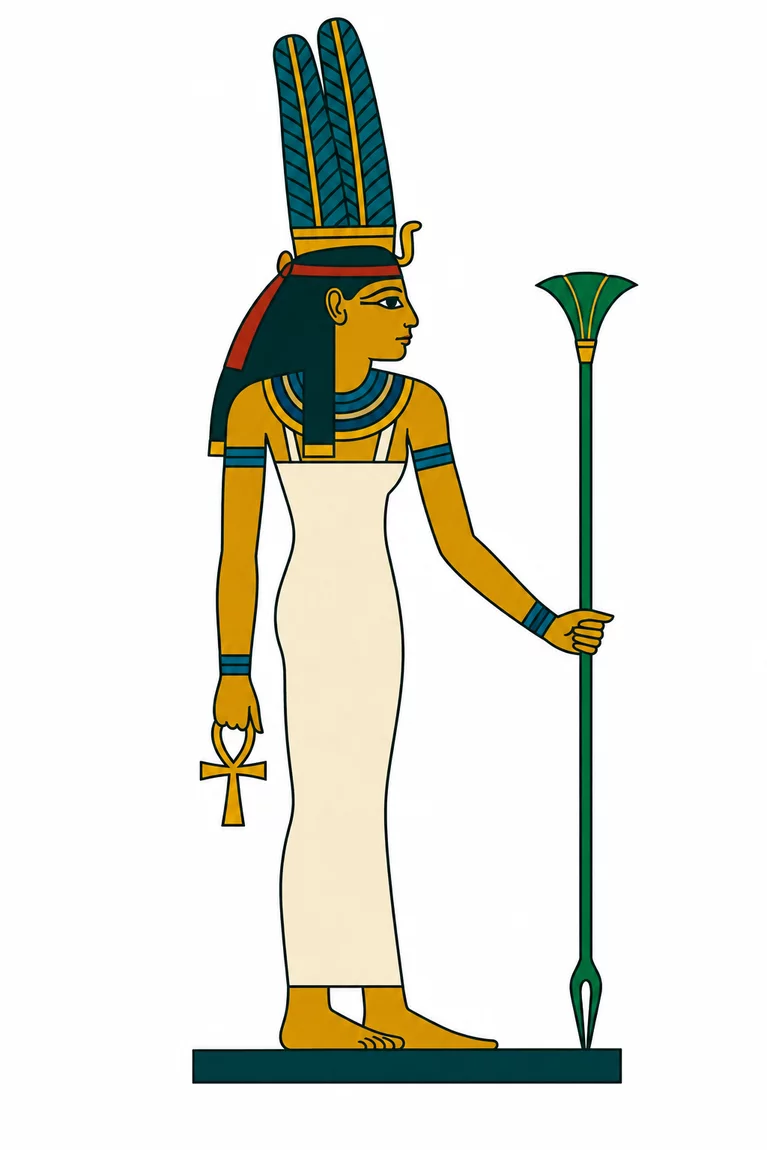
Images of Anuket often show her in human form, with a tall crown decorated with feathers. A statuette among the collections brought together by the Global Egyptian Museum shows her seated and wearing this attribute. The crown is a useful clue, but the surest identification comes from an inscription or a precise archaeological context. Other deities also wear feathers in Egyptian art.
The drawing shows her with this feathered crown, standing and in profile. It does not copy an ancient statue. The papyrus sceptre and the ankh belong here to a general graphic vocabulary of Egyptian gods; they should not be taken as attributes exclusive to Anuket.
What her cult tells us
Anuket is often presented as a goddess of the southern waters. The monuments make it possible to refine this description: her identity was built around a territory where the Nile, the frontier and human movement met. Associating a goddess with the river does not mean that she alone commanded all its floods. At Elephantine, Khnum and Satet also had essential ties with the waters and the life of the region.
The presence of Anuket in the triad and on the monuments of Sehel shows above all a religion rooted in the landscape. Divine names give meaning to the places people frequent, while temples and inscriptions make these relationships visible. Her story invites us to leave an abstract map of the pantheon and follow the gods along the banks of the Nile.
Sources and references
- Global Egyptian Museum, Anuqet
- Global Egyptian Museum, statuette of Anuket
- Egyptian Ministry of Tourism and Antiquities, Sehel Island
Reference works
- Richard H. Wilkinson, The Complete Gods and Goddesses of Ancient Egypt, London, Thames & Hudson, 2003, entry Anuket
- Christian Leitz (ed.), Lexikon der ägyptischen Götter und Götterbezeichnungen, 8 vols, Leuven, Peeters, 2002–2003 (Orientalia Lovaniensia Analecta 110–116 and 129)