A change of empire in 525
Cambyses II, son of Cyrus the Great, conquered Egypt in 525 BC and reigned there until 522. For the country he inaugurated the 27th Dynasty, that is, Achaemenid rule. His victory put an end to the brief rule of Psamtek III and to the independence of the Saite 26th Dynasty. The traditional account of the conquest is often dominated by Herodotus (in French), who wrote several decades later and passes on dramatic scenes. The Egyptian monuments provide a counterpoint: Cambyses adopted a pharaonic titulary and intervened in cults. The conquest combines the military event, the integration of Egypt into an empire and the way different authors judged the new ruler. In the chronology of Ian Shaw (Oxford, 2000), his reign runs from 525 to 522 BC.
The battle and the seizure of power
The ancient sources place the Persian campaign towards the eastern Delta, with a decisive clash before the capture of Memphis. The tactical details vary between authors and cannot be reconstructed with certainty. What is certain is the fall of the Saite dynasty and the installation of an administration answering to the Achaemenid Great King. The conquest did not mean the immediate disappearance of the Egyptian framework: scribes, sanctuaries and local officials remained indispensable. Later texts sometimes turned the victory into a moral tale about the cruelty of Cambyses. These representations must be distinguished from the concrete management of a territory important for the resources and routes of the Persian empire.
Udjahorresnet and the titulary
The autobiographical statue of Udjahorresnet, now in the Vatican, is a major source. This Egyptian dignitary recounts his role with the new masters and refers to the creation of the Egyptian throne name of Cambyses, Mesutire. His text naturally seeks to show the usefulness and piety of its owner. It nevertheless proves that the Persian court could use pharaonic forms and rely on local experts to do so. Cambyses thus appears in an Egyptian language of sovereignty. This does not mean that all Egyptians approved of the conquest. Rather, the statue reveals a negotiation between imperial power, native expertise and the prestige of the sanctuaries.
The Serapeum and the stories of impiety
A stela from the Serapeum bears a date in the reign of Cambyses and belongs to the record of the cult of the Apis bull. It obliges us to reread with caution the Greek stories according to which the king systematically despised the Egyptian gods. The pieces of evidence do not all say the same thing, and a ruler’s actions could vary with circumstances. A dated cult monument is more direct evidence than an anecdote written later, but it does not allow generalisation to all religious policies. The comparison is instructive: it shows how a hostile reputation can form and why contemporary inscriptions must be examined before concluding that there was a total break in the cults.
Nubia and the oasis of Siwa
UCL Digital Egypt mentions expeditions by Cambyses towards Nubia and towards the western oasis of Siwa, without lasting incorporation of these regions into the empire. The stories of an army lost in the desert are famous, but their reality and details remain debated. The strategic aims are clearer: to secure the southern and western margins after the conquest of the valley. The environment made these operations difficult, between desert routes, supply and the autonomy of local powers. The absence of lasting control does not allow us to conclude that there was a single defeat exactly as tradition tells it. It shows the practical limits of imperial expansion, even for a powerful conqueror.
An administration in transition
Egypt became part of an empire stretching from Anatolia to Central Asia. Languages, fiscal networks and military commands were superimposed on the local institutions. Under Cambyses, the transition was short and the direct administrative evidence is less abundant than under Darius I. We must therefore avoid attributing to the conqueror all the structures attested later. The continuity of the temples and dignitaries nevertheless shows that governing Egypt required collaboration with the country’s elites. The royal titulary, the stelae and the statue of Udjahorresnet bear witness to it. The conquest was a break in sovereignty, but it also opened a time of adaptation rather than an institutional void.
A king to be freed from clichés
The figure of Cambyses II was shaped by very hostile accounts, whereas the Egyptian monuments show a more complex reality. The capture of Egypt was a major event; the pharaonic titulary and the Serapeum record reveal acts of local legitimation; the expeditions towards Siwa and Nubia show the ambitions and limits of the new empire. The Greek, Egyptian and Persian sources answer one another, without sharing the same dates or aims. This method allows us to understand the 27th Dynasty as a period of real imperial domination, but also of continuity and negotiation in the Nile Valley.
Main sources
- UCL Digital Egypt, Cambyses II and his attestations
- UCL Digital Egypt, Egypt under the Achaemenids
- UCL Digital Egypt, the Late Period and the Greek sources
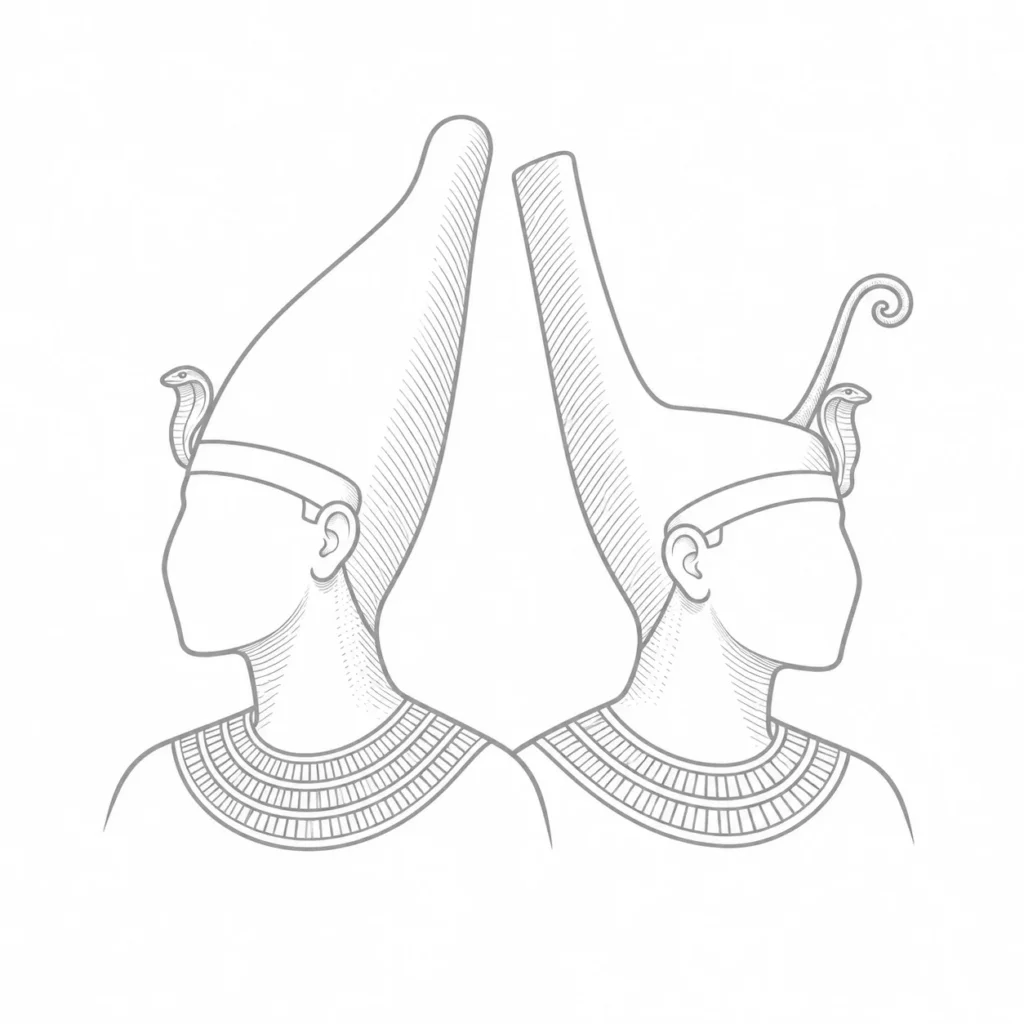
- Crowns drawn from the statue of Senusret I and the relief of Ahmose, Metropolitan Museum of Art.
Reference works
- Ian Shaw (ed.), The Oxford History of Ancient Egypt, Oxford, Oxford University Press, 2000, chronology pp. 479–483
- Aidan Dodson and Dyan Hilton, The Complete Royal Families of Ancient Egypt, London, Thames & Hudson, 2004