A long reign after a dynastic crisis
Amasis, Ahmose II in the Egyptian titulary and Khnemibre as throne name, reigned from 570 to 526 BC. He came to power after a conflict with Apries, but the length of his rule stabilised the 26th Dynasty for several decades. UCL Digital Egypt sees his reign as a peak of Saite wealth and prosperity. This formula must be explained through evidence: the multiplication of monuments, the activity of the sanctuaries and the development of Mediterranean trade. The anecdotes of Herodotus (in French) about the king’s personality are famous, but their literary character calls for caution. The historical portrait rests first on the geography of the building projects, the inscriptions and the archaeology of the ports.
A contested accession
The ancient sources relate that Amasis was sent by Apries against rebels and was then proclaimed king. The war that followed ended the reign of his predecessor. The precise stages and the motives of the groups involved are not always confirmed by contemporary texts. It is tempting to sum up the affair as an opposition between Egyptian soldiers and Greek mercenaries, but Saite society was more complex. Amasis then had to build his legitimacy without breaking all the networks of the dynasty. The royal titles, the funeral attributed to Apries and the donations to the temples were part of this normalisation. His long reign shows that a violent accession did not prevent later stability.
Naukratis and Greek trade
Under Amasis, Naukratis became a major point in commercial relations between Egypt and the Greek world. UCL states that the colony or trading post then received a more formal framework. Archaeology has yielded large quantities of Greek pottery, inscriptions and objects from the eastern Mediterranean. The town was not an isolated enclave with no connection to the Egyptians; its trade depended on the routes of the Delta and on royal decisions. Herodotus’s accounts of the privileges granted to the Greeks must be compared with the remains and with the Egyptian texts. The reign shows a policy of controlled openness, profitable to the court while maintaining the sanctuaries and institutions of the country.
A programme in the sanctuaries
Amasis had work carried out at Sais in the temple of Neith (in French), as well as at Buto, Mendes and Behbeit el-Hagar, according to UCL. These building projects give a more solid image of his government than the amused portraits handed down by the Greek authors. The choice of several Delta sanctuaries recalls that this region was the political heart of the dynasty. Sais has, however, been very largely destroyed, which limits the reconstruction of its buildings. The foundation deposits and the reliefs preserved elsewhere show the royal investment. They also point to workshops able to produce refined art, often inspired by ancient models without being reduced to mechanical imitation.
The king of the Greek stories
Herodotus describes Amasis as a man of unkingly habits, sometimes a drinker or fond of jokes. UCL warns that these traits may be a literary motif rather than a faithful portrait. The Greek tradition sought to explain how a man of non-dynastic origin could become a good ruler despite unexpected behaviour. The contrast between the king of the anecdotes and the king of the monuments is instructive. It shows how a pharaoh’s reputation could be reshaped for a foreign audience. These stories belong to their authors and their time; they are not facts observed during the years 570–526.
The Persian threat at the end of the reign
During the last decades of Amasis, the Achaemenid empire expanded in the Near East. Egyptian foreign policy had to take this new power into account. Amasis died shortly before the conquest of Egypt by Cambyses II in 525 BC; his successor Psamtek III had only a brief reign. It would be inaccurate to present the whole Persian victory as the direct result of Amasis’s choices, since the military and diplomatic causes were many. The long reign nevertheless placed Egypt in a rich Mediterranean network, but one exposed to imperial transformations. The transition is a reminder that internal prosperity and external security are not the same thing.
A Saite monarchy at its height
Amasis stands out for the length of his reign, the scale of his building works and the place of Naukratis in trade. His life also allows the difference between history and reputation to be studied: the monuments show a king devoted to cult and building, while the Greek accounts compose a sometimes colourful character. Comparing the sources avoids artificially choosing one against the other. The policy in the Delta, the Saite workshops and the contacts with the Greeks give the reign an economic and cultural depth. Its end, on the eve of the Persian conquest, places this success in a wider and more unstable regional context.
Main sources
- UCL Digital Egypt, Amasis and his monuments
- UCL Digital Egypt, sites of the Late Period and Naukratis
- UCL Digital Egypt, background of the 26th Dynasty
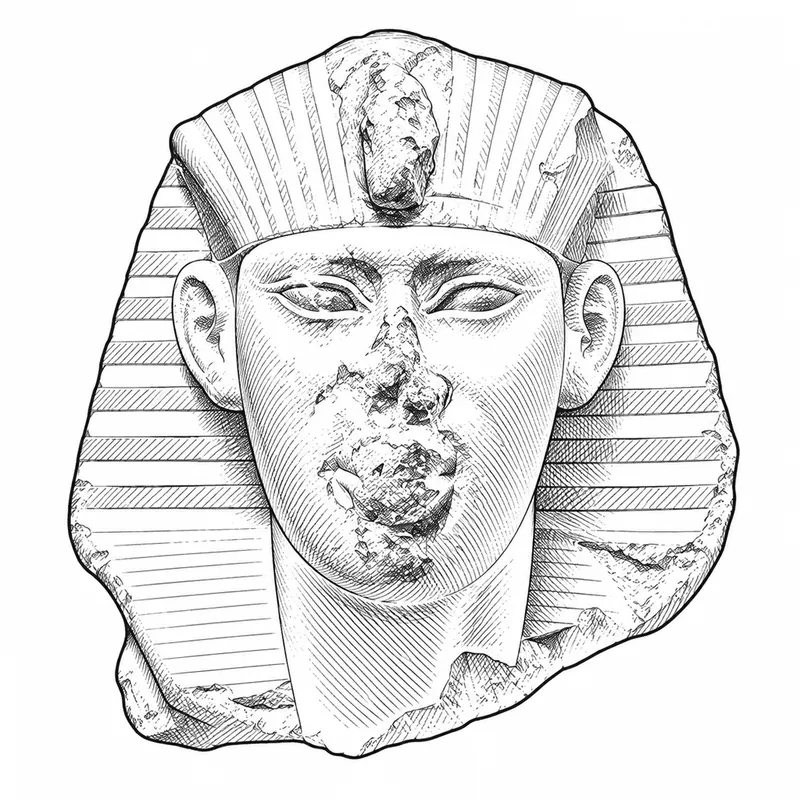
- Model for the line portrait: small sphinx head attributed to Amasis, Metropolitan Museum of Art, 66.99.178.
Reference works
- Ian Shaw (ed.), The Oxford History of Ancient Egypt, Oxford, Oxford University Press, 2000, chronology pp. 479–483
- Aidan Dodson and Dyan Hilton, The Complete Royal Families of Ancient Egypt, London, Thames & Hudson, 2004