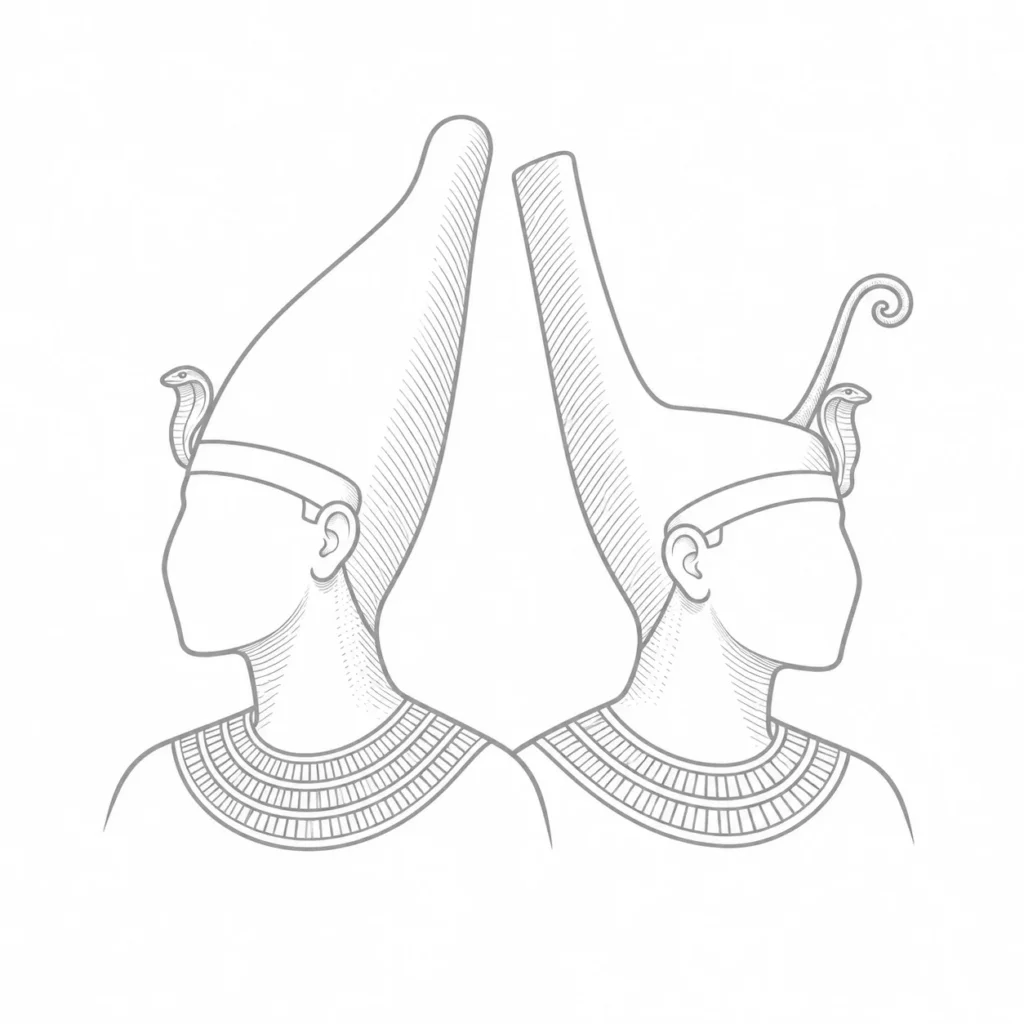
A Great King who was also pharaoh
Darius I ruled the Achaemenid empire from 522 or 521 to 486 or 485 BC. In Egypt he also bore a pharaonic titulary, including the throne name Setutre. He succeeded Cambyses II at a time when the empire had to consolidate recently conquered territories. His Egyptian government is better documented by stelae, quarry inscriptions, objects and large building projects. UCL Digital Egypt highlights the temple of Hibis in the oasis of Kharga and the canal through the Wadi Tumilat towards the Red Sea. These projects show an imperial domination that was not limited to extracting resources: it also invested in the routes and sanctuaries of the country.
The canal to the Red Sea
Stelae from Tell el-Maskhuta, Kabret and Suez mention the construction or completion of a canal linking the Nile to the Red Sea. According to the traditions, the project had been begun under Necho II. Darius made it a symbol of his power over lands and waterways. The inscriptions belong to an imperial context in which people, materials and goods circulated between Egypt and other regions. The exact route and the phases of navigation require topographical study; we should not imagine a canal identical to the modern Suez Canal. The work remains major because it combines hydraulic knowledge, labour and royal propaganda in a long-distance communication project.
Hibis and the oasis of Kharga
The temple of Hibis, in the oasis of Kharga, is one of the great monuments linked to Darius I in Egypt. Its decoration shows the ruler in ritual scenes conforming to pharaonic traditions. The oasis was not an unimportant margin: it controlled desert routes and had its own communities. Investing in its sanctuary made it possible to anchor Achaemenid rule in a geography wider than the valley. The architecture and reliefs provide material proof of how a Persian king could have himself represented as pharaoh. They do not mean that all decisions were taken locally. Rather, they show the empire’s ability to use Egyptian religious forms.
Quarries and administration
The inscriptions of Darius in the Wadi Hammamat bear witness to expeditions to the quarries of the Eastern Desert. As in earlier periods, extracting and transporting stone required officials, teams and supplies. These texts link the name of the Great King with works commissioned within an Egyptian framework. Faience objects from Memphis and calcite vessels complete the record. The imperial administration did not necessarily replace all local practices; it relied on officials able to write in Egyptian and to manage building sites. Quarry inscriptions are therefore witnesses to the day-to-day workings of an empire, less spectacular than a battle but essential to its survival.
The question of the Egyptian laws
Traditions and documents refer to an attention paid by Darius to the laws of the country. A distinction must be drawn between the compilation or translation of local norms, the measures actually applied and the representation of a just king. The sources do not allow us to imagine a single code imposed on all Egyptians in one act. The interest of the record is to show that the empire needed to know the institutions it governed. The temples, judges and administrations had ancient practices. Darius may have sought to organise them or have them recorded in order to administer the satrapy better. This policy follows the same logic as the pharaonic titulary: exercising a new sovereignty in a language understood locally.
Resistance and the limits of domination
UCL states that from the reign of Darius onwards, Egypt experienced repeated revolts against Persian rule. Their chronology and intensity varied. The king did not reign over a country uniformly hostile or uniformly submissive for thirty-six years. The monuments of Hibis and of the canal show a strong capacity for action; the resistance is a reminder that this capacity had political limits. The Persian defeat at Marathon, in the Greek world, belongs to a wider imperial history and must not be confused with a single Egyptian uprising. The government of Egypt must be understood within a network of provinces, routes and international rivalries.
A domination inscribed in the landscape
The projects of Darius I link distant spaces: the Delta, the Eastern Desert, the oasis of Kharga and the Red Sea. His titulary and the temple of Hibis show the adoption of pharaonic codes; the canal stelae show an imperial ambition for circulation; the quarry inscriptions reveal the logistics. The reign allows us to move beyond a uniform image of ‘Persian domination’. Egypt was a conquered province, but its sanctuaries and specialists contributed to the form that power took. The later resistance and the debates about the laws show that this relationship remained negotiated and sometimes conflictual.
Main sources
- UCL Digital Egypt, Darius I and his monuments
- UCL Digital Egypt, the First Persian Period
- UCL Digital Egypt, Necho II and the initial canal project
- Crowns drawn from the statue of Senusret I and the relief of Ahmose, Metropolitan Museum of Art.
Reference works
- Ian Shaw (ed.), The Oxford History of Ancient Egypt, Oxford, Oxford University Press, 2000, chronology pp. 479–483
- Aidan Dodson and Dyan Hilton, The Complete Royal Families of Ancient Egypt, London, Thames & Hudson, 2004