A reign better documented by writings
Djedkare Isesi belongs to the second half of the 5th Dynasty. His pyramid lies at South Saqqara, while royal letters and the biographies of dignitaries offer unusual evidence about his court. The exact dates of the reign vary between the chronologies of the Old Kingdom, but the relative abundance of sources makes it possible to go beyond a mere description of the tomb. Papyri from Abusir are dated to his time: they reveal that the funerary foundations of earlier kings continued their activities. The documents do not, however, make up a continuous political diary. They shed light on certain relationships between the king, his senior officials and the religious institutions. In the chronology of Ian Shaw (Oxford, 2000), his reign falls c. 2414–2375 BC.
The pyramid at South Saqqara
After several reigns marked by the monuments of Abusir, Djedkare chose South Saqqara for his own funerary complex. The pyramid bore a name expressing its beauty and permanence. Its present, very ruined state means that we must rely on excavations and plans to understand the original programme. Temples, passages and service spaces formed around it an institution intended for the rites after the ruler’s death. The change of site does not in itself prove a religious or political break with his predecessors. It shows the variety of possible choices within the Memphite region. The monuments of Abusir continued to function, as the archives dated to the reign confirm.
Letters addressed to senior officials
Texts copied or carved in the tombs of dignitaries preserve letters attributed to Djedkare. Those addressed to Senedjemib and to Rashepses give a rare glimpse of communication between the palace and the elites. They must be read in their context: placed in private burials, they helped to celebrate the royal favour received by their owners. Their existence nevertheless shows that writing could record decisions, honours or instructions that mattered enough to be handed down to posterity. They allow us to study closeness to the king and the social value of his words, without concluding that all the business of government passed through the same channels.
Biographies and court careers
Several autobiographies of senior officials mention Djedkare or belong to his time. They shed light on the length of careers, the titles held and the links between administrative service and funerary reward. The owners sought to show their loyalty and success; their accounts are therefore selective. Yet, compared with one another, these inscriptions reveal a court made up of people able to serve in different fields and sometimes under several rulers. Djedkare appears less as an isolated figure than as the centre of a network of offices. The private tombs complement the remains of the pyramid by restoring some of the men through whom royal decisions were carried out.
Sinai and the regions of resources
The ruler’s name appears in inscriptions at Wadi Maghara, in Sinai. They point to expeditions or an official presence in a region sought after for its mineral resources. The texts do not allow us to reconstruct the whole foreign policy of the reign or to measure the exact scale of each operation. They are nevertheless a reminder that the monarchy had to obtain materials beyond the valley for its monuments and workshops. A rock inscription is situated evidence: it documents an action or a claim in a specific place, not permanent control of the whole peninsula. Taken together with the letters and biographies, it extends Djedkare’s history beyond his necropolis.
Royal festival and the memory of predecessors
An inscription on a vessel mentions a first Sed festival of the king, a ceremony linked to the renewal of royal power. Its presence is a precise attestation, but it does not give the details of how all the celebrations unfolded. Another inscription records a dedication to Niuserre found at Abusir. These traces show that Djedkare’s reign belonged to ritual and institutional continuities. The papyri of the older mortuary temples, dated to his time, confirm that their services did not stop at a king’s death. The monarchy thus had to maintain several royal cults while founding its own, which raised questions of staff, offerings and resources.
A less monumental image of power
The pyramid remains a major element of Djedkare’s record, but the writings make his reign particularly instructive. Letters, biographies, the Sinai inscriptions and the Abusir archives shed light on the circulation of orders, on careers and on the persistence of religious foundations. They do not allow us to speak of a specific administrative reform without examining each document and its dating. Their richness is nevertheless enough to show power exercised through sustained relationships with the elites, and not only through stone building sites. Djedkare is thus a privileged vantage point on the court at the end of the 5th Dynasty, whose workings appear in fragments but with rare density.
Main sources
- UCL Digital Egypt, Djedkare Isesi
- UCL Digital Egypt, the Abusir papyri
- Metropolitan Museum of Art, Egypt in the Old Kingdom
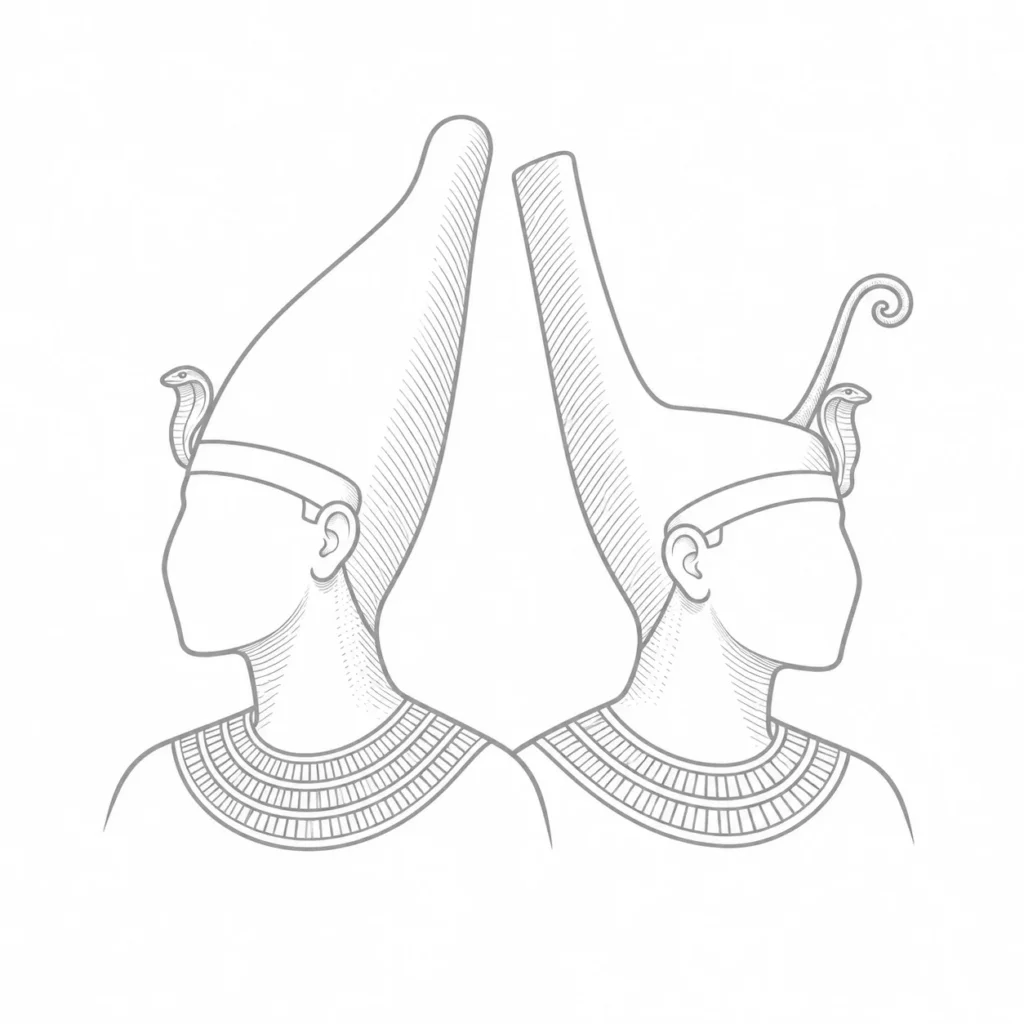
- Crowns drawn from the statue of Senusret I and the relief of Ahmose, Metropolitan Museum of Art.
Reference works
- Ian Shaw (ed.), The Oxford History of Ancient Egypt, Oxford, Oxford University Press, 2000, chronology pp. 479–483
- Aidan Dodson and Dyan Hilton, The Complete Royal Families of Ancient Egypt, London, Thames & Hudson, 2004