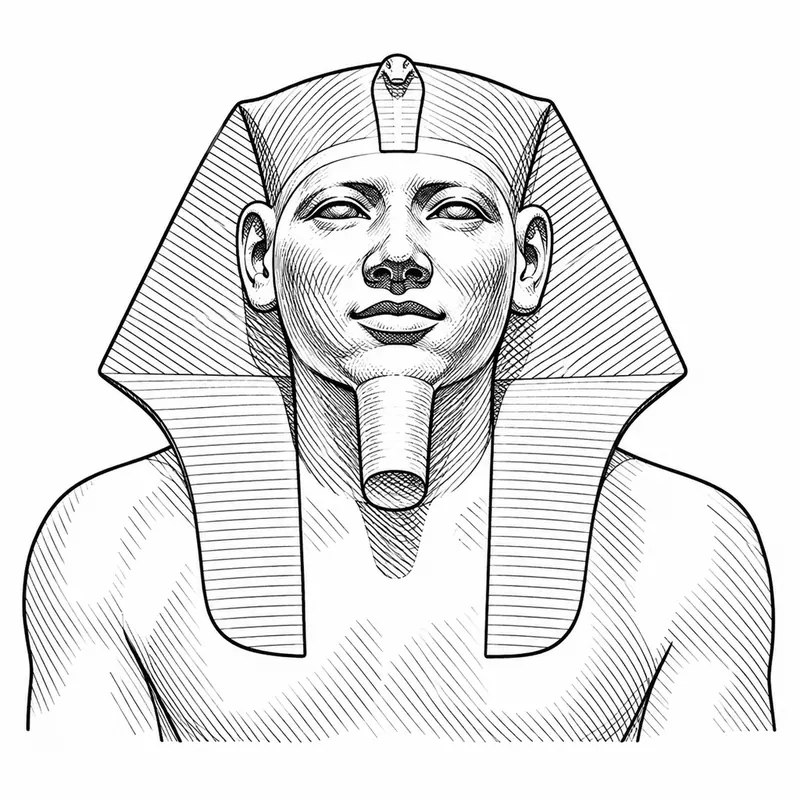
A reign in the 4th Dynasty
Chephren (Khafre) belongs to the 4th Dynasty and succeeds Djedefre in the usual reconstructions. He is generally regarded as a son of Cheops. The absolute dates proposed for his reign differ between chronologies; the relative order of the great funerary complexes of Giza is more secure. His record is not limited to a pyramid: temples, causeway, statues, seals and court tombs make it possible to study the kingship expressed there. Contemporary texts do not, however, provide a continuous chronicle of his decisions. A distinction must therefore be drawn between what his vast architectural programme reveals and what remains unknown about his day-to-day policy and any campaigns he may have fought. In the chronology of Ian Shaw (Oxford, 2000), his reign falls c. 2558–2532 BC.
The second pyramid of Giza
Chephren had the second great pyramid of the plateau built, south-west of that of Cheops. It sometimes looks taller because it stands on higher ground, although its original dimensions were smaller. Part of the limestone casing remains near the summit and recalls the once pale appearance of the monument. The pyramid was only one element of a funerary complex comprising a temple at its foot, a long causeway and a valley temple. This arrangement linked the royal burial with the spaces for ceremonies and offerings. The phases of construction and the details of the work are still debated; the surviving building is not enough, on its own, to reconstruct the methods used by the builders.
The valley temple and the statues
The valley temple provides exceptional evidence for the representation of the king. Seated statues in hard stone were discovered there, some remarkably well preserved. The royal figure appears motionless and powerful, integrated into an architectural setting in which the image probably served the funerary cult. A famous statue shows the falcon of Horus (in French) behind the ruler’s head: the visual association makes the divine dimension of kingship tangible without being a realistic description of the person. The statues are not simple portraits intended to hand down his features to posterity. Their number, materials and placement point to an elaborate ritual programme, which the excavations in the valley and the inventories of the collections make it possible to reconstruct in part.
The Great Sphinx and the limits of interpretation
The Great Sphinx holds a major place in the landscape associated with Chephren’s complex. Its proximity to the causeway and the temples leads most scholars to attribute its creation to this reign, but the monument bears no contemporary inscription directly naming the person who commissioned it. The lion with a royal head was carved from the rock of the plateau; its neighbouring temple formed a monumental group distinct from the valley temple. Later repairs, erosion and interventions complicate the reading of its original state. The Sphinx should not, therefore, be used to reconstruct Chephren’s personal beliefs freely. Above all, it attests the scale of a religious and political staging around the royal necropolis.
A court organised around the complex
The tombs of relatives and high-ranking officials on the plateau shed light on Chephren’s circle. Their titles show the priestly, administrative and family functions linked to the great building works and the royal cult. Seals and objects bearing the ruler’s name have been recorded outside Giza, notably in Nubia and the Levant. Taken in isolation, such a spread does not prove direct rule over each of these places; it indicates networks of circulation that must be studied in their archaeological context. Building and maintaining the complex required quarries, transport, craftsmen and supplies. The monuments make this capacity for coordination visible, even though the management archives of the building site have not come down to us.
Between contemporary documents and later stories
Chephren’s fame was amplified by the authors of classical antiquity, who wrote long after the 4th Dynasty. Their accounts can tell us about the memory of the pyramids, but they do not replace the evidence produced during the reign. The names inscribed on objects, statues and monuments provide a more direct basis for his history. They do not, however, specify the exact length of his rule, his relationship with Djedefre or the circumstances of all his undertakings. Chronological caution takes nothing away from the importance of the king: it avoids turning gaps in the documentation into family intrigues or political decisions imagined solely from the layout of the pyramids.
The significance of the reign
Chephren shaped an essential part of the present face of Giza. His complex brings together the pyramid, the temples, the causeway, a rich statuary and, very probably, the Sphinx in a landscape of great coherence. This organisation makes it possible to study the place of royal images in the cult of the dead, the relationship between architecture and topography, and the resources mobilised by the court. Knowledge of the ruler remains uneven: stone has preserved his funerary programme better than the events of his government. His historical influence lies precisely in this contrast. The remains of his reign show how the monarchy of the Old Kingdom could inscribe its authority durably in a territory and in religious practice.
Main sources
- UCL Digital Egypt, Khafre
- Harvard University, Digital Giza, Royal Pyramid Complexes
- Harvard University, Digital Giza, Khafre Valley Temple
- Harvard University, Digital Giza, Introduction to Giza
- Model for the line portrait: statue of Chephren, Egyptian Museum, Cairo, JE 10062.
Reference works
- Ian Shaw (ed.), The Oxford History of Ancient Egypt, Oxford, Oxford University Press, 2000, chronology pp. 479–483
- Aidan Dodson and Dyan Hilton, The Complete Royal Families of Ancient Egypt, London, Thames & Hudson, 2004