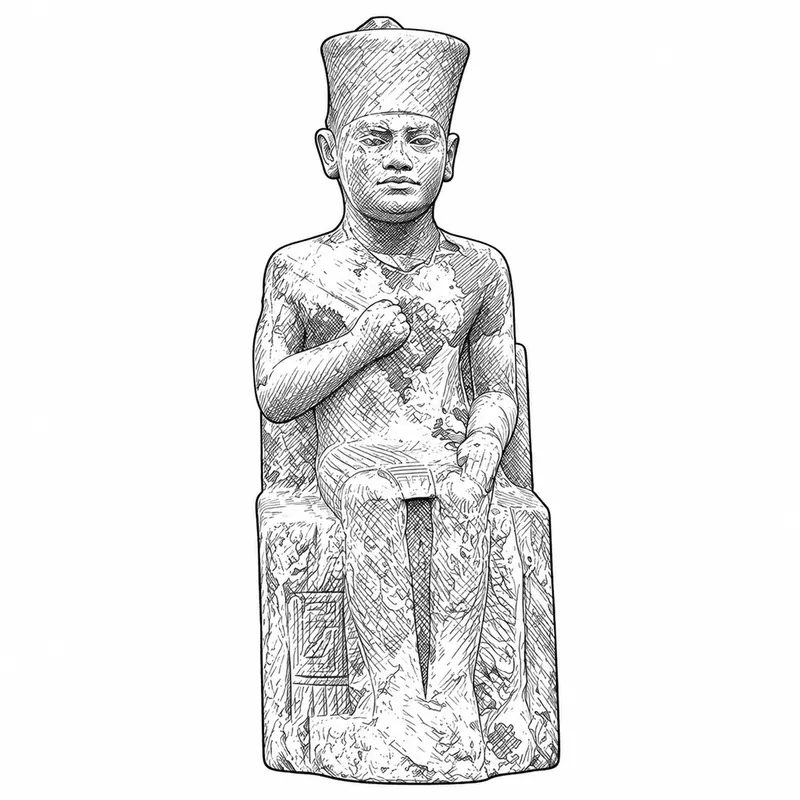
A king of the 4th Dynasty
Cheops (Khufu) succeeded Sneferu at the beginning of the 4th Dynasty. The chronology of the Egyptian ministry generally places his reign c. 2589–2566 BC, but these years remain conventional for such an early period. His name is linked above all with the Great Pyramid of Giza. The monument sometimes attracts stories that almost erase the ruler himself. Archaeological discoveries now make it possible to set the building site within a royal administration, transport routes and a court society. A distinction must be drawn between the evidence from the reign, later descriptions and modern hypotheses about building methods.
Akhet-Khufu, the royal monument
The pyramid bore the name Akhet-Khufu, ‘the Horizon of Khufu’. Its original height was about 146.6 metres. It combined a core mainly of local limestone with a casing of fine limestone brought from Tura. The inner passages lead to three main spaces, of which the so-called King’s Chamber contains a granite sarcophagus. The traditional names of the chambers do not prove how each space was used, but the overall programme of the complex was funerary. Temples, causeway, boat pits, queens’ pyramids and the mastabas of high officials extended the meaning of the building site well beyond the mass of the pyramid.
The journal of the inspector Merer
The papyri discovered at Wadi al-Jarf offer rare direct access to the work of teams employed at the end of the reign of Cheops. Merer’s journal records journeys and operations transporting blocks of Tura limestone to the building area. It attests a network of navigation, officials and deliveries on which the pyramid depended. These documents do not describe every stage of construction and do not reveal a single lifting technique. They are nevertheless more valuable for the history of the reign than unsourced speculation: they show men carrying out specific tasks within a named royal programme.
A building site on the scale of the kingdom
Supplying stone, food and tools required coordination between quarries, waterways, storage sites and specialised teams. The Wadi al-Jarf papyri shed light on part of this organisation, while the installations and cemeteries at Giza document the social world of the builders and administrators. Nothing obliges us to reduce all these workers to a mass of slaves, an image popularised by later stories. The teams held different functions and depended on an administration able to allocate resources over the long term. The exact arrangements for payment, rotation and lifting the blocks must be studied from each category of source, without excessive generalisation.
The king and his circle
The Giza plateau contains the tombs of members of the royal family and of high officials. These groups place Cheops within a network of relatives, officials of the cult and agents responsible for building projects. Direct portraits of the king are rare in relation to the scale of his monument. This disproportion partly explains why his pyramid has often replaced his biography in the modern imagination. The names and titles of the people buried near it nevertheless give a more concrete history of the court. The reign of Cheops cannot be reduced to a geometrical feat: it also reveals the hierarchy and relationships through which a monarchy mobilised its resources.
The limits of the evidence
Inscriptions bearing the name of Cheops are known in Egypt and in Sinai, but the surviving sources do not allow every year of his rule to be told. The authors of classical antiquity, writing more than two millennia after him, pass on judgements and anecdotes that must be examined separately. Recent scientific measurements have detected unknown voids inside the pyramid; their function has not been established. Neither a new cavity nor a late literary tradition can, on its own, resolve the history of the building site. Understanding Cheops requires ranking these pieces of evidence and measuring what each one really contributes to the history of the reign.
An exceptional afterlife
The Great Pyramid remained a monument of reference throughout antiquity and down to our own day. Its success has sometimes created the illusion that the reign of Cheops is fully understood, whereas architecture, archives and tombs each shed different and partial light on it. The Merer papyri transformed the record by introducing an administrative voice contemporary with the building work. The pyramid remains the central monument of his reign, while the ruler also emerges as the organiser of a system of labour, circulation and cult. It is this combination that gives his reign a major place in the history of the Old Kingdom.
Main sources
- Egyptian Ministry of Tourism and Antiquities, Great Pyramid
- UCL Digital Egypt, Khufu
- IFAO, Wadi al-Jarf
- Harvard University, Digital Giza, Khufu Pyramid
- Model for the line portrait: statuette of Cheops, Egyptian Ministry of Antiquities.
Reference works
- Ian Shaw (ed.), The Oxford History of Ancient Egypt, Oxford, Oxford University Press, 2000, chronology pp. 479–483
- Aidan Dodson and Dyan Hilton, The Complete Royal Families of Ancient Egypt, London, Thames & Hudson, 2004