In brief
Buto, today Tell el-Fara’in, lies in the north-west of the Nile Delta. Beneath its earth mounds lie the traces of many successive occupations. The oldest known go back to the beginning of the 4th millennium BC, long before the first pharaohs. They reveal the daily life of Delta communities and the exchanges that linked Egypt to other regions. The monumental buildings of later periods should not make us forget these early levels, buried deep down.
What you discover
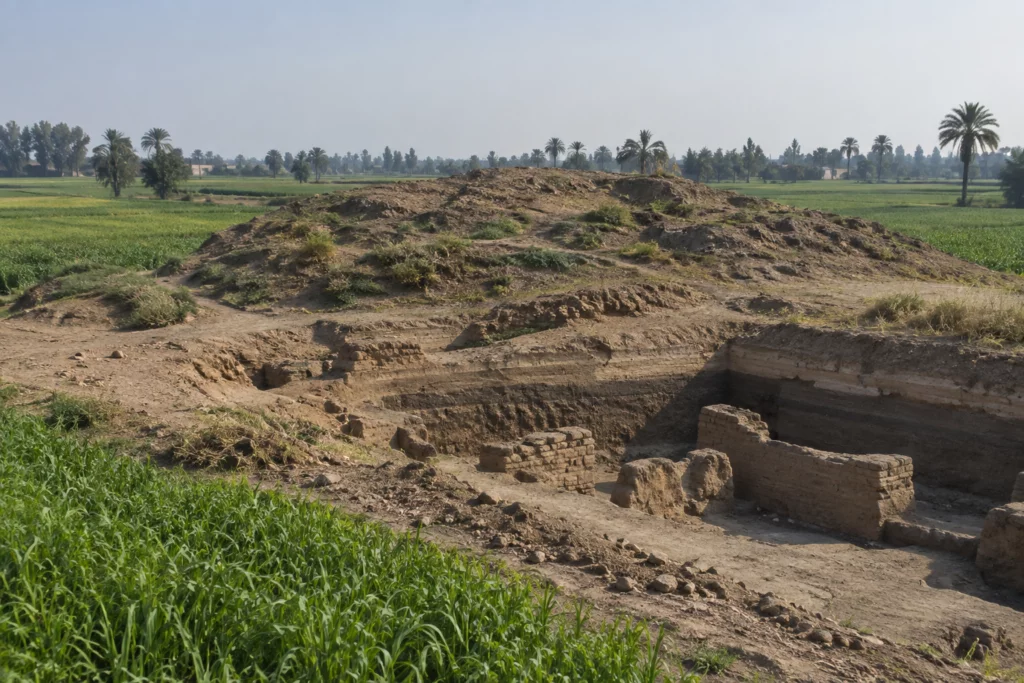
At Buto, the eye first meets mounds, called tells, formed by the accumulation of buildings and deposits over the centuries. The Predynastic levels do not appear as a standing monument. Excavations have uncovered living floors, traces of light structures, pottery and installations linked to food preparation. A circular kiln found in a later phase may have been used to make beer; pits containing shells also point to the exploitation of aquatic resources. Archaeologists read these remains layer by layer, distinguishing them from the pharaonic, Greek and Roman occupations above.
Its history
The site developed on a sandy dune that rose above the wet plain. In its first levels, handmade pottery lies alongside vessels in a style close to traditions of the southern Levant, but made with local clay. This coexistence sheds light on contacts and perhaps on the presence of groups with different skills; on its own, it does not allow a specific migration to be told. The following levels belong to the Lower Egyptian culture known as Buto-Maadi. Later, mud-brick buildings appear and, in the first dynasties, a complex with economic and administrative functions. Modern excavations have reconstructed this sequence from the layers and objects.
Why this place matters
Buto shows that the formation of ancient Egypt cannot be explained by the great centres of Upper Egypt alone. The Delta had its own traditions, while maintaining relations with other regions. The pottery and buildings reveal gradual changes rather than a single break. The site also recalls an essential rule of archaeology: a single place can hold several successive towns. To understand its Predynastic beginnings, one must look at the deep layers and not confuse their remains with the later sanctuary of the goddess Wadjet.