In brief
Naucratis stood in the western Delta, near the present village of Kom Gi’eif, on the bank of the former Canopic branch of the Nile. Founded at the end of the 7th century BC as a base for Greek and Cypriot merchants, it also served as the port of Sais, the royal city of the 26th Dynasty. It was the first Greek port in Egypt and, for a time, the only one. Yet the town was also Egyptian: it housed a vast sanctuary of Amun-Ra beside the Greek sanctuaries.
What you discover
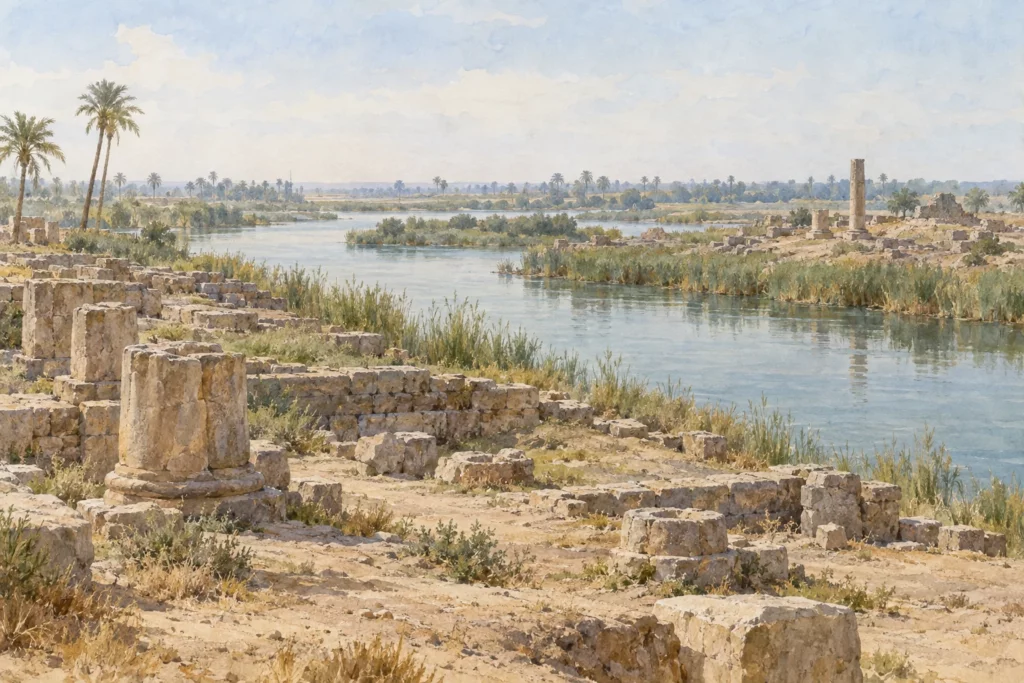
The site is disconcerting at first: no colonnade, no standing wall. Cultivated fields, villages and a depression where a lake extended from 1903 to 2011 occupy the site of the ancient town. The ruins were largely levelled as early as the 19th century by excavators and by the sebbakhin, who took the earth of the tells to fertilise the fields. What survives lies below the surface: cores suggest that four to five metres of archaeological deposits are still preserved beneath the fields of the enclosure of Amun-Ra.
Reading the place therefore goes through the plans. To the north are the Hellenion, a sanctuary shared by several Greek cities, and the sanctuary of the Dioscuri, protectors of sailors. To the south, beneath the village of el-Baradany, extends the Egyptian Great Enclosure, whose monumental gateway was built under Ptolemy II. To the west, the riverbank and its harbour installations can be traced.
What to look at
The object that sums up Naucratis is not a monument but a ship’s plank. Found in 2015 in the waterlogged deposits of the former bank, this fragment of wood, probably pine, bears a mortise and was accompanied by a tenon pierced for a peg: an assembly typical of Mediterranean shipbuilding. Deposited at the beginning of the 4th century BC or earlier, it proves that seagoing ships sailed up the Nile to the port. In the same place, terracotta figurines (Hathor, a Persian rider) may have been thrown into the river during festivals linked to the flood.
Another telling detail: the bank did not stay fixed. The Canopic branch shifted from east to west, by about 86 metres in twelve centuries, and the quays followed the river.
Its history
According to Herodotus, Amasis (570–526 BC) settled Greeks at Naucratis, which for a time held the monopoly of Mediterranean trade entering Egypt. Miletus, Samos and Aegina founded their own sanctuaries there, while nine other cities of Ionia, of Asian Doris and of Lesbos shared the Hellenion. The town did not disappear with the foundation of Alexandria: in the Ptolemaic period it obtained the status of a Greek city and remained occupied until around the 7th century AD, about twelve centuries in all.
Flinders Petrie and Gardner excavated it in 1884–1886, David Hogarth in 1899 and 1903, then the teams of Coulson and Leonard from 1977 to 1983. More than 18,000 objects from these excavations are now scattered across more than 70 museums. The British Museum resumed fieldwork from 2012. Much remains to be understood: the old plans fit poorly together, and the extent of the town in each period remains debated.
Sources
Consulted on 30 September 2026: Naukratis: Greeks in Egypt, British Museum; Ross Thomas and Alexandra Villing, ‘The Harbour of Naukratis, “Mistress of Ships”’, excavation report 2015, British Museum and Honor Frost Foundation; Stefan Pfeiffer, ‘Egypt and Greece Before Alexander’, UCLA Encyclopedia of Egyptology, 2013.