A royal name in an obscure succession
Neferneferuaten designates a ruler of the late Amarna Period, associated with the throne name Ankhkheperure. This ruler’s exact place between Akhenaten and Tutankhamun, the length of the rule and the person’s identity remain debated. The name recalls that of Nefertiti, who was called Neferneferuaten Nefertiti, but a resemblance of names is not enough to establish an identity. Other hypotheses involve Meritaten or distinguish Neferneferuaten more clearly from King Smenkhkare. Older publications sometimes confused these figures. The surviving cartouches, their epithets and their material contexts form the starting point; interpretations come afterwards, with their degrees of certainty. The period is short, but what is at stake for the succession is considerable. In the chronology of Ian Shaw (Oxford, 2000), the reign falls c. 1338–1336 BC (years that Shaw assigns to Smenkhkare, between Akhenaten and Tutankhamun).
The problem of Smenkhkare
UCL Digital Egypt presents Smenkhkare as a ruler attested by rings from Amarna and stresses the uncertainty of his relationship with Nefertiti and Neferneferuaten. The two throne names can resemble or overlap each other in fragmentary documents, which has fed several reconstructions. The question is not only how many rulers reigned, but how to date their inscriptions and identify the epithets added to the cartouches. An old copy, a photographic reading and direct examination of an object may lead to different conclusions. The state of the evidence rules out a series of secure portraits. A methodical distinction between birth names, throne names and feminine titles is the precondition for any biography.
Nefertiti, a major candidate
Nefertiti is well attested as great royal wife of Akhenaten. Objects and representations name her Neferneferuaten Nefertiti. She appears in the scenes of the Aten cult and in the royal family. This position makes it plausible, for many Egyptologists, to identify her with a ruler bearing the name Neferneferuaten. It does not automatically prove that she bore all the cartouches attributed to this figure, or that she reigned alone after Akhenaten. Specialists examine the formulas that seem to designate a woman and those that link the ruler to Akhenaten. They also compare these texts with the last dated attestation of Nefertiti as queen. The record remains open because the most decisive inscriptions are rare.
The royal family and the other hypotheses
Akhenaten’s family included several daughters whose names and titles changed during the last years of the reign. Meritaten, the eldest, plays an important role in some reconstructions of the succession. Her existence and her status as princess are attested; identifying her with Neferneferuaten is a proposal that requires further arguments. The use of several theophoric names containing Aten complicates the debate. Objects may also have been reinscribed or moved. Each hypothesis must therefore explain all the available inscriptions without multiplying persons or transformations at will. This discipline is essential to prevent a gap of two or three years from becoming an over-detailed political fiction.
The objects from the tomb of Tutankhamun
Researchers have proposed that some of Tutankhamun’s funerary equipment was first prepared for another ruler of the late Amarna Period. Traces of altered names, dimensions and iconography are clues to be examined. They do not on their own show to whom each object belonged before it was placed in KV62. The photographic archives and excavation records of Howard Carter (in French), kept by the Griffith Institute in Oxford, are essential for re-examining the record without losing the provenances. The tomb provides a concrete end point for the succession, but it is also an assemblage put together in haste after the death of a young king. Possible reuses must be proved piece by piece.
Amarna abandoned, the evidence scattered
After Akhenaten, the court gradually left Akhetaten and the monuments of the Aten were dismantled. This transformation scattered the inscriptions that might shed light on Neferneferuaten. Rings, blocks and tomb objects have remained, but rarely in the form of complete archives. The archaeology of Amarna shows the city and its inhabitants; it does not always allow each phase of the abandonment to be dated to a particular reign. Hacked-out or reused names create further difficulties. The chronology must therefore combine inscribed years, stratigraphy and the comparison of titularies. The discrepancies between modern lists reflect this documentary poverty, not mere carelessness on the part of researchers.
How a reign is established
The record of Neferneferuaten exposes the limits of historical identification. Names and objects attest a sovereignty at the end of Amarna, but the links with Nefertiti, Smenkhkare and Meritaten continue to be debated. The point is not to choose an appealing solution and then present it as settled. It is to show which texts support each proposal, what evidence is missing and why the political restoration under Tutankhamun follows a complex transfer of power. Such a portrait remains detailed without inventing campaigns or great building projects. It makes visible a moment when the pharaonic institution survived a radical reform while the documentation became fragmented.
Main sources
- UCL Digital Egypt, Smenkhkare and the Amarna succession
- UCL Digital Egypt, the family of Akhenaten
- Staatliche Museen zu Berlin, Amarna catalogue and the last attestations of Nefertiti
- Griffith Institute, archives of the tomb of Tutankhamun
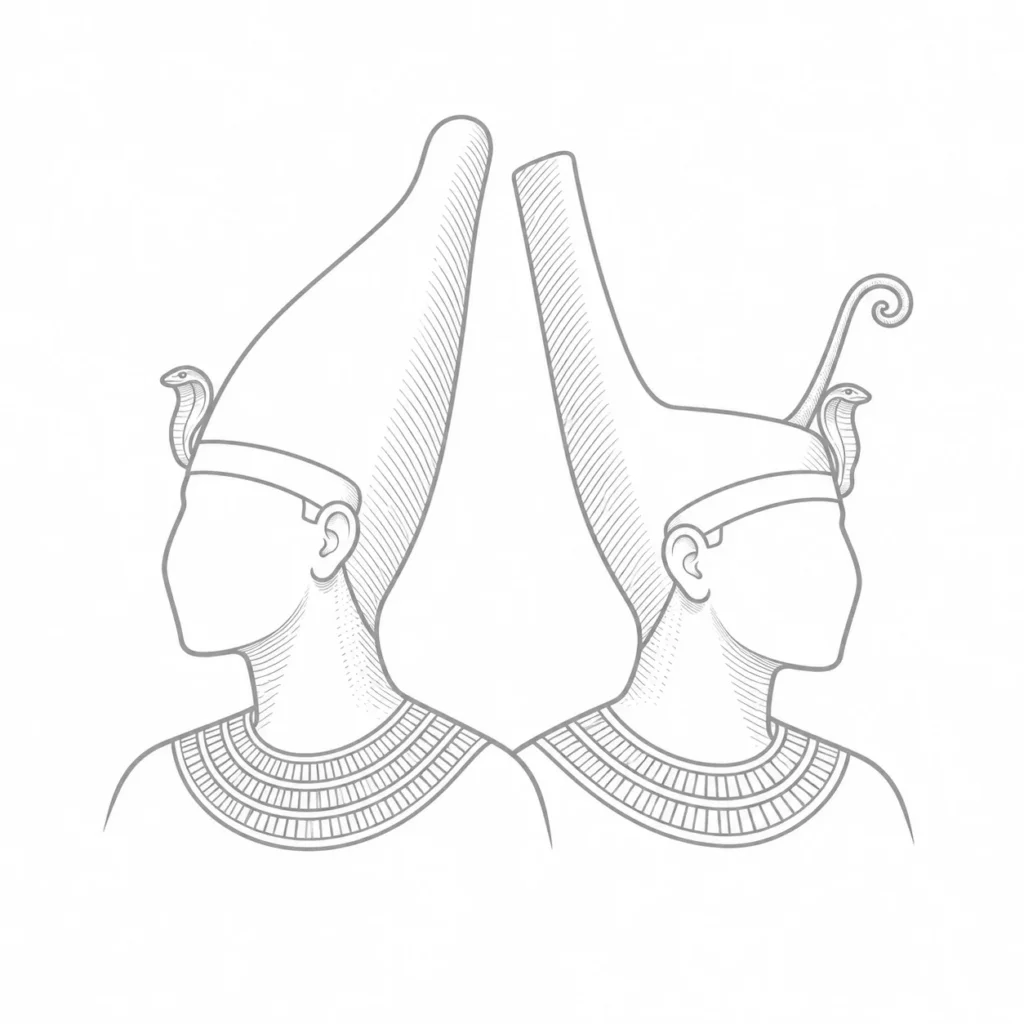
- Crowns drawn from the statue of Senusret I and the relief of Ahmose, Metropolitan Museum of Art.
Reference works
- Ian Shaw (ed.), The Oxford History of Ancient Egypt, Oxford, Oxford University Press, 2000, chronology pp. 479–483
- Aidan Dodson and Dyan Hilton, The Complete Royal Families of Ancient Egypt, London, Thames & Hudson, 2004