Identification and location
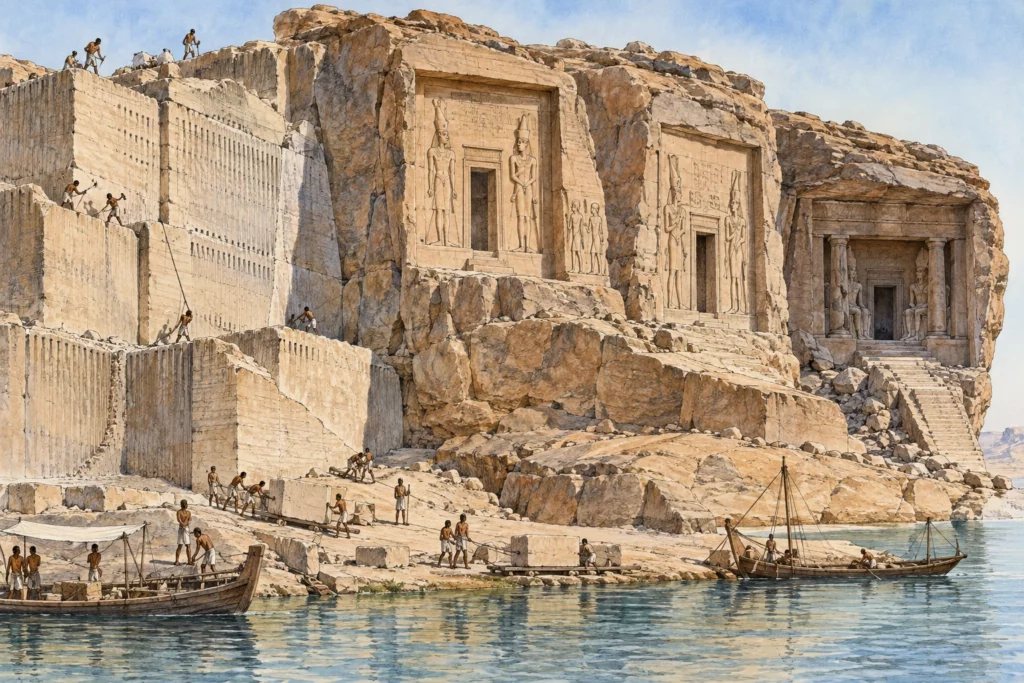
Gebel el-Silsila is a gorge of the Nile, between Edfu and Kom Ombo, where sandstone quarries occupy both banks. The site is not a single sanctuary: it combines quarry faces, workers’ inscriptions, rock-cut chapels, stelae, graffiti and necropolises. Sandstone was extracted there from the Middle Kingdom to the modern era, while the most visible cult monuments belong mainly to the New Kingdom. This long time span requires each quarry and each carved space to be dated separately.
General presentation
More than a hundred quarries supplied blocks for Egyptian buildings. The tool marks and inscriptions preserved in the rock make visible the work of extraction, often absent from the temples built with these stones. On the west bank is the speos of Horemheb, a temple cut into the cliff, along with a series of rock-cut chapels of high officials and later royal monuments. On the east bank, a New Kingdom necropolis studied since 2015 shows that a community probably lived in the area, beyond a mere camp of stonecutters.
Monuments and remains
The Egyptian ministry reports two temples of the time of Horemheb on the west bank, only one of which is preserved: the speos dedicated to seven deities, represented in the sanctuary. Further south, thirty-two chapels were cut for New Kingdom dignitaries, mostly close to the time of Hatshepsut and Thutmose III. Rock-cut structures associated with Seti I, Ramses II (Ramesses II) and Merneptah, then a great stela of Ramses III, show the continuity of royal marks. The sanctuaries make room for gods linked to the Nile and the region, including Hapy, Khnum and Sobek (article on Sobek, in French), without excluding the great Theban cults.
Chronology and building phases
Sandstone extraction began at least in the Middle Kingdom and continued well after the pharaonic period. The chapels of 18th-Dynasty dignitaries precede the speos of Horemheb; the monuments of Ramesside sovereigns were added later. The graffiti also cover a long period, from prehistory to times after the Roman period. On the east bank, the Egyptian-Swedish mission begun in 2015 has revealed seventy-eight New Kingdom tombs. It would be misleading to represent all these remains in a landscape dated to a single reign, or to deduce the date of a quarry from that of a neighbouring chapel.
History and functions
Gebel el-Silsila combined economic activity and religious practice. The extracted blocks supplied temple building sites; the inscriptions recalled the people or groups associated with this work. The chapels and the speos gave a place to sovereigns, dignitaries and deities in a narrow passage of the river. The necropolis on the east bank offers another perspective: men, women and children were buried there with modest objects. This demographic composition suggests a more lasting settlement than the mere temporary lodging of a quarry team, while leaving its precise organisation to be established.
Excavations and the history of research
The quarry walls have been described and copied for their texts, but the archaeological study of the site is no longer limited to the monumental inscriptions. Since 2015, a mission of the Supreme Council of Antiquities and Lund University has studied the tombs on the east bank. The simple, undecorated burial chambers contained in particular vessels, beads, scarabs, bracelets and animal remains. These objects add to the history of the people who lived near the quarries. The comparison between the monumental west bank and the funerary east bank avoids reducing Gebel el-Silsila to a series of royal façades.
State of preservation and research questions
The cut surfaces keep precious traces, but erosion can erase inscriptions and tool marks. In the eastern necropolis, the ministry stresses the damage caused by erosion and by the rising water table. The tombs have also been covered by sand. The questions concern how long the settlement was occupied, the relationship between the dead and the quarries, and the chronology of each extraction sector. An overall plan must distinguish the two banks and the periods, without placing all the monuments side by side as if they were contemporary.
Sources
Main sources: Egyptian Ministry of Tourism and Antiquities, ‘Gebel al-Silsila’ and ‘New Kingdom Cemetery in Gebel Al-Silsila’, consulted on 28 September 2026: https://egymonuments.gov.eg/archaeological-sites/gebel-el-silsila/; https://egymonuments.gov.eg/monuments/new-kingdom-cemetery-in-gebel-al-silsila/.