In brief
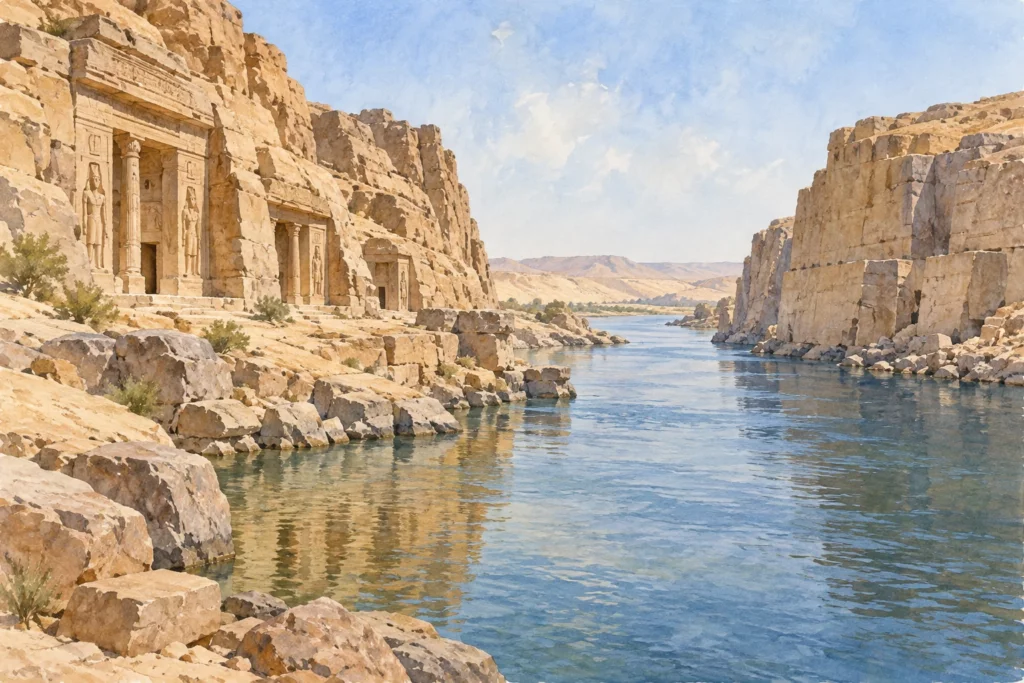
Between Edfu and Kom Ombo, the Nile narrows between two sandstone banks: this is the gorge of Gebel el-Silsila. The place has often been described as the largest quarry of the ancient world. More than a hundred quarries were opened there, from the Middle Kingdom to the 20th century, and their stone was used for the great temples of the valley, among them Karnak, Luxor and Dendera. But Gebel el-Silsila is not just a work site: it preserves a rock-cut temple, chapels, royal stelae and thousands of carved marks spanning an exceptional length of time.
What you discover
From the river, you first make out the quarry faces, which still bear the marks of tools and inscriptions left by the workers. On the west bank, the cliff is pierced by a façade with five openings separated by pillars: this is the speos of Horemheb, last king of the 18th Dynasty (c. 1323–1295 BC), probably fitted out in an existing quarry gallery. Of the two temples of his reign recorded on this bank, it is the only one preserved.
Further south, thirty-two rock-cut chapels line the cliff above the Nile. They belong to high officials of the New Kingdom, most of them contemporaries of Hatshepsut and Thutmose III. Then come rock-cut monuments and stelae in the names of Seti I, Ramses II (Ramesses II), Merneptah and Ramses III. Deities linked to the river and the region were invoked there, Hapy, god of the flood, Khnum, Sobek and Taweret, alongside Isis, Horus, Min and the Theban triad.
What to look at
In the sanctuary of the speos, seven statues are carved directly from the rock: Sobek, Taweret, Horemheb himself, Thoth, Amun-Ra, Mut and Khonsu. The king takes his place among the gods. On the west wall, a scene shows him being suckled by Taweret; near it, a relief unfolds the triumphal procession that followed his victory in Nubia. The Ramesside kings and high dignitaries later added scenes, stelae and inscriptions to mark their passage, and Christian visitors later carved crosses on the walls.
In the quarries, a different way of looking is needed, more attentive to the bare walls. The surveys of the Swedish mission have recorded some five thousand quarry marks, a marking system on a scale unmatched on the site. Some rock drawings go back to the Epipalaeolithic, around 10,000 years before present, long before any pharaonic quarrying. A single wall can thus layer millennia of images.
Its history
Sandstone extraction began at least in the Middle Kingdom. In the New Kingdom, the gorge also became a place of devotion: the chapels of 18th-Dynasty dignitaries precede the speos of Horemheb, then the Ramesside kings multiplied their monuments there. The inscriptions and sanctuaries thus range from prehistory to the Roman period.
A mission from Lund University has resumed the systematic study of the site, paying as much attention to the marks and drawings on the walls as to the carved monuments. Much remains uncertain: the date of many extraction sectors, the meaning of the marks and the organisation of the people who lived near the quarries. Each remain must be dated on its own terms, without attributing to the whole gorge the date of a neighbouring chapel.
Sources
Consulted on 30 September 2026: Gebel al-Silsila, Egyptian Ministry of Tourism and Antiquities; Speos of Horemheb, Egyptian Ministry of Tourism and Antiquities; Maria Nilsson and John Ward, ‘Pictorial representations at Gebel el Silsila: A 10,000 year long repertoire’, AHMES 3, 2016, Lund University.