In brief
Esna, a town in Upper Egypt built on the bank of the Nile, lies about sixty kilometres south of Luxor. Its temple was that of Khnum, the local god, whose sacred barque still appears on the walls. Only part of this great sanctuary survives, but that part is complete: the entrance hypostyle hall, or pronaos, counted among the six great preserved temples of the Graeco-Roman period, with Philae, Kom Ombo, Edfu, Dendera and Athribis.
What you discover
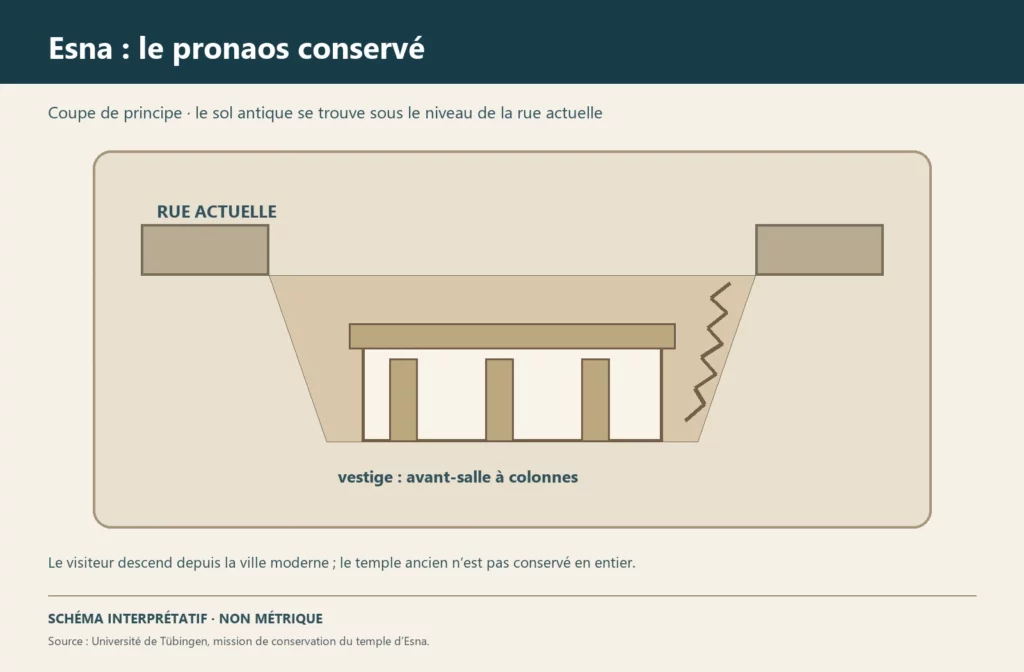
The temple is seen below street level, amid the houses and streets of the modern town, whose ground has risen over centuries of occupation. You go down towards the façade, then enter a sandstone hall 37 metres long, 20 wide and 15 high. Twenty-four columns, arranged in six rows of four, support the ceiling; each ends in a plant-form capital whose design differs from its neighbours. Far from being disorder, this variety is one of the features of the temples of this period.
The pronaos was not an isolated building. It was placed in front of the temple proper, which it was meant to outshine by its size. This main temple has disappeared. Its position at the heart of the town probably explains why the hall escaped the quarrymen: used in the 19th century as a cotton warehouse, it did not serve as a stone reserve like so many other monuments of the valley.
What to look at
Look up. The astronomical ceiling, long blackened by soot and dust, was entirely cleaned between 2018 and 2023 by some thirty Egyptian conservators, in a joint project of the Egyptian Ministry of Tourism and Antiquities and the University of Tübingen. The figures have regained a palette dominated by yellow and red, very different from the whites and pale blues of the ceiling at Dendera. One can recognise the sun, the moon, the signs of the zodiac, the hours of the night and New Year’s Day. In one of the bays, the sky goddess Nut swallows the evening sun above a trio of deities: Orion, Sothis (the star Sirius) and Anuket. The return of Sirius to the eastern horizon, after about seventy days of invisibility, marked the New Year and announced the flood, while Anuket presided over its retreat.
Above all, the cleaning has made visible what had never been carved. Nearly two hundred ink inscriptions, previously unknown, name constellations and have made it possible to identify figures that had remained obscure, and many details of hieroglyphs existed only in paint. Lower down, on the walls and columns, royal and divine costumes appear, along with crowns and a procession of priests carrying the sacred barque of Khnum.
Its history
The sanctuary goes back at least to the Ptolemaic period, but the visible pronaos is Roman: it was erected at the latest under the emperor Claudius (AD 41–54), and its decoration probably took nearly two centuries. Its texts form the last great coherent body of hieroglyphic inscriptions to survive. Admired from the time of the French expedition to Egypt as a model of temple architecture, it was published by Serge Sauneron, director of the Institut français d’archéologie orientale (IFAO, French Institute for Oriental Archaeology), in a series of volumes issued from 1963 to 1975, the last in 2009. Conservators are now continuing to clean the walls and columns, and the plan of the vanished temple, buried beneath the town, remains largely unknown.
Sources
Consulted on 30 September 2026: Restaurierung der Tempeldecke im ägyptischen Esna abgeschlossen, University of Tübingen (2023) (in German); The Temple of Esna, research project, University of Tübingen; Conservation of the Temple of Esna, American Research Center in Egypt.