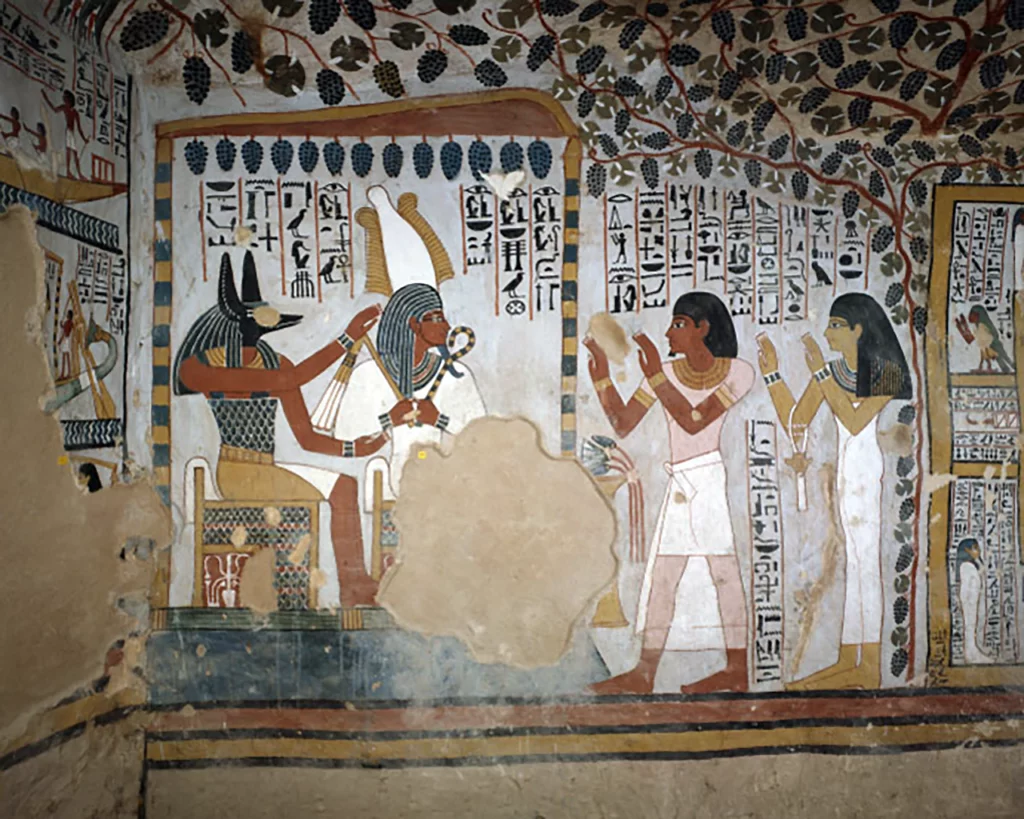
Beneath the hill of Sheikh Abd el-Qurna, a painted vine spreads its leaves and bunches of grapes above visitors. This famous ceiling has given the monument of Sennefer, mayor of Thebes under Amenhotep II, its nickname of the ‘tomb of the vines’. But behind the burial chamber lies a larger complex, where the paintings also tell of the responsibilities of a great administrator.
A man at the heart of the wealth of Thebes
Sennefer lived in the 15th century BC, in the 18th Dynasty. As mayor of Thebes, he belonged to the circle of senior officials close to royal power. His titles also designate him as overseer of the gardens, fields and granaries of Amun. He thus took part in the management of the great temple’s properties: farmland, produce, stores and supplies.
These functions explain the place given to prosperity in his monument. The harvests, gardens and offerings evoke the resources he was responsible for, while preparing his existence after death. His cousin Amenemope, owner of the neighbouring tomb TT29, held the office of vizier. Their monuments bear witness to the importance of this family in the entourage of Amenhotep II.
Three large halls and a separate burial chamber
The tomb comprises two complexes with separate entrances from the courtyard. The upper chapel, known as TT96A, was intended for the funerary cult and for visits by relatives. The underground apartments, TT96B, housed the burial.
The chapel has three large halls: a transverse hall, a longitudinal hall and a vast hall with four pillars. An annexe with a single pillar completes this group. Lower down, a staircase leads to an antechamber, then to the burial chamber, also supported by four pillars.
There are therefore six main rooms counting the annexe, without including the courtyard and the passages. The four pillars of the vine chamber should not be confused with those of the large upper hall.
Beneath the painted vine
In the burial chamber, the irregular ceiling becomes a trellis. The stems follow the undulations of the rock; the leaves and bunches seem to hang above the figures. The painters took advantage of the natural relief to create an enveloping canopy of vegetation.
The burial chamber measures about 7.50 metres by 6.70 metres, with a height varying roughly between 2.20 and 2.80 metres. The pillars break up the perspectives and bring the scenes close to the eye. The greens of the foliage, the dark bunches, the ochre flesh and the white garments give this underground space a warm presence.
This vegetation accompanies the hope of renewed life. It is not enough to demonstrate a personal taste of Sennefer for nature: it belongs above all to the religious language of the monument.
Images to nourish and protect
On the walls and pillars, Sennefer receives offerings and takes part in the ceremonies needed for his future in the afterlife. Meryt, his companion in several scenes of the burial chamber, presents him with flowers and ritual objects. The outstretched hands, the close gestures and the figures brought together give the compositions a tender intimacy.
These images answer precise needs: to nourish the dead man, to protect him and to restore his capacity to act. They combine the presence of relatives with the efficacy of the rites. In the upper chapel, the programme develops Sennefer’s official functions further, with in particular the garden of Amun, farming activities and the riches of the marshes.
The hands of the artists
The chapel preserves concrete traces of how it was made. The fissured limestone was corrected with a mixture of earth, straw and organic matter, sometimes reinforced with fragments of stone. In places, the fingerprints of the workers can still be seen.
Several layers of plaster then prepared the surface. The painters worked on dry plaster, with pigments bound notably with gum arabic: these are therefore not frescoes in the technical sense. After the sketches came the colours, then the outlines and details. Sennefer’s wigs reveal a particular refinement: small drops of plaster carefully aligned give relief to the curls.
A beauty marked by history
The chapel later served as a shelter and a stable; its pillared hall was also used as a store for antiquities. Smoke, rubbing by animals and overly aggressive early cleaning altered the paintings. Their condition thus differs greatly from that of the famous burial chamber.
The conservation programme begun in 2001 sought to stabilise the plaster and make the scenes more legible. Some gaps have been kept because they reveal the materials and the traces of the ancient work. They make it possible to look at the painting and its making together, in a monument that still bears the marks of its many lives.
Sources
- Université libre de Bruxelles, CReA-Patrimoine, ‘Archéologie égyptienne’: mission carried out with the University of Liège in the tombs of Sennefer and Amenemope. Presentation of the mission (in French).
- Laurent Bavay and Roland Tefnin, ‘Cheikh abd el-Gourna / Thèbes’: architecture of the chapel and decorative programme.
- ‘Les fac-similés de la tombe égyptienne de Sennefer : une solution pour la conservation’, In Situ. Revue des patrimoines, 22, 2013: organisation and dimensions of the burial chamber, decoration and conservation. Read the study (in French).
- Projet Rosette, ‘Tombe de Sennefer (TT96B)’: corpus of the inscriptions of the burial chamber. Consult the texts (in French).
- Hugues Tavier and Bianca Madden, ‘The conservation of the tomb chapel of Sennefer TT 96 A’, paper at the CTT conference, Luxor, 11 February 2016: painting techniques, material history and conservation-restoration of the chapel. Read the paper.