In brief
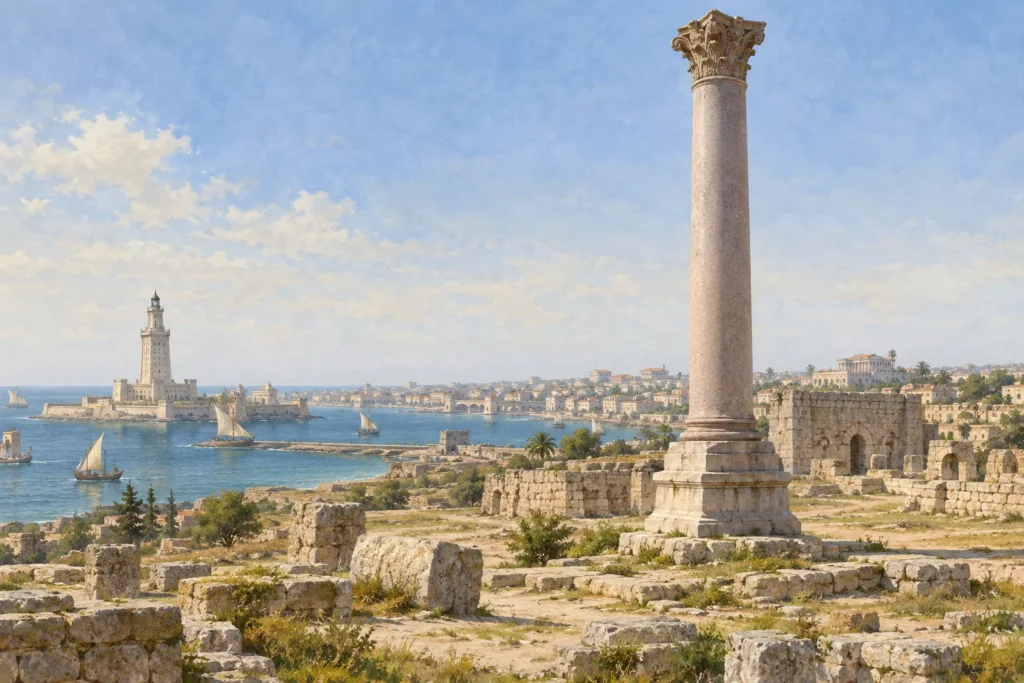
The great column of Alexandria is one of the last ancient monuments still standing in the city. It was erected in AD 297 in honour of the emperor Diocletian, after his victory over the usurper Domitius Domitianus. Its name of Pompey’s Pillar is an old mistake: the Roman general, killed in Egypt, died about three and a half centuries earlier, and the monument has no connection with him. The column stands on the hill of the Serapeum, the main sanctuary of Sarapis, of which only foundations and underground passages remain.
What you discover
The shaft is a monolith of Aswan granite, cut from a single block, one of the tallest monolithic shafts ever raised. It rests on a base and carries an enormous Corinthian capital, also of granite. The published heights vary, from 22 to 30 metres depending on the author; the diameter reaches 2.70 m at the base. The top carried a statue of the emperor, whose nature is debated: the inventory submitted to UNESCO speaks of an equestrian statue, while the Centre d’études alexandrines (CEAlex, Centre for Alexandrian Studies), drawing on a 5th-century mosaic from Sepphoris, suggests a porphyry statue. Around it, the visitor walks over the foundations of the sanctuary and goes down into galleries cut into the rock.
What to look at
The most telling detail is at the foot of the monument. The base of the column contains much older Egyptian blocks, reused by the Roman builders; two are still in place, two others are now kept in the British Museum. The tribute to a Roman emperor thus rests on fragments of pharaonic Egypt. In the underground galleries, the niches made in the walls have been linked to the temple library, which is thought to have stored its papyrus rolls there; the hypothesis remains debated.
The second detail is a story of measurement. On 30 August 1798, the architects and engineers of the French expedition to Egypt wanted to record the exact dimensions of the monument. Charles Norry and his colleagues managed to pass a rope tied to a kite over the top, then ropes, and finally to hoist a seat that allowed them to reach the capital. Norry’s measured drawing, made in 1799, still gives the column the name of Septimius Severus, proof that its attribution was then still uncertain.
Its history
The Serapeum was the most important sanctuary in Alexandria and one of the most famous in Antiquity, the centre of a cult spread throughout the Mediterranean. The excavations carried out around 1900 and then during the Second World War made it possible to distinguish a Ptolemaic phase and a Roman phase; the architecture of the Ptolemaic sanctuary seems to have been Greek rather than Egyptian in style. The column was one of the last additions. In 391, the temple was destroyed and the site passed to Christian use. The column remained standing, and the Arabic name of the place, al-Sawari, ‘the columns’, keeps the memory of a once denser landscape.
Many points remain open: the plan of the sanctuary when the column was raised, the exact function of the underground passages and even the date of the foundation of the temple, which the sources place sometimes in the 3rd and sometimes in the 2nd century BC.
Sources
Consulted on 30 September 2026: Pompey’s Pillar, exhibition ‘1798: Bonaparte’s scholars draw Alexandria’, Centre d’études alexandrines (in French); Alexandria, ancient remains and the new library, World Heritage Tentative List, UNESCO; Judith S. McKenzie, Sheila Gibson and A. T. Reyes, ‘Reconstructing the Serapeum in Alexandria from the Archaeological Evidence’, Journal of Roman Studies 94, 2004.