In brief
Alexandria lies on the Mediterranean coast of Egypt, at the western edge of the Delta, between the sea to the north and Lake Mareotis to the south. Alexander the Great founded it in 331 BC, near an older Egyptian settlement, Rhakotis (Raqote). Having become the seat of Ptolemaic power, it remained the largest and most important city of the eastern Mediterranean until the rise of Constantinople, from the 5th century AD. This long history explains why none of its districts is frozen at the moment of foundation: the ancient city was rebuilt on top of itself for centuries, and it is beneath the modern city that it must be sought.
What you discover
At first sight, Alexandria shows very little of its Greek past. The avenues, the apartment blocks and the Corniche cover the city of the Ptolemies, which comes to the surface only at a few points. The largest non-funerary complex is Kom el-Dikka: a small roofed theatre (odeon), a large bath complex, lecture halls (auditoria), houses with mosaic floors and workshops have been uncovered there, mostly of the late Roman and Byzantine periods. On the hill of the Serapeum stands Diocletian’s column, erected at the end of the 290s AD and wrongly known as Pompey’s Pillar. Close by, the catacombs of Kom el-Shuqafa bear witness to the funerary practices of the Roman period.
What can no longer be seen counts just as much. The Serapeum, the main temple of Sarapis, was destroyed in AD 391, when the emperor Theodosius banned the pagan cults; the Pharos and the Library have also disappeared. The city is therefore read in fragments, which excavations carried out plot by plot are gradually making it possible to connect.
What to look at
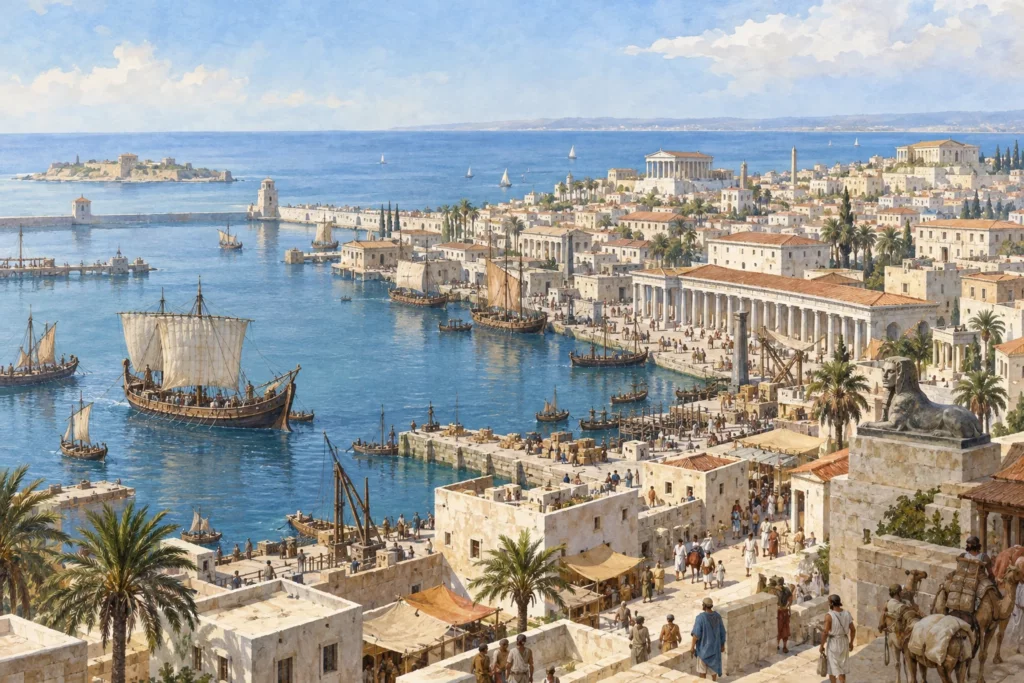
The most telling detail is an orientation. According to the Centre d’études alexandrines (CEAlex, Centre for Alexandrian Studies), Alexander’s first act of town planning was the Heptastadion, a causeway-dyke of seven stades, about 1,300 metres, thrown between the mainland and the island of Pharos. Combined with an aqueduct that supplied the island with water and crossed by two bridges that let boats through, it separated two basins: to the east the Great Harbour, to the west the harbour of Eunostos, the ‘Happy Return’. The axis of this dyke and its perpendicular, the future Plateia or Canopic Way, fixed the orientation of the street grid, which survives to this day. The Heptastadion itself is invisible; it has been found by geophysical survey and the study of sediments.
A second landmark is the Caesareum, a sanctuary of the imperial cult covering more than two hectares. Cleopatra VII had raised an altar there for the cult of Mark Antony; after Actium, Octavian had their monuments destroyed and a temple built, in front of which in 13 BC he had two obelisks of Thutmose III, brought from Heliopolis, set up. Pharaonic monuments nearly fourteen centuries old thus served to mark a Roman temple. Between 1992 and 2002, the CEAlex excavated four adjoining plots in this area during urban building works.
Its history
Alexandria was at once a royal capital, a great port and a centre of learning, before remaining the metropolis of Roman and then Byzantine Egypt. The Museum and the Library belong to this history, but their locations and architecture cannot be reconstructed from the literary traditions alone, and many images of an entirely monumental Alexandria are reconstructions. The ordinary districts, the streets and the dated rubbish dumps count just as much for understanding the city. The exact layout of many blocks, the extent of the palaces and the position of several monuments mentioned by ancient authors remain uncertain.
Sources
Consulted on 30 September 2026: Ports of Alexandria: Antiquity, Centre d’études alexandrines (in French); Alexandria, Egyptian Ministry of Tourism and Antiquities; The Caesareum, Centre d’études alexandrines (in French).