In brief
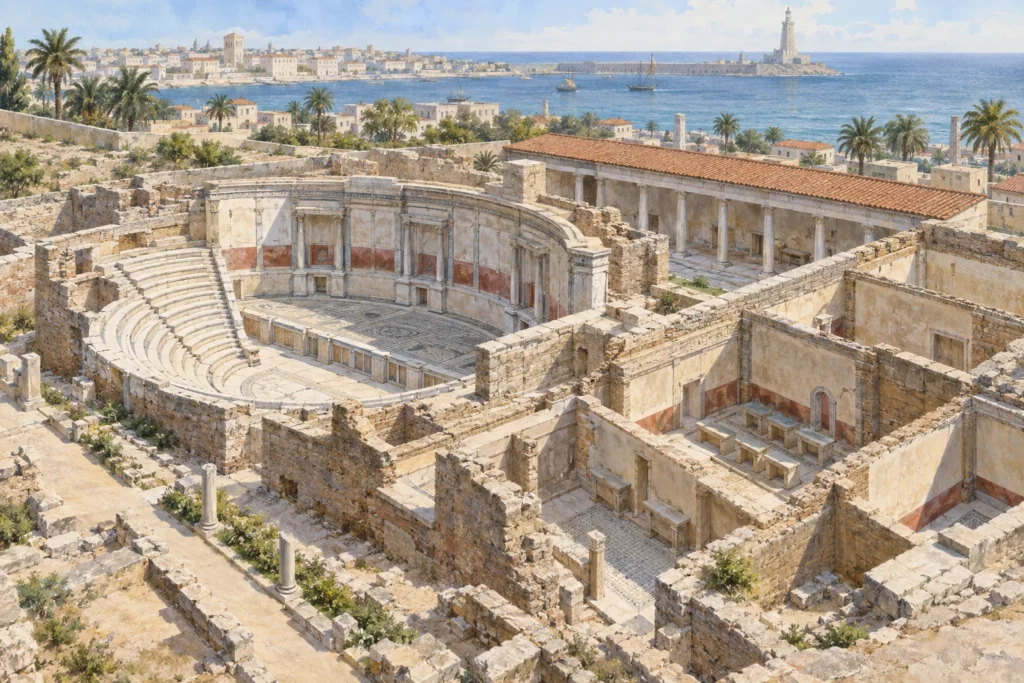
In the heart of modern Alexandria, Kom el-Dikka preserves, over about four hectares, a residential and civic district of the Roman and Byzantine periods, occupied from the 2nd to the 6th century AD. One can see a small theatre, or odeon, presented as the only example of its type known in Egypt, large baths, some twenty lecture halls and houses with mosaics. It is not a city built in a single campaign: each building has its own phases, and the visible whole layers several centuries of rebuilding.
What you discover
The theatre and its marble tiers first catch the eye. It closes the southern end of a great portico that crossed the whole block from north to south. Around the theatre and the portico are lined the auditoria, small halls with tiered benches interpreted as lecture rooms. In the northern part of the site extend the baths, with their rooms heated by hypocaust, a large masonry cistern, palaestrae and public latrines.
This public complex has not always existed. On its site stood, in the 1st and 2nd centuries, wealthy town houses, destroyed at the end of the 3rd century before the whole block was reorganised. Another house of the early Roman period, the Villa of the Birds, owes its name to a pavement showing different species of birds; it now houses, under a shelter, several mosaics, including a mosaic of Dionysus found near the theatre and moved there in 2016.
What to look at
A tiny detail sheds light on the origin of the baths. Beneath a marble Ionic capital, reused in the building, the letters ΦΛ ΑΝΤ are carved. These capitals had been imported from Asia Minor in the 1st or early 2nd century, then recovered. According to a study published in 2021, the abbreviation would refer to Flavius Antonius Theodorus, prefect of Egypt in 337 and 338, which would place the start of the work under Constantine, around 337.
Look also at the ground itself. South of the baths, an immense mound of ash and urban waste accumulated from the 4th to the 7th century, until it rose several metres above the paving of the baths and the portico. The excavators recovered mainly pottery from it, but also glass, and, beneath it, the ruins of the houses of the early Roman period.
Its history
The baths went through three main phases: a construction in the 4th century, then two rebuildings, the first after 395–425 according to a coin, the second dated by a coin of the emperor Maurice (582–602). The mission of the Polish Centre of Mediterranean Archaeology of the University of Warsaw, which excavates the site with the Egyptian authorities, opened a new visitor route on 1 April 2017, marked by bilingual panels in front of the main monuments.
Several questions remain open. Some link the foundation date of the baths to the tsunami of 365, others to the reign of Constantine. The precise use of each auditorium remains unknown: it cannot be attributed to a known school or teacher. Finally, the phases of the theatre remain to be clarified.
Sources
Consulted on 30 September 2026: Kom el-Dikka, Egyptian Ministry of Tourism and Antiquities; Anna Urszula Kordas, ‘The baths at Kom el-Dikka in Alexandria as a foundation of Constantine the Great?’, Journal of Roman Archaeology 34, 2021; Grzegorz Majcherek, ‘Alexandria, Kom el-Dikka. Season 2017’, Polish Archaeology in the Mediterranean 27/1, 2018.