In brief
The catacombs of Kom el-Shuqafa are the most famous of the necropolises of Alexandria. This great hypogeum, that is, a tomb entirely dug underground, was cut into the rock at the end of the 1st century AD, not far from the great temple of Sarapis. It is neither a pharaonic tomb nor a monument contemporary with the founding of the city: it is a collective burial place of the Roman period, whose decoration combines Egyptian and Greek forms in a single space.
What you discover
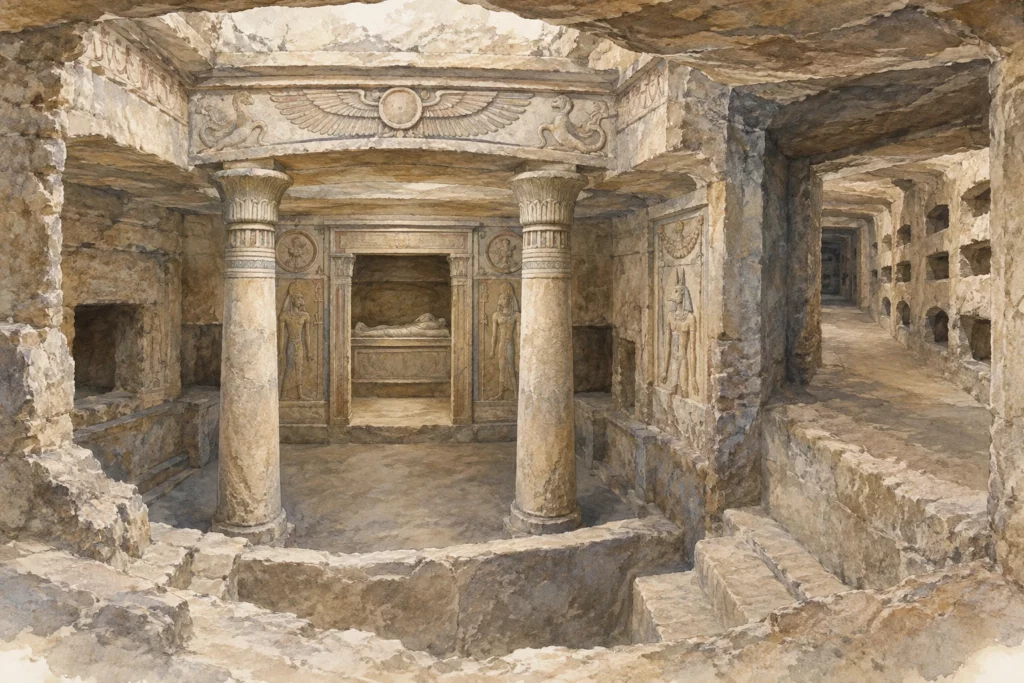
The descent begins with a wide circular shaft around which a staircase winds. The central void probably allowed bodies to be lowered without carrying them down the steps. On the first underground level, a rotunda gives access to the rooms. The largest is a funerary banqueting hall, where relatives and friends gathered on stone benches cut from the rock for meals in honour of the dead.
A narrower staircase leads one level down to the main tomb, then to galleries cut with many loculi, the rectangular niches into which the dead were slid before being closed with a slab. The hypogeum had three levels; the deepest is now entirely flooded. Originally the whole was much more modest: the galleries were added over the generations, and a passage cut later now links the main tomb to a second hypogeum, called the Hall of Caracalla.
What to look at
The façade of the main tomb sums up the Alexandrian style on its own. Papyriform columns, of Egyptian inspiration, open onto a vestibule whose walls bear great carved serpents. These are figures of Agathodaimon, the good protective spirit peculiar to Alexandria, wearing the double crown of Egypt. Each holds the caduceus of Hermes and the thyrsus of Dionysus, two Greek attributes, and above each rises a shield adorned with a head of Medusa, meant to ward off evil.
Inside, the figures of Anubis, the jackal-headed god who watches over the dead, are dressed as Roman soldiers. In the neighbouring Hall of Caracalla, two painted tombs show the other face of this blend: an upper register in Egyptian style devoted to Osiris, a lower register in Greek style telling the myth of Persephone.
Its history
The area was explored by Giuseppe Botti from 1892, then by the German expedition funded by Ernst von Sieglin. The entrance of the great hypogeum was found in 1900, according to tradition when a donkey fell into the opening. The paintings of the Hall of Caracalla, reported as early as 1901, were really studied only from the 1990s onwards by the Centre d’études alexandrines (CEAlex, Centre for Alexandrian Studies), using infrared photography and then ultraviolet fluorescence, which brought back images that had become invisible to the naked eye.
The monument is still threatened by groundwater. Between 2017 and 2019, a dewatering project installed six deep pumping wells to lower the water level. Many questions remain: we do not know who commissioned the main tomb, and the history of its successive enlargements remains difficult to reconstruct.
Sources
Consulted on 30 September 2026: Jean-Yves Empereur, A Short Guide to the Catacombs of Kom el Shoqafa, presentation, Centre d’études alexandrines; Sayed Hemeda, ‘Geotechnical modelling of the climate change impact on world heritage properties in Alexandria, Egypt’, npj Heritage Science, 2021; Marjorie S. Venit, review of Guimier-Sorbets, Pelle and Seif el-Din, Renaître avec Osiris et Perséphone, Bryn Mawr Classical Review, 2015.