Thebes, in the Luxor region, is read on both banks of the Nile. To the east lie Karnak and Luxor Temple; to the west extends the necropolis, with its valleys of tombs and its mortuary temples. This article links these great sectors and shows where to begin exploring the articles.
In brief
Thebes was the capital of Egypt in the Middle and New Kingdoms. The ancient city, now Luxor, lies in Upper Egypt, far south of Cairo. For UNESCO, which inscribed it on the World Heritage List in 1979 as ‘Ancient Thebes with its Necropolis’, it bears witness to Egyptian civilisation at its height. Its inscriptions and decoration also evoke the neighbouring peoples: Nubians, Libyans, Syrians.
What you discover
On the east bank, Karnak brings together several cult domains, the largest of which is that of Amun-Ra. Luxor Temple, a masterpiece of 14th-century BC architecture according to UNESCO, is another great sanctuary. An avenue lined with sphinxes links the two places, which are close in the history of the city without forming a single building.
On the west bank, the necropolis counts, according to UNESCO, thousands of tombs, dozens of temples and a multitude of houses, villages, shrines, monasteries and workshops. Here are the tombs of kings, queens and princes, those of high officials, the temples intended for the cult of the dead rulers and the craftsmen’s village of Deir el-Medina. Malkata, the palace of Amenhotep III, is also there, without being a mortuary temple.
What to look at
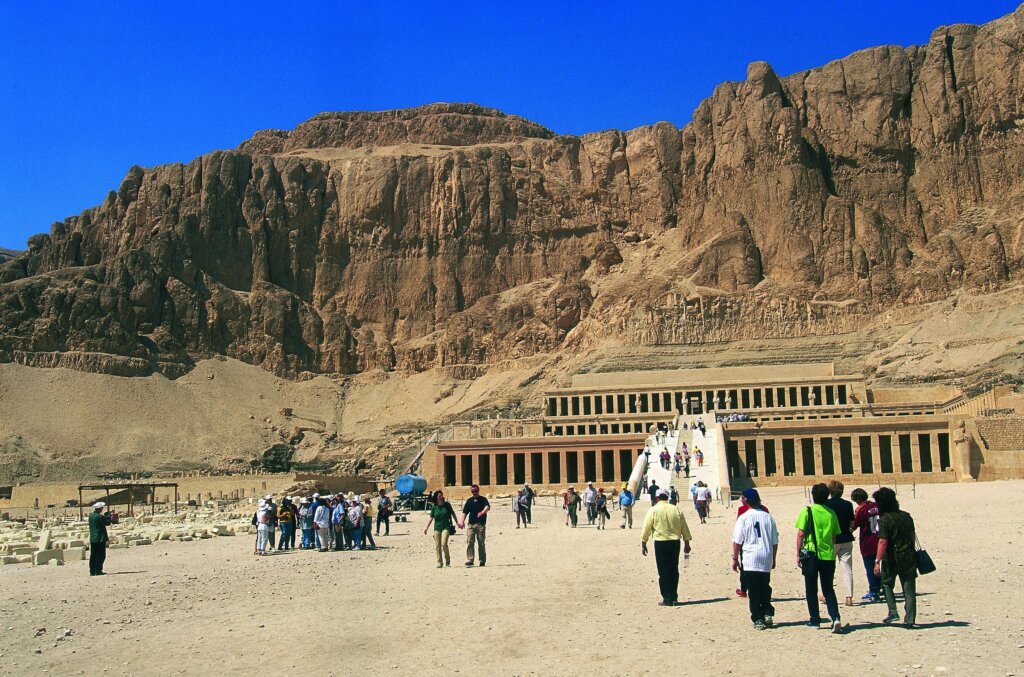
At Karnak, the great hypostyle hall gives the measure of the city: 134 columns spread over about 102 m in width and 53 m in depth, according to UNESCO. Begun under Amenhotep III, it was mainly built and decorated under Seti I and Ramses II (Ramesses II). In the photograph, the mortuary temple of Hatshepsut at Deir el-Bahri is a reminder that the west bank is also a bank of temples, set against the cliff.
Its history
The Theban monuments span several periods. The oldest evidence at Karnak goes back to the reign of Intef II, c. 2112–2063 BC; almost all the kings of the New Kingdom then built there, and the Ptolemies and the Romans still added buildings. The river, the processional ways and the reliefs of the west bank give reference points for reading, but no sector can be reduced to a static image of ‘the Egypt of the pharaohs’.
How to explore the articles
On the east bank, the Karnak article opens onto the domain of Amun-Ra, the sanctuary of Mut and the sanctuaries of Montu; Luxor Temple has its own overview. On the west bank, the Theban necropolis leads to the Valley of the Kings, the Valley of the Queens, the tombs of the nobles and the mortuary temples.
Sources
UNESCO, Ancient Thebes with its Necropolis: https://whc.unesco.org/en/list/87
Egyptian ministry, Thebes: https://egymonuments.gov.eg/collections/thebes/
Egyptian ministry, Luxor Temple: https://egymonuments.gov.eg/monuments/luxor-temple