In brief
On the west bank at Thebes, Malkata was a city of palaces and services built for Amenhotep III. It housed the court and the Sed festivals that symbolically renewed kingship. Its mudbrick remains and the traces of the immense Birket Habu basin belong to a complex larger than an isolated residence.
What you discover
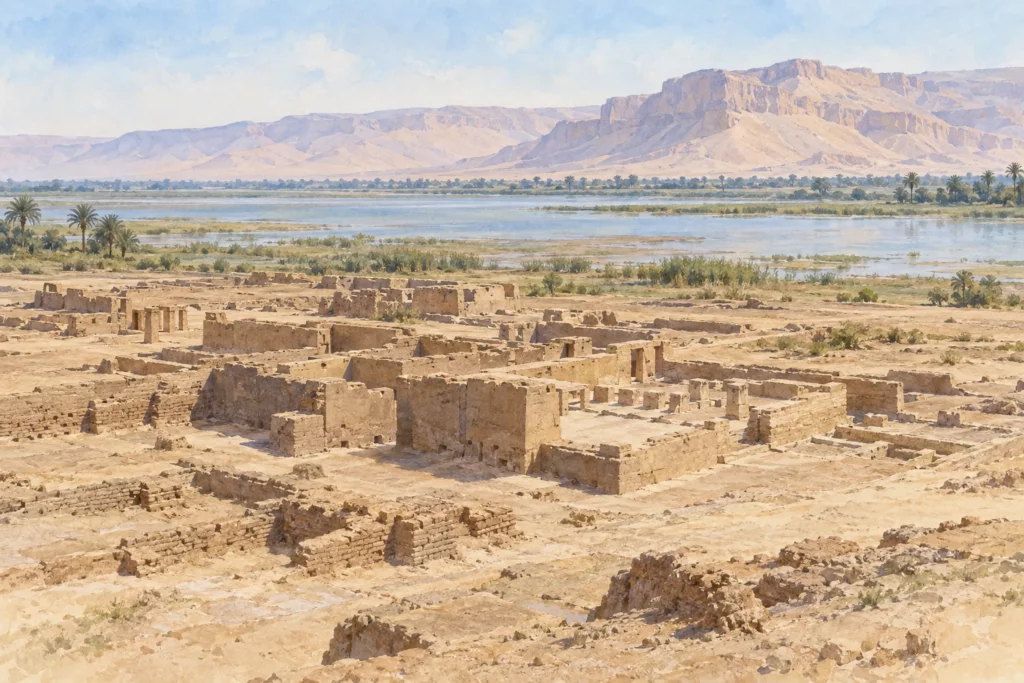
Visitors mainly come across low walls: royal palaces, administrative buildings, housing, workshops and a temple of Amun have lost much of their elevations. Fragments of painted floors, walls and ceilings nevertheless bear witness to once very rich decoration. Birket Habu was an artificial basin about 2.5 kilometres long, east of the palace areas. Further south, the platform of Kom el-Samak is associated with the jubilee rites. A present-day view cannot on its own convey the scale of this festival city.
Its history
Building had begun before the ruler’s first jubilee, celebrated in year 30. Two further Sed festivals took place in years 34 and 37; the buildings and repairs therefore do not all belong to a single campaign. After the death of Amenhotep III, the city was largely abandoned. The Metropolitan Museum excavated Malkata in the early 20th century; other missions later studied the basin, the quarters and the conservation of the remains.
Why this place matters
Tombs and temples say much about Egyptian kingship, but Malkata also shows its material life. Jar labels document the supplies for the jubilees and name officials. The palaces, dwellings and workshops reveal the work needed for the ceremonies. Since mudbrick walls are fragile and often incomplete, any image reconstructing the city must remain a clearly signalled hypothesis.