Identification and location
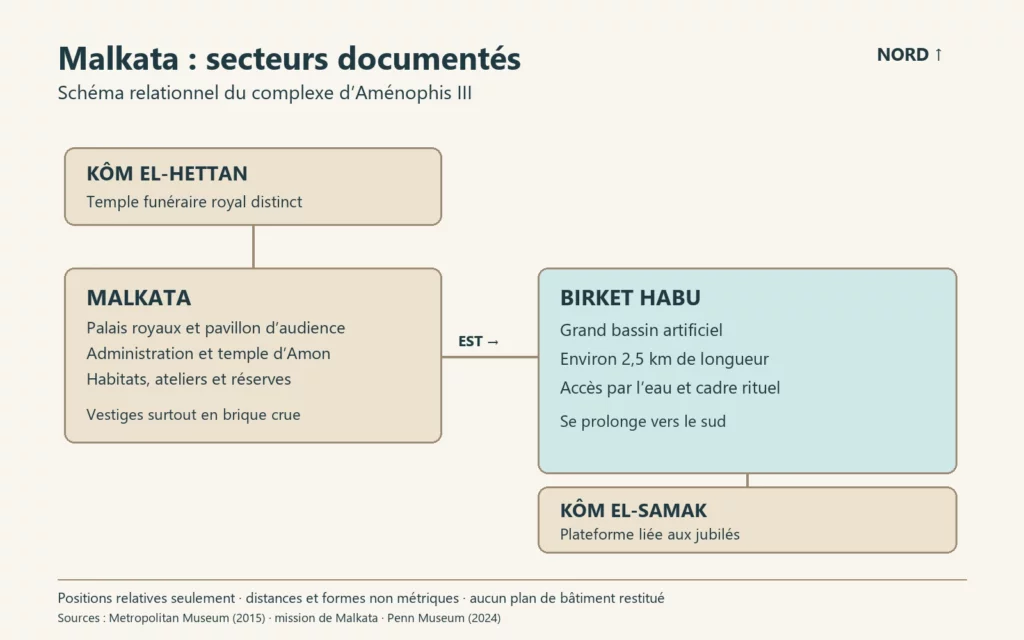
At the southern end of the Theban west bank, Malkata occupied the edge of the desert and the cultivated plain. The name refers to an extensive archaeological landscape, not just to the ruler’s residence. The low ruins of the mudbrick buildings and the embankments that bordered Birket Habu are today the most legible landmarks. The royal city lay south of the mortuary temple of Kom el-Hettan; this proximity does not merge their functions.
General presentation
The palace area brought together the king’s palace, other residences, an audience pavilion, administrative spaces and a sanctuary of Amun. Areas of housing and production accommodated the people responsible for running the court and the celebrations. The painted floors, walls and ceilings known from fragments show elaborate decoration. They provide information on particular rooms, without making it possible to reconstruct the appearance of all the buildings uniformly. The undulating walls, preserved to a low height in several areas, contributed to the organisation of the space.
Monuments and remains
Birket Habu was a vast artificial basin, laid out on the edge of the city and about 2.5 kilometres long according to the fieldwork presented by the Penn Museum. It served as an approach by water and also played a part in the ceremonial setting. The spoil from its excavation formed imposing embankments. Further south, the platform of Kom el-Samak is linked to the jubilee rites; that of Kom el-Abd remains of uncertain interpretation. These elements show that the workings of Malkata went far beyond the state rooms.
Chronology and building phases
The palace was begun before the first jubilee, and the court moved to Malkata at the end of year 29, according to the Penn Museum. The three Sed festivals of Amenhotep III are placed in years 30, 34 and 37 of his reign. The initial building work, the works carried out for the following celebrations and the repairs to existing buildings must therefore be distinguished. The Joint Expedition to Malkata attributes in particular to the second festival the construction of a temple dedicated to Amun. After the ruler’s death, the city was largely abandoned; it would be misleading to describe it as a complex that remained active in the same way for centuries.
History and functions
The city housed the royal family and met the material needs of a large court. The jar labels found on the site mention wine, beer, fat and meat intended for the festivals, as well as the officials responsible for supplying them. They give access to the practical administration of the jubilees, beyond their ritual representations. The stoppers bearing the cartouches of the king and of Queen Tiye also refer to producing royal estates. The ceremonies involved several places in the Theban region: the presence of Malkata at the centre of the arrangement does not allow a precise route to be traced between each monument.
Excavations and the history of research
The Metropolitan Museum of Art carried out six campaigns between 1910 and 1920. The excavations of David O’Connor and Barry Kemp in the 1970s studied Birket Habu in particular; Waseda University worked on the site from 1985 to 1992. A joint expedition, under way since 2008, has continued the exploration and conservation of the palace. Old plans, finds, surface observations and recent test trenches provide information of different kinds: their results must be compared before attributing a function to a room or a date to a wall.
State of preservation and research questions
Mudbrick erodes quickly when walls are exposed. As the upper parts have often disappeared, the original height, the internal circulation and the appearance of some façades remain hypothetical. Cultivation and changes in the landscape complicate the reading of the basin. The questions concern in particular the sequence of the jubilee works and the links between palace, service quarters and the areas towards Kom el-Hettan.
Sources
Main sources (consulted on 28 September 2026): Catharine H. Roehrig, ‘The Met’s Joint Mission to Malqata’, Metropolitan Museum of Art, https://www.metmuseum.org/ja/perspectives/malqata-excavation; ‘History of the Site’, Joint Expedition to Malqata, https://imalqata.wordpress.com/history/; Jennifer Houser Wegner, ‘Festive Fragments’, Penn Museum, https://www.penn.museum/sites/expedition/festive-fragments/.