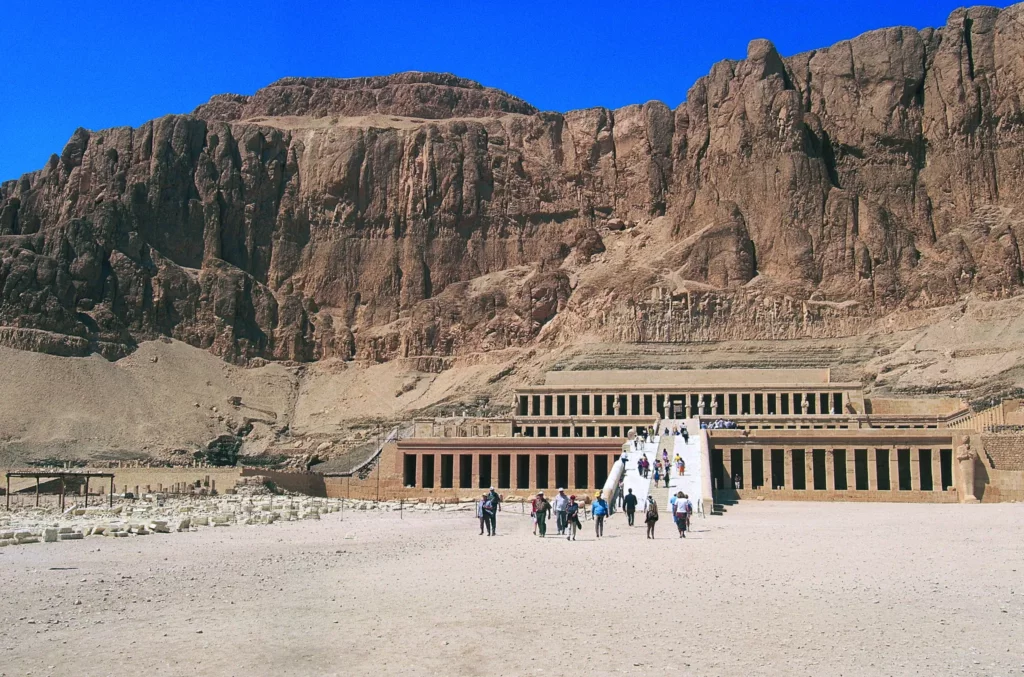
The Theban necropolis is an archaeological territory of the west bank whose components have different functions, dates and states of preservation. Its editorial hierarchy serves to distinguish the categories of evidence without imposing a uniform model on all the monuments.
Kings, queens and other dead
The Valley of the Kings gathers royal tombs of the New Kingdom; the Valley of the Queens concerns other members of the ruling family, in situations that changed over time. The tombs of high officials show yet other social paths and practices of representation. These categories do not cover all the tombs of the west bank.
The case of tomb C4 calls for geographical precision. Valley C is a distinct sector west of the Valley of the Kings; the distances and the attribution of C4 are detailed in the monument’s article. It therefore appears directly under the Theban necropolis. Its historical closeness to the royal burials is not an identity of place.
Temples and work spaces
The royal mortuary temples form a sub-group devoted to rites linked to the dead rulers. The temples of Mentuhotep II, Hatshepsut, Amenhotep III, Seti I and several Ramesside kings are not royal tombs in the strict sense. Their architecture and programmes must each be described in their own article.
Deir el-Medina (063) adds the village and the tombs of the craftsmen. Its traces document families, work, cults and funerary practices. This sector is not a mere appendage of the Valley of the Kings; it provides sources on the people who lived in this landscape.
Topography and reading the remains
The relief of the west bank, the valleys and the cultivated strip guided the siting of the monuments. However, the present map also results from excavations, access roads and modern restorations. A panoramic view informs about the landscape but does not on its own restore the ancient limits of the sectors.
The division adopted makes it possible to link the articles while keeping the functional distinctions. Malkata does not belong to the necropolis: this palace complex appears directly under Thebes. The plate in this article is a reading map of the categories, not an excavation plan.
Categories and the limits of classification
Classification into kings, queens, high officials and mortuary temples makes access to the articles easier, but the categories do not cover the whole Theban funerary topography. The valleys, slopes and areas of plain were occupied unevenly from period to period. Some monuments involve several questions at once: a tomb makes it possible to study a dead person, a decoration, workshops and a history of excavation.
UNESCO describes on the west bank not only tombs and temples but also houses, villages, shrines, monasteries and places of work. The necropolis is therefore a lived-in and reused landscape, not just a succession of royal burials. The present route gives priority to the articles documented in the list of 144; it does not claim to inventory every remain of the heritage property.
Sources
UNESCO, Ancient Thebes with its Necropolis: https://whc.unesco.org/en/list/87
Egyptian ministry, Valley of the Kings: https://egymonuments.gov.eg/archaeological-sites/valley-of-the-kings
Egyptian Ministry of Tourism and Antiquities, Ancient Thebes and its Necropolis: https://egymonuments.gov.eg/en/world-heritage/ancient-thebes-and-its-necropolis/