In brief
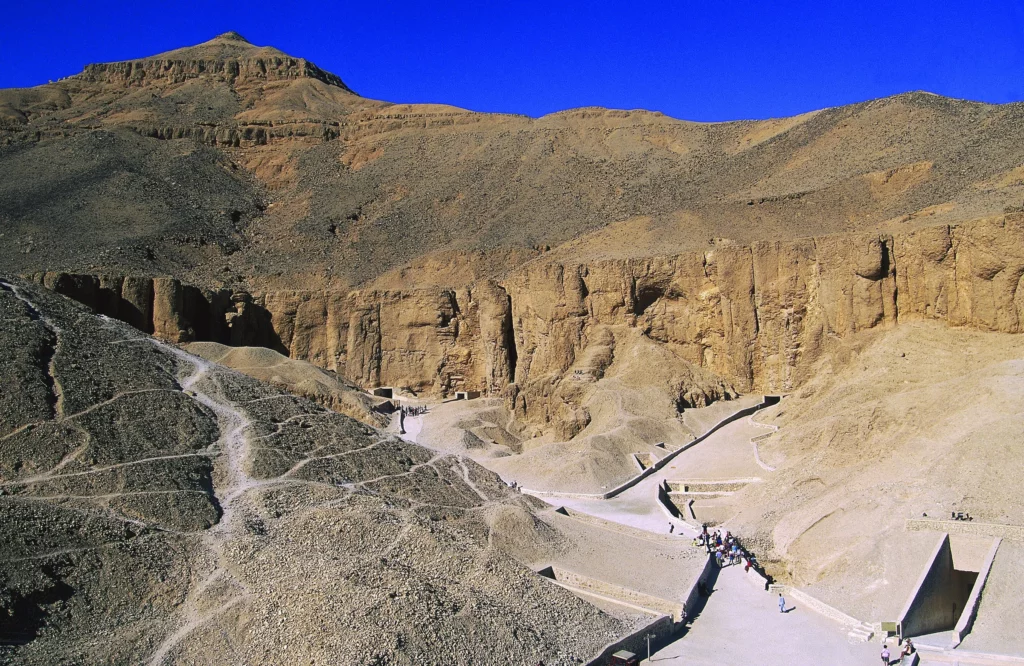
On the west bank at Thebes, opposite present-day Luxor, the Valley of the Kings holds the burials of New Kingdom rulers. The Egyptian Ministry of Tourism and Antiquities counts more than 60 completed tombs and some twenty unfinished ones there, divided between an eastern valley, the most visited, and a western valley. The tombs are cut into the limestone, far from the great mortuary temples visible from the plain. Thutmose I is the first king whose burial in the valley is confirmed; the identification of his original tomb remains debated.
What you discover
The first royal burials of the 18th Dynasty do not yet offer the long decorated routes that would characterise some later tombs. The entrances are hidden in a relief of cliffs and ravines, dominated by a naturally pyramidal peak. The choice of the place was due to the isolation of the valley, which favoured discretion in the face of the looting that had struck the pyramid complexes, and to the religious value of the West, where the sun dies and is reborn. The ministry also points out that the region honoured Hathor in her funerary aspect as ‘Mistress of the West’.
What to look at
The most eloquent detail is a text, not a painting. In the inscription of his tomb, the official Ineni declares that he supervised the excavation of the king’s cliff tomb in secret, ‘no one seeing, no one hearing’. This passage, cited by the ministry, sheds light on what was at stake in the building work under Thutmose I: hiding the entrance of a royal burial. On the ground, therefore, one should look at the position of the entrances, the slope of the ravines and the outline of the peak, rather than seek great decoration that does not yet exist in these tombs.
Its history
The name of Thutmose I is linked to two tombs, KV20 and KV38. KV20 was also fitted out for Hatshepsut. Inscribed objects, fragments of the Book of the Amduat and the study of the underground spaces make it possible to examine their history, without definitively settling the order of all the works and transfers. Scholars do not agree on which of the two Ineni mentions. ‘KV’ is a modern inventory number: it indicates neither the age nor the certain occupant of a tomb.
Why this place matters
Since 1979 the valley has been part of ‘Ancient Thebes with its Necropolis’, inscribed by UNESCO, which mentions there tombs dated from about 1500 to 1000 BC, including the burial chamber of Tutankhamun. The first tombs show how kingship chose a burial place separate from its cult temples. The investigation into KV20 and KV38 also reveals the work of archaeologists: bringing together architecture, inscriptions and displaced remains, while taking into account the looting and floods that have altered the contexts.
Sources
Consulted on 30 September 2026: Valley of the Kings, Egyptian Ministry of Tourism and Antiquities; Ancient Thebes with its Necropolis, UNESCO.