In brief
Tomb C4 is cut into Wadi C of the Theban mountain, about 2.4 kilometres west of the Valley of the Kings. Its entrance and main corridor were located in October 2022 by a joint mission of the Egyptian Supreme Council of Antiquities and a British foundation devoted to the New Kingdom. In 2025, the Egyptian Ministry of Tourism and Antiquities attributed it to Thutmose II, a king of the 18th Dynasty. It lies outside the Valley of the Kings proper, in a distinct sector of the Theban necropolis.
What you discover
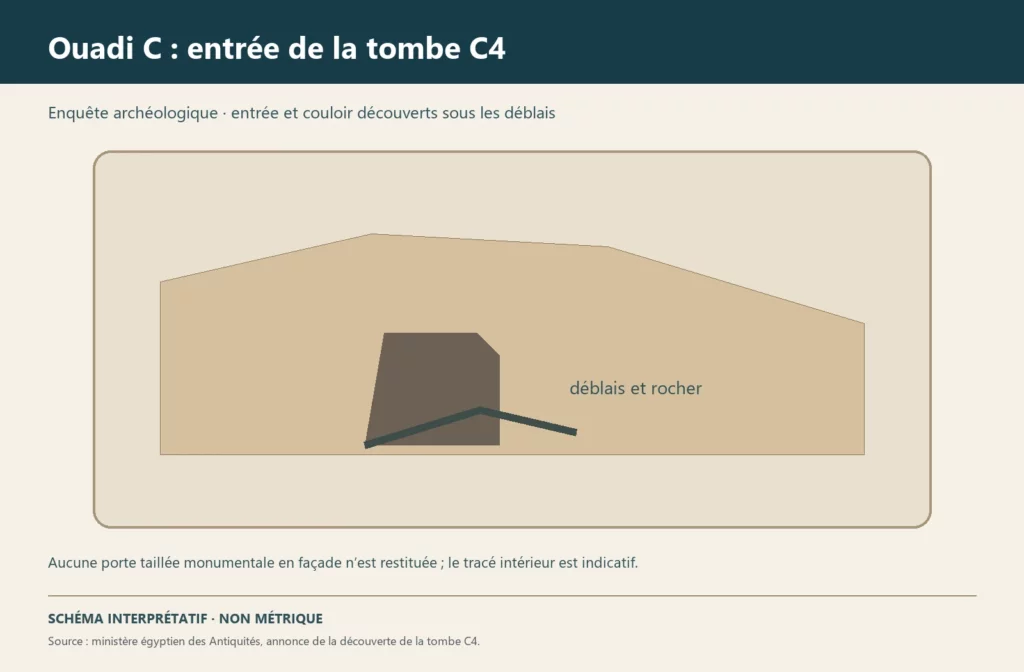
The monument has nothing of a monumental façade. The entrance was buried under deposits, and the plan remains simple: a corridor coated with white plaster descends towards the burial chamber. The ministry notes a difference in level of about 1.4 metres between the corridor and the chamber. The walls have suffered greatly. It is therefore mainly fragments, collected from the debris, that make it possible to understand the place: pieces of alabaster vessels, flakes of painted plaster, scraps of text.
What to look at
The fragments of alabaster vessels are the centrepiece of the file. They bear the name of Thutmose II with the designation of deceased king, which makes them funerary objects intended for his cult, and that of Hatshepsut, his wife. This detail changed the identification of the tomb. The second element to observe is the plaster: some pieces preserve blue inscriptions, yellow stars on a dark ground and passages from the Book of the Amduat, a text describing the night journey of the sun god through the underworld. This decoration, reserved for royal burials, carries more weight than the position of the tomb alone.
Its history
The excavators first considered a burial of a woman of the royal family, because of the neighbouring female tombs. The reading of the inscriptions corrected this first hypothesis. According to the ministry, a flood is thought to have struck shortly after the burial, damaging the tomb. The funerary equipment and the body are thought to have been moved later in Antiquity. This explanation rests on the state of the monument and on the few objects found; it does not say where the king was transferred, nor on what exact date.
Why this place matters
UNESCO’s World Heritage List recognises the Theban necropolis as a vast group of tombs and temples on the west bank, occupied mainly between 1500 and 1000 BC. C4 adds a rare example to it: that of an attribution that changes as evidence appears. The official announcement remains a press release on a discovery, not a complete scientific publication. The precise dimensions, the sequence of the deposits and the destination of the mummy remain to be established.
Sources
Consulted on 30 September 2026: Discovery of the Tomb of King Thutmose II, Egyptian Ministry of Tourism and Antiquities; Ancient Thebes with its Necropolis, UNESCO.