On the west bank at Thebes, the necropolis comprises much more than the Valley of the Kings. Tombs of rulers, burials of queens and princes, tombs of dignitaries, mortuary temples and the craftsmen’s settlement form a landscape of different functions and periods.
In brief
Facing Karnak and Luxor, on the other side of the Nile, the Theban mountain served as the necropolis of the New Kingdom kings and their entourage. UNESCO, which inscribed Thebes and its necropolis on the World Heritage List in 1979, describes there thousands of tombs, dozens of temples and a multitude of houses, villages, shrines, monasteries and workshops. It is a lived-in territory as much as a burial place.
What you discover
The Valley of the Kings, where Tutankhamun was buried, and the Valley of the Queens are two distinct sub-groups. The tombs of high officials occupy other sectors, on the slopes of the mountain. Valley C, where tomb C4 attributed to Thutmose II lies, belongs to the Theban funerary landscape without being located in the Valley of the Kings proper.
At the foot of the cliff and in the plain stand the mortuary temples: that of Hatshepsut at Deir el-Bahri, the Ramesseum of Ramses II (Ramesses II), Medinet Habu of Ramses III, and the Colossi of Memnon, the last guardians of the temple of Amenhotep III. These temples are not the tombs of the rulers: they served the rites and the memory of the king. Deir el-Medina, finally, preserves the village and the tombs of the workmen who cut the royal tombs.
What to look at
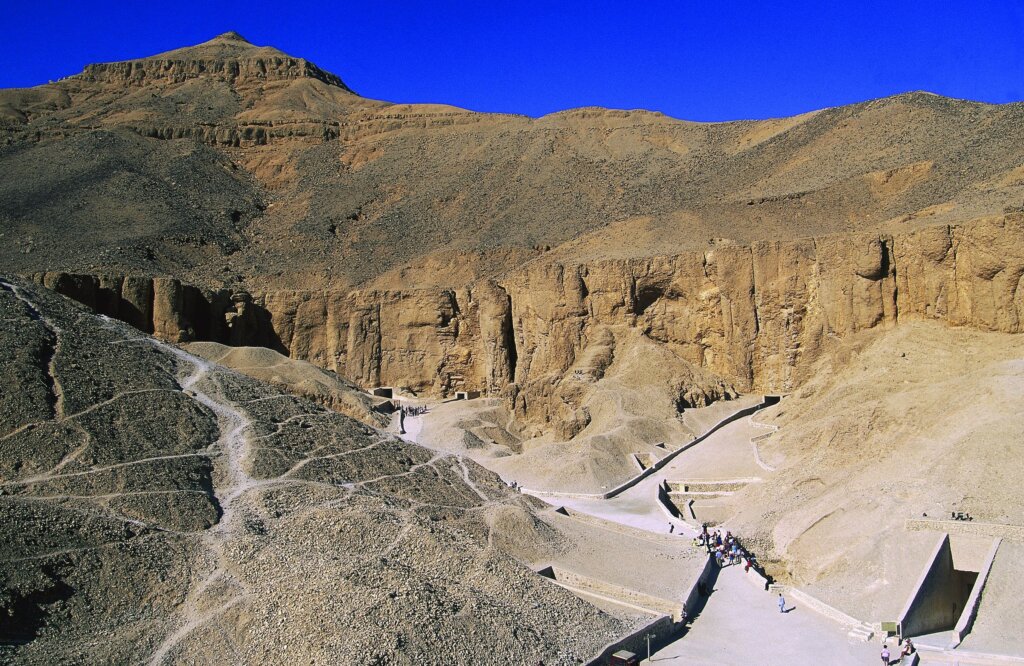
Above the Valley of the Kings, a pyramid-shaped peak stands out from the cliffs. The Egyptian Ministry of Antiquities points it out as a landmark of the landscape: the New Kingdom kings, who no longer built pyramids, thus rested in the shadow of a natural pyramid. The photograph shows the valley itself, its limestone slopes and the entrances to the tombs.
Its history
The Valley of the Kings received royal tombs during the 18th, 19th and 20th Dynasties, between about 1550 and 1069 BC. The Valley of the Queens first received officials, then wives, sons and daughters of kings. Much later, in the 25th and 26th Dynasties, high dignitaries still had monumental tombs cut, such as that of Padiamenope in the Asasif. In the Roman and Coptic periods, tombs were reoccupied and monasteries were established on the west bank.
How to explore the articles
The sub-articles separate the kings, the queens and princes, the high officials and the mortuary temples. The individual tombs and monuments then detail their inscriptions, their layout and their excavation history. Deir el-Medina and tomb C4 are attached directly to the necropolis.
Sources
UNESCO, Ancient Thebes with its Necropolis: https://whc.unesco.org/en/list/87
Egyptian ministry, Valley of the Kings: https://egymonuments.gov.eg/archaeological-sites/valley-of-the-kings
Egyptian Ministry of Tourism and Antiquities, Ancient Thebes and its Necropolis: https://egymonuments.gov.eg/en/world-heritage/ancient-thebes-and-its-necropolis/