Identification and location
The royal necropolis of South Saqqara developed around the pyramid of Pepi I during the 6th Dynasty and beyond. The systematic excavations carried out since 1987 by the French Archaeological Mission, which became French-Swiss, have revealed queens’ complexes south and west of the royal monument. The usual name of the sector must not lead to attributing all the pyramids to wives of Pepi I: some owners were among his descendants or belong to later reigns, and others remain uncertain.
General presentation
The scientific interest of the whole is that it allows several women’s monuments to be compared within a single space. Differences of area, plan, titles and decoration shed light on court hierarchies and on changes in the use of the necropolis. The complexes clearly attributed to Nubunet and Inenek-Inti, wives of Pepi I, can be compared with those of Mehaa, Ankhesenpepi II and Behenu. The discovery of funerary texts in the tombs of some queens shows that access to the Pyramid Texts was not limited to kings.
Monuments and remains
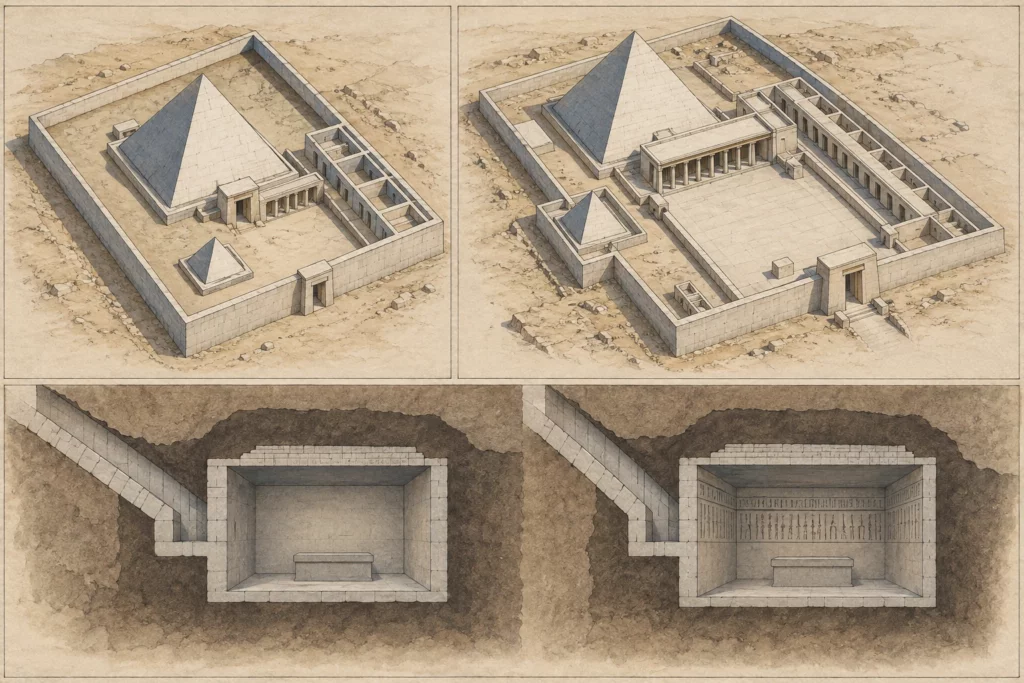
The pyramids of Nubunet and Inenek-Inti have bases of about 21.22 and 22.79 metres according to the mission’s surveys. Their funerary apartments are undecorated. The complex of Inenek-Inti comprises a porticoed court, a suite of rooms of the inner temple and a satellite pyramid. That of Nubunet is organised around a hall of niches, an offering hall and a probable storeroom. Behenu has a larger pyramid, a porticoed court, several storerooms and Pyramid Texts. Ankhesenpepi II, dealt with in article 037, received the largest complex after the king’s. The lanes, walls and constraints of the neighbourhood partly explain the variations in plan.
Chronology and building phases
Inenek-Inti seems to have received one of the first plots, her regular plan suggesting a space that was still uncrowded. The necropolis then grew denser. The anonymous western complex shows a history in several phases: a stone pyramid, then brick structures and changes of access; the mission stresses that their chronology remains conjectural. The tomb of Behenu encroaches on the area of Mehaa. Monuments of Ankhesenpepi III, a daughter of Merenre, and of Meretites II, probably a wife of Pepi II, are a reminder that the whole extends beyond the founding reign.
History and functions
The temples of these queens received the offering rites linked to their cult. The halls of niches or statues, the courts and the storerooms contributed to this functioning. The burial chambers were distinct from the accessible ceremonial spaces. The Pyramid Texts of Behenu and Ankhesenpepi II contributed to their posthumous survival, but the absence of surviving texts for Nubunet or Inenek-Inti does not prove the absence of complex funerary practices. The titles of Inenek-Inti, notably that of vizier, invite us to consider the political position of some royal women without projecting the same function onto all of them.
Excavations and the history of research
The mission identified the owners from inscriptions, architecture and context, while distinguishing levels of certainty. For Behenu, an inscription calls her ‘beloved of Pepi’, without specifying which one; the attribution to Pepi I is therefore plausible but not definitive. The ‘western complex’ still has an unknown owner. The French-Swiss Archaeological Mission provides room-by-room descriptions and the measurements of several pyramids; the IFAO offers an overview and a plan of the necropolis. These documents make it possible to move beyond older reconstructions that presented a more uniform whole than is actually the case.
State of preservation and research questions
The surviving decoration and dimensions vary greatly. The Pyramid Texts of Behenu are fragmentary and still being studied; those of Ankhesenpepi II have been the subject of a dedicated edition. The distinction between original walls, replaced fragments and graphic reconstruction is indispensable.
Sources
Main sources: French-Swiss Archaeological Mission at Saqqara, ‘Les reines de Pépy Ier’ (in French), https://www.unige.ch/mafssaqqara/fouilles/reines-pepy-ier; ‘Textes des Pyramides’ (in French), https://www.unige.ch/mafssaqqara/textes-des-pyramides; Institut français d’archéologie orientale, ‘Saqqara’ (in French), https://www.ifao.egnet.net/recherche/archeologie/saqqara/ (consulted on 27 September 2026).