Identification and location
The complex of Pepi II, King Neferkare, lies in the southern part of Saqqara. It belongs to the end of the 6th Dynasty and follows on from the complexes of Pepi I and Merenre. University College London describes an exceptionally long reign, variously estimated at between about sixty and ninety years. The precise chronology of the reign and of each element of the complex should therefore not be fixed in a single date. Several queens’ monuments are linked to this royal necropolis.
General presentation
The site makes it possible to study at once the persistence of the Pyramid Texts, the organisation of the royal cult and the place of queens in a necropolis of the late Old Kingdom. The king’s chambers had an inscribed programme; the monuments of Neith, Iput and Wedjebten provide their own bodies of texts. The publications of different periods also show how successive excavations and reassemblies can change the reading of the same walls. The interest of the complex goes beyond a simple measure of the length of the king’s reign.
Monuments and remains
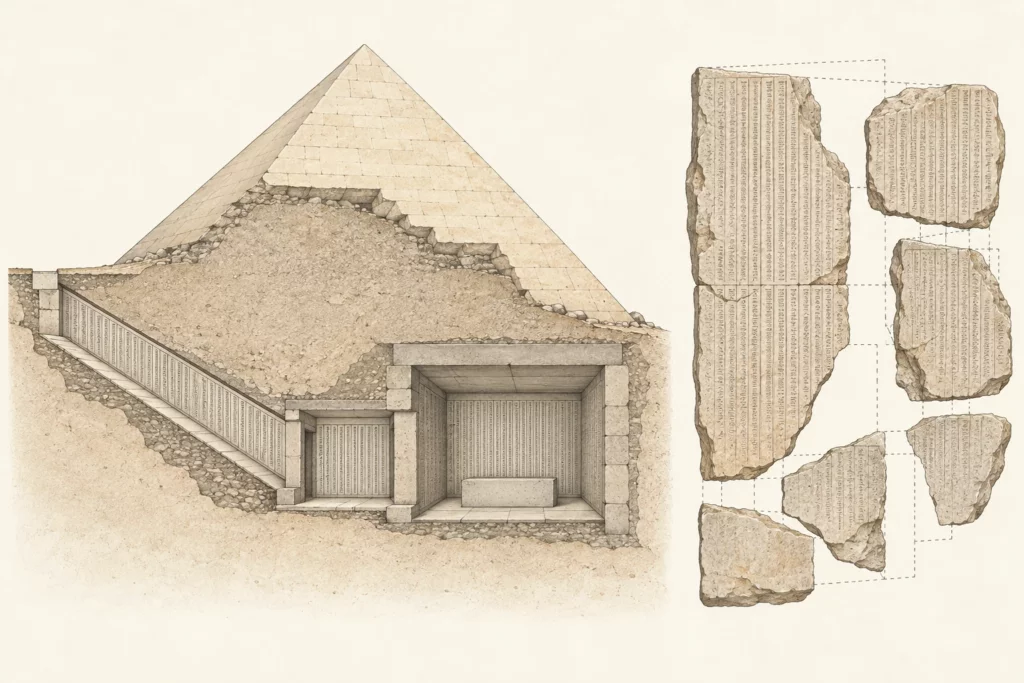
The pyramid belonged to a complex comprising a mortuary temple, approaches and ritual buildings. Its internal passages opened onto the funerary apartments in which spells were carved. The casing and external structures have suffered heavy losses, while the chambers and the carved blocks provide another kind of documentation. The neighbouring queens’ pyramids are smaller and each has a cult arrangement. A general view can show their spatial relationship, but it is not enough to establish the exact limits, transformations or relative dates of each monument.
Chronology and building phases
The pyramid was opened by Gaston Maspero in April 1881, and its Pyramid Texts were published shortly afterwards. Kurt Sethe took up readings of them in his synoptic edition. In the 1930s, Gustave Jéquier excavated the complex again, reconstructed walls from scattered blocks and published additional passages. The French-Swiss Archaeological Mission included the pyramid in its study programme in 2018. These campaigns document successive states of the monument; a stone visible today may have been moved or put back in place during a modern restoration.
History and functions
The temple served the funerary cult of Pepi II and the offerings due to the dead king. The spells inscribed in his chambers aimed at the protection and transformation of the sovereign in the afterlife. The queens had distinct complexes: the mission points out that the pyramids of Neith, Iput and Wedjebten also contain Pyramid Texts. The presence of these texts in several women’s monuments in the same area shows an adaptation of the corpus to its owners, not the simple repetition of a single royal formula.
Excavations and the history of research
Maspero, Sethe and Jéquier represent fundamental stages in the edition of the texts. However, the mission stresses that the pyramid of Pepi II did not yet have, when it took up the work, a complete photographic record and facsimile comparable to those of other pyramids. New surveys and the examination of replaced blocks may refine the old readings. The UCL entries distinguish the attestations of Pepi II from those of other rulers who used the throne name Neferkare; an object cannot be attributed to the king on the strength of that name alone without further context.
State of preservation and research questions
The ruined envelope, the displaced blocks and earlier restorations call for documentation of the states of preservation.
Sources
Main sources: French-Swiss Archaeological Mission at Saqqara, ‘Textes des Pyramides’ (in French), https://www.unige.ch/mafssaqqara/textes-des-pyramides; Institut français d’archéologie orientale, ‘Saqqara’ (in French), https://www.ifao.egnet.net/recherche/archeologie/saqqara/; University College London, ‘King Pepy II’, https://www.ucl.ac.uk/museums-static/digitalegypt/chronology/kingpepyII.html (consulted on 27 September 2026).