Identification and location
The pyramid of Merenre I, the successor of Pepi I, belongs to the series of royal monuments of the 6th Dynasty at South Saqqara. It combines a superstructure that is now badly degraded with funerary apartments decorated with the Pyramid Texts. Its study must be placed between that of the complex of Pepi I and that of the reign of Pepi II. The absolute chronology of the reign varies between authors; the monument is dated here by its dynastic position, without fixing a single year for the completion of all its elements.
General presentation
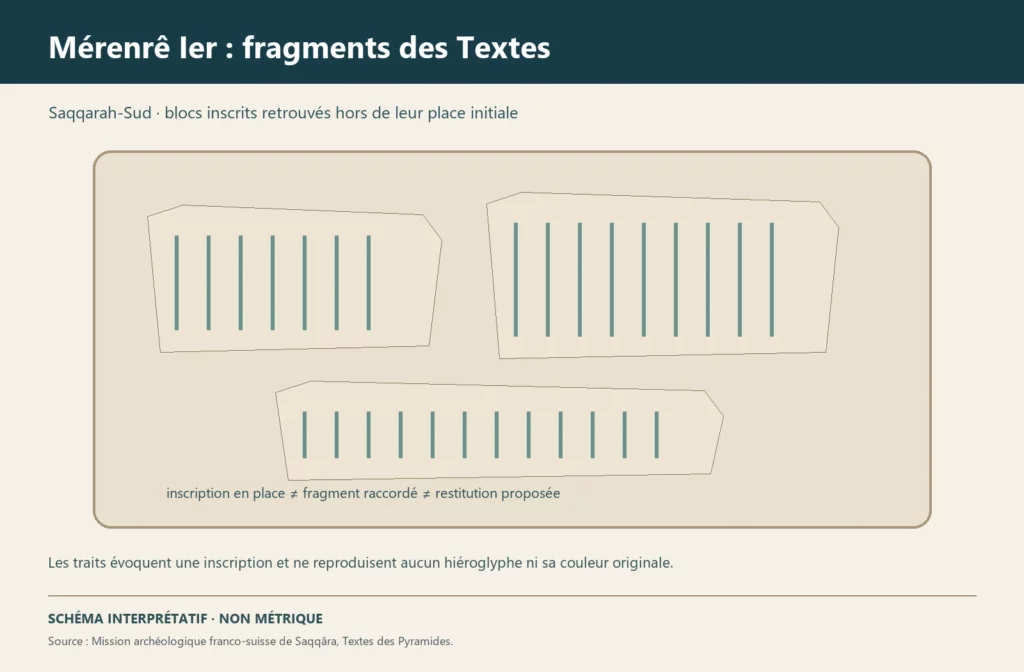
The main interest of the pyramid is epigraphic and architectural. The spells on its walls complement those of the other pyramids with texts at Saqqara and show that the corpus was not reproduced mechanically from one king to the next. The thousands of scattered blocks have made it possible to reconstruct sections of the decoration, but they require a distinction between inscription in place, joined fragment and proposed reconstruction. The external architecture, less well preserved, must not be illustrated as a fully documented whole.
Monuments and remains
The entrance descended to a system of passages and chambers beneath the pyramidal mass. The antechamber and the burial chamber belonged to the inscribed programme. The walls retained carved texts, while many of the wall stones had been moved or broken. The fragments collected from the rubble are direct documentation, but their original position has to be established by studying the joins and the sequences of spells. The remains of the mortuary temple to the east are incomplete.
Chronology and building phases
The pyramid was opened at the end of 1880 on the orders of Auguste Mariette; Heinrich Brugsch entered it in early 1881, then Gaston Maspero recorded the inscriptions. The French Archaeological Mission at Saqqara returned to the monument from 1970–1971. Jean Leclant and Jean-Philippe Lauer continued the clearance until 1974, then in seasons from 1976 to 1980. The team consolidated the structures as it went, to prevent collapses. These modern stages have transformed access and the documentation available; they must not be confused with the ancient phases of the building work.
History and functions
The pyramid was the royal tomb, associated with rites and offerings for Merenre in his posthumous existence. The Pyramid Texts formulated protections, transformations and divine journeys. The mission reports about 627 identified spells, plus 51 newly catalogued passages. These numbers reflect the state of research and the definition of textual units, not a raw count of blocks. The parallels with Pepi I and with other owners shed light on the transmission of the corpus without erasing the choices of Merenre’s own programme.
Excavations and the history of research
The Saqqara team drew and analysed more than two thousand fragments. In 2019 Isabelle Pierre-Croisiau published with the IFAO the facsimiles of the inscribed walls, in 34 plates. This edition provides a verifiable basis for the proposed reconstructions, supplemented by the excavation descriptions and observation of the monument. Photographs and surveys must be compared when a stone was moved, kept elsewhere or put back in place. The present location of a block is not necessarily its original position.
State of preservation and research questions
The poor state of the superstructure and the danger of collapse have marked the history of the excavations. The conservation and study of the carved surfaces call for careful reading of the breaks, of any reuse and of the joins.
Sources
Main sources: French-Swiss Archaeological Mission at Saqqara, ‘Textes des Pyramides’ (in French), https://www.unige.ch/mafssaqqara/textes-des-pyramides; Institut français d’archéologie orientale, I. Pierre-Croisiau, ‘Les textes de la pyramide de Mérenrê’ (in French), https://www.ifao.egnet.net/publications/catalogue/9782724707243/; University College London, ‘King Merenre’, https://www.ucl.ac.uk/museums-static/digitalegypt/chronology/kingmerenre.html (consulted on 27 September 2026).