Identification and location
The funerary complex of Ankhesenpepi II occupies the south-western part of the royal necropolis of Pepi I at South Saqqara. The queen was successively the wife of Pepi I and of Merenre I, then the mother of Pepi II. The French-Swiss Archaeological Mission presents her as regent during her son’s youth. Her monument, built in the context of these dynastic ties, is the most extensive in the necropolis after the king’s. A single date should not, however, be attributed to all its architectural phases and to all the surrounding tombs.
General presentation
The complex is remarkable for its size, its cult programme and the presence of Pyramid Texts for a royal woman. The inscriptions in the burial chamber and the many stones recovered make it possible to study how a corpus first attested in kings’ pyramids was used for a queen. The architecture reveals an elaborate offering arrangement and an organisation of stores. Comparison with the more modest complexes of Nubunet or Inenek-Inti shows a difference of status and means, without justifying a simplistic hierarchy based on the width of the pyramid alone.
Monuments and remains
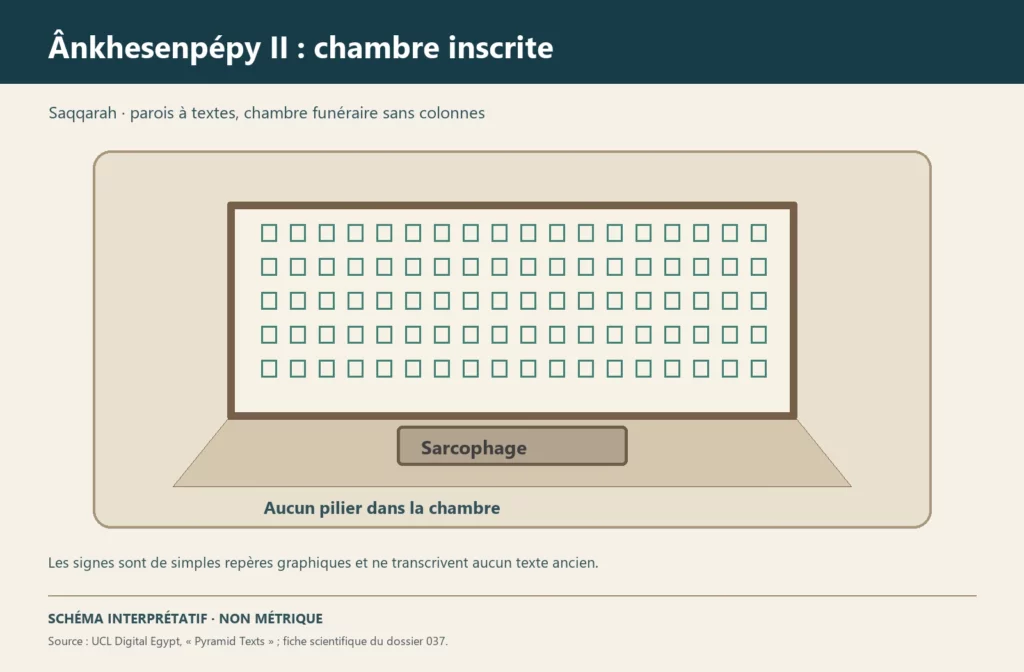
The pyramid measures 31.40 metres a side according to the mission’s surveys. The outer temple is laid out on a north–south axis; it gives access to a series of twenty comb-like storerooms and to a vast porticoed court. Two doors in the southern corners of this court lead to the pyramid enclosure and to the inner temple. The latter comprises a hall of niches, a square antechamber and an offering hall flanked by a storeroom. A separate court serves the satellite pyramid. Beneath the pyramid, the funerary apartments held a sarcophagus and had inscribed walls.
Chronology and building phases
The queen belongs to the end of the 6th Dynasty, at the turn of the reigns of Pepi I, Merenre and Pepi II. Her sarcophagus calls her ‘king’s mother’, direct proof of her dynastic role. The mission’s first discoveries of fragments of Pyramid Texts date from February 2000. The seasons of 2000 to 2003, 2008 to 2010 and 2016 brought together nearly 1,400 inscribed blocks. The reconstruction of the walls proceeds by studying and matching these fragments, not by observing decoration fully preserved in place.
History and functions
The outer temple, its storerooms and the court organised access and the preparation and presentation of offerings. In the chamber, the spells aimed at the continuity of the queen’s existence after her death. The team estimates that about 365 spells originally appeared in the funerary apartments. Many repeat versions known from the pyramid of Pepi I; a few are new or attested elsewhere in the pyramid of Merenre. The inscriptions, the sarcophagus and the architectural programme complement one another, but they do not directly tell of the political decisions of the regent.
Excavations and the history of research
The documentation comes from the excavations of the French-Swiss Archaeological Mission and from the detailed study of the blocks. The facsimile edition of the texts of Ankhesenpepi II, published by the Institut français d’archéologie orientale (IFAO, French Institute of Oriental Archaeology) in 2024 under the direction of Bernard Mathieu, provides a working basis for reading the spells. The mission’s presentation gives the route through the complex and its main measurements. The IFAO also publishes views and an overview of the necropolis. General images must be compared with the plans and publications to locate a relief or a text fragment exactly.
State of preservation and research questions
Much of the decoration is known from displaced blocks. Each proposed reassembly depends on joins, on former positions and on comparisons, with different degrees of certainty.
Sources
Main sources: French-Swiss Archaeological Mission at Saqqara, ‘Les reines de Pépy Ier’ (in French), https://www.unige.ch/mafssaqqara/fouilles/reines-pepy-ier; ‘Textes des Pyramides’ (in French), https://www.unige.ch/mafssaqqara/textes-des-pyramides; Institut français d’archéologie orientale, ‘Saqqara’ (in French), https://www.ifao.egnet.net/recherche/archeologie/saqqara/ (consulted on 27 September 2026).